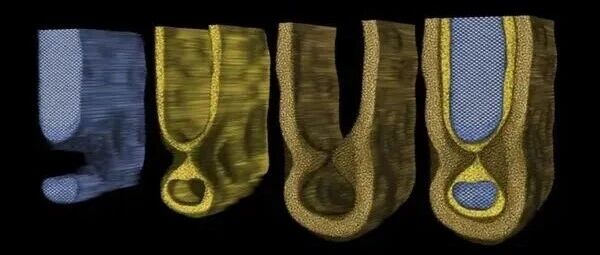
高分辨率3D电子叠影成像技术(ptychography)

Search documents
半导体重大突破!“鼠咬”缺陷首现,成像技术改写高端芯片研发
是说芯语· 2026-03-04 08:23
Core Insights - The article discusses a significant breakthrough in semiconductor imaging technology achieved by Cornell University in collaboration with TSMC and ASM, which allows for the first-time observation of atomic-level "mouse bite" defects in chips using high-resolution 3D electron ptychography [1][4]. Group 1: Understanding "Mouse Bite" Defects - "Mouse bite" defects refer to atomic-level roughness at the Si/gate oxide interface of transistors, which can slow down electron flow, impacting chip performance [4]. - As chip technology advances to 3nm and below, the impact of these microscopic defects is magnified, with transistor channel widths being only 15 to 18 atoms wide, making any structural deviation potentially detrimental [4]. Group 2: Technological Advancement - The core of this breakthrough is the electronic ptychography imaging technology, combined with Cornell's EMPAD electron microscope pixel array detector, which has set a Guinness World Record for precision [5]. - Previously, the industry relied on 2D projection images for defect observation, which was indirect and imprecise, leading to time-consuming trial-and-error processes [5][6]. Group 3: Implications for Chip Development - This technology allows engineers to observe atomic-level defects in real-time after each critical process step, enabling precise adjustments to process parameters and significantly reducing R&D cycles [8]. - The ability to directly observe defects is expected to enhance yield rates, particularly for advanced processes where defect impacts are exponentially magnified, with TSMC planning to integrate this technology into its advanced process development [8]. Group 4: Future Prospects - The collaboration between Cornell, TSMC, and ASM exemplifies a successful model of industry-academia partnership, facilitating rapid technology application to address industry challenges [9]. - Although still in the early stages of development, the technology aims to expand its application to other atomic-level defects and improve chip reliability, addressing the growing demands of AI and high-performance computing [9].