高纯纳米碳纤维(单晶碳纳米管)CNTp

Search documents
东方材料亏损背后,接连跨界暗藏风险
Xin Lang Cai Jing· 2026-02-10 00:13
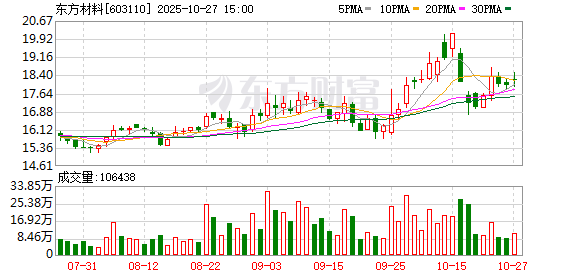
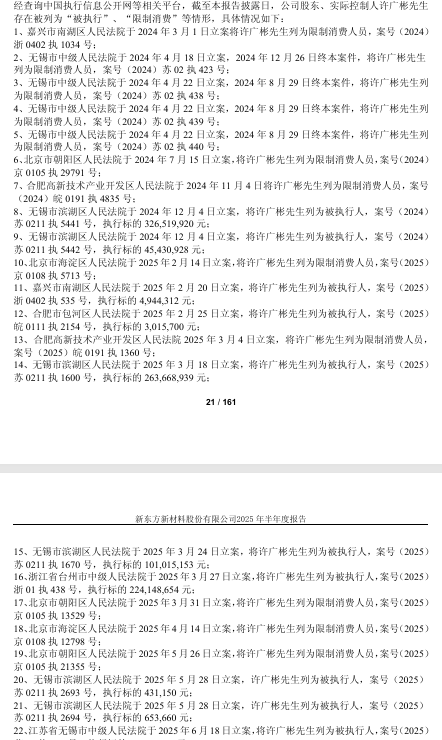
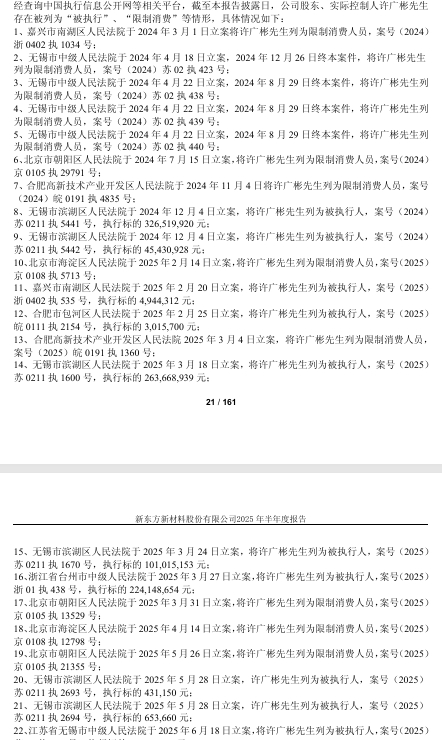
Core Viewpoint - 2025 is a tumultuous year for Dongfang Materials (603110.SH), marked by the loss of control by its actual controller Xu Guangbin due to debt issues, a significant drop in shareholding, and a new shareholder's violation of commitments, alongside declining revenues and profits in its core business of inks and adhesives, leading to an expected annual loss [1][21]. Shareholder Changes - Xu Guangbin's debt crisis has led to a drastic reduction in his shareholding from 13.54% to 1.34%, resulting in the loss of his position as the largest shareholder [3][5]. - Xu has been involved in 22 instances of judicial enforcement and consumption restrictions, severely impacting the company's operational stability and market confidence [3][23]. - The new shareholder, Jiangsu Teliang New Materials Technology Co., Ltd., acquired 12 million shares (5.96% of total shares) through judicial auction but violated a commitment not to increase or decrease holdings within 12 months shortly after the acquisition [6][26]. Business Performance - Dongfang Materials' core business of inks and adhesives, which accounts for over 90% of revenue, is facing significant challenges due to industry downturns and intense competition, leading to declining revenues and profits [11][29]. - For the first three quarters of 2025, the company reported revenues of 279 million yuan, a year-on-year decline of 7.41%, and a net profit attributable to shareholders of 3.19 million yuan, down 75% year-on-year [30]. - The company anticipates a net loss of 5.94 million to 7.11 million yuan for the entire year of 2025, a stark contrast to a net profit of 13.96 million yuan in 2024 [12][30]. Cross-Industry Ventures - In response to the pressures on its core business, Dongfang Materials has attempted to diversify into new areas, including the AI-driven computing power sector and investments in nanocarbon materials, but these efforts have been controversial and unprofitable [13][20]. - The computing power business, managed by two subsidiaries, reported combined revenues of only 13.16 million yuan with significant operating losses, indicating a lack of profitability [14][32]. - The investment in the nanocarbon materials company, which has a high debt ratio and has reported continuous losses, raises concerns about the viability and risk of such ventures [19][36].


财说丨东方材料亏损背后,接连跨界暗藏风险
Xin Lang Cai Jing· 2026-02-10 00:06
Core Viewpoint - 2025 is a tumultuous year for Dongfang Materials (603110.SH), marked by significant ownership changes, financial struggles, and operational challenges, leading to a projected annual loss [1][8]. Ownership Changes - The actual controller Xu Guangbin's shareholding plummeted from 13.54% to 1.34% due to debt issues, resulting in the loss of his status as the largest shareholder [3][4]. - Xu Guangbin faced 22 instances of judicial enforcement and consumption restrictions, severely impacting the company's stability and market confidence [1][3]. - New shareholder Teliang, after acquiring shares through judicial auction, violated a commitment not to increase or decrease holdings within 12 months, prompting regulatory scrutiny [5][6]. Financial Performance - Dongfang Materials' core businesses, ink and adhesive products, which account for over 90% of revenue, are suffering from industry downturns, leading to declining revenue and profits [8][9]. - For the first three quarters of 2025, the company reported revenue of 279 million yuan, a year-on-year decline of 7.41%, and a net profit of 3.19 million yuan, down 75% [9]. - The company anticipates a net loss of 5.94 million to 7.11 million yuan for the entire year of 2025, a stark contrast to a profit of 13.96 million yuan in 2024 [9][10]. Operational Challenges - Despite declining revenue, sales expenses increased by 10.55% to 24.67 million yuan in the first three quarters of 2025, indicating a misalignment in cost management [9][10]. - The company has not effectively optimized its product structure or improved technology, instead relying on cross-industry ventures that have not yielded positive results [10][11]. Cross-Industry Ventures - Dongfang Materials attempted to pivot into the AI and computing power sectors, but these efforts have not generated significant returns, leading to operational losses [11][12]. - The company invested 18 million yuan in a high-risk nanocarbon material firm, which has been consistently losing money and has a high debt ratio, raising concerns about its viability [14][15].
标的尚亏损,为何仍跨界投资?东方材料回复上交所问询
Mei Ri Jing Ji Xin Wen· 2025-10-27 14:32
Core Viewpoint - The company Oriental Materials announced a cross-industry investment plan involving a total of 48 million yuan, which includes an investment of 18 million yuan in Suzhou First Element Nanotechnology Co., Ltd. and the establishment of a joint venture named Carbon Nest Technology (Tengzhou) Co., Ltd. [2] Investment Details - The investment consists of a convertible debt of 18 million yuan, which can be converted into equity under certain conditions, and a direct investment of 30 million yuan in the joint venture, giving Oriental Materials a 30% stake [2][5] - The joint venture has a registered capital of 100 million yuan, with First Element contributing 40% through intellectual property or cash [2] Financial Performance of First Element - First Element reported cumulative losses exceeding 5.4 million yuan from 2024 to the first half of 2025, with projected revenues of 10.5 million yuan and a net loss of 4.15 million yuan for 2024, and revenues of 4.73 million yuan with a net loss of 1.32 million yuan for the first half of 2025 [3] Business Rationale - The Shanghai Stock Exchange questioned the commercial rationale behind investing in a loss-making asset, highlighting the significant differences between the core businesses of Oriental Materials and First Element [3] - Oriental Materials defended the investment by emphasizing First Element's status as a national high-tech enterprise and its core product, high-purity carbon nanofibers, which have applications in various battery technologies [3][4] Production Capacity and Market Potential - First Element's subsidiary has a production capacity of 4.67 tons of carbon nanofiber powder and 65.5 tons of carbon nanofiber slurry for 2024 [3] - The joint venture aims to produce 1,000 tons of conductive slurry and 30 million square meters of CNTp-3D current collectors, which is expected to enhance the competitiveness of China's battery industry [7] Shareholder and Management Background - The joint venture includes a former executive of Oriental Materials, who has relevant experience and management capabilities, although the company clarified that there are no conflicts of interest [6] - The intellectual property contributed by First Element has not yet been evaluated for its value [6] Future Risks - The company acknowledged potential risks, including the possibility that First Element may face financing challenges, which could hinder the conversion of debt to equity [7]