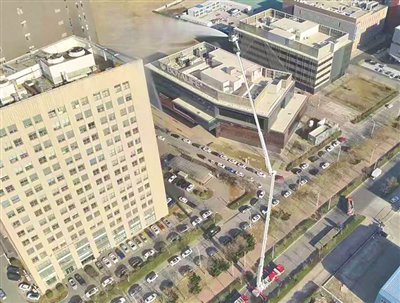
101米登高平台消防车

Search documents
高层起火别慌张 合理“避烟”最关键
Xin Lang Cai Jing· 2025-12-24 22:54
高层火灾蔓延速度快、救援难度大,一旦发生,可能造成严重的人员伤亡和财产损失。近日,天津经济 技术开发区消防救援支队组织开展高层建筑火灾事故处置实战演训,检验101米登高平台消防车等车辆 装备性能。同时,提醒市民主动学习掌握高层建筑火灾逃生常识。 演训假设位于滨海新区洞庭路的天津国际生物医药联合研究院主体建筑外立面保温材料起火。接到报警 后,天津经济技术开发区消防救援支队第一时间调集辖区消防救援站101米登高平台消防车编队到场处 置。演训中,登高平台工作斗顺利攀升至99米预设作业高度,全流程演示水炮对建筑外墙立面进行全覆 盖、无死角冷却、灭火,真实模拟了阻截外墙火势垂直蔓延的实战场景。 "高层起火往上跑还是往下跑?""家门口有烟能不能开门?"成为近期市民关注的焦点。天津经济技术开 发区消防救援支队十一大街消防救援站站长李善鹏介绍,着火时,浓烟的竖向传播速度远超过成年人爬 楼梯的速度,因浓烟会沿楼梯间或其他竖向管井快速向上扩散,原本用于疏散逃生的楼梯间,可能变成 致命的"危险通道",盲目逃生很容易引发吸入浓烟窒息中毒死亡风险。据统计,高层火灾中70%伤亡源 于吸入有毒浓烟,而非火焰烧伤,因此,"躲烟"是选择逃生方 ...

无人机、外骨骼加速应用,竞争高空消防赛道仍存难点
Di Yi Cai Jing· 2025-12-10 14:00
Core Viewpoint - The integration of technology in firefighting, particularly for high-rise buildings, is transitioning from training exercises to real-world applications, with various innovative products being deployed to enhance emergency response capabilities [1][2]. Group 1: Technological Advancements - Companies like Zhongke Xingtou and Jiechuang Intelligent are developing and deploying advanced firefighting technologies, including drones and exoskeletons, to improve efficiency and effectiveness in emergency situations [1][4]. - The use of unmanned aerial vehicles (UAVs) and robotic systems, such as "machine dogs," is becoming more prevalent in firefighting operations, providing real-time monitoring and support for rescue teams [2][3]. Group 2: Practical Applications - In practical scenarios, such as the fire drills conducted by Jiangsu and Guangdong fire rescue teams, new technologies like drones and exoskeletons have been successfully utilized to enhance situational awareness and operational efficiency [2][3]. - The exoskeleton equipment has been recognized for significantly reducing the physical strain on rescue personnel, allowing them to perform their duties more effectively in challenging environments [3][4]. Group 3: Market Trends - The market for exoskeleton devices is rapidly expanding, with increasing interest from various sectors, including emergency services, although the adoption in industrial and emergency contexts is still in its early stages [4]. - Companies are actively seeking to adapt existing exoskeleton technologies for specialized environments, indicating a growing demand for innovative solutions in emergency response [4]. Group 4: Challenges and Limitations - Despite advancements, there are still significant challenges in the practical application of these technologies, such as the operational limitations of high-altitude firefighting equipment and the need for further development of exoskeletons to meet specific rescue requirements [6][7]. - The effectiveness of drones in high-temperature environments poses a technical challenge, as their operational stability can be compromised under extreme conditions [6][7].