
256通道高通量柔性脑机接口

Search documents
2025年中国脑机接口行业细分产品市场分析 非侵入式脑机接口是市场上最为普遍的消费级设备【组图】
Qian Zhan Wang· 2026-02-24 06:11
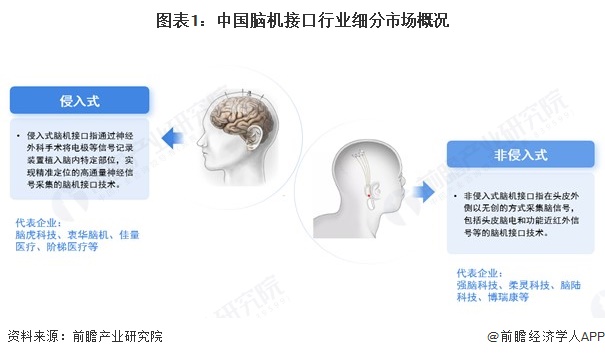
Group 1 - The core viewpoint of the article highlights the development prospects and investment opportunities in the brain-computer interface (BCI) industry, particularly focusing on the segmentation of the market into invasive and non-invasive categories [1][9]. - The invasive BCI market is still in its early stages compared to the non-invasive market, primarily due to higher technical requirements and fewer companies involved in development [7][9]. - The article identifies key companies in the invasive BCI sector, such as JieTi Medical, which is set to complete its first human clinical trial by March 2025, and Brain Tiger Technology, which has achieved significant milestones in motion decoding experiments [8][9]. Group 2 - Invasive BCIs offer advantages such as precise measurement of neuronal impulses, high signal-to-noise ratio, and high resolution, but they also come with disadvantages like the risk of immune response and surgical trauma [5]. - The capital focus on invasive BCI has increased significantly, with financing share rising from 7% (2015-2019) to 44% (2020-2023), although it is expected to decrease to 27% in 2024-2025 [9]. - Non-invasive BCIs are the most common consumer-grade devices in the market, with numerous companies like QiangNerve Technology and RouLing Technology leading in this segment [11][12].

中美脑机接口创新、实验频获突破,推动相关产业迎来高增长
Jin Rong Jie· 2026-02-24 02:58
Group 1 - The research team from Northwestern Polytechnical University has successfully completed the first in-orbit verification of brain-computer interface (BCI) technology in China, demonstrating stable collection of brain signals in extreme space environments [1] - The BCI product developed by the team shows significantly reduced noise levels compared to traditional metal electrodes, enhancing stability and potential for clinical multimodal imaging monitoring [1] - Clinical trials of BCI technology are advancing in China, with patients able to control devices through thought after minimal invasive procedures [1] Group 2 - As of the end of 2025, there will be over 800 brain-computer interface companies globally, with more than 25% based in China, and the medical health application sector accounting for 56% of the market [2] - The investment scale in the BCI sector is approaching $10 billion, indicating a critical phase in the technological revolution of "human-machine collaboration" [2] - McKinsey predicts that the global market for medical applications of brain-computer interfaces will reach $40 billion by 2030 and expand to approximately $145 billion by 2040, with China's market potentially exceeding 120 billion yuan by 2040 [2]