
超柔性微创植入式脑机接口系统

Search documents
2025年中国脑机接口行业细分产品市场分析 非侵入式脑机接口是市场上最为普遍的消费级设备【组图】
Qian Zhan Wang· 2026-02-24 06:11
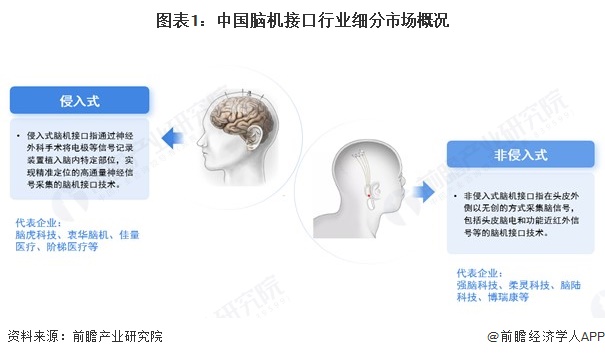
Group 1 - The core viewpoint of the article highlights the development prospects and investment opportunities in the brain-computer interface (BCI) industry, particularly focusing on the segmentation of the market into invasive and non-invasive categories [1][9]. - The invasive BCI market is still in its early stages compared to the non-invasive market, primarily due to higher technical requirements and fewer companies involved in development [7][9]. - The article identifies key companies in the invasive BCI sector, such as JieTi Medical, which is set to complete its first human clinical trial by March 2025, and Brain Tiger Technology, which has achieved significant milestones in motion decoding experiments [8][9]. Group 2 - Invasive BCIs offer advantages such as precise measurement of neuronal impulses, high signal-to-noise ratio, and high resolution, but they also come with disadvantages like the risk of immune response and surgical trauma [5]. - The capital focus on invasive BCI has increased significantly, with financing share rising from 7% (2015-2019) to 44% (2020-2023), although it is expected to decrease to 27% in 2024-2025 [9]. - Non-invasive BCIs are the most common consumer-grade devices in the market, with numerous companies like QiangNerve Technology and RouLing Technology leading in this segment [11][12].

脑机接口,重大突破!
证券时报· 2026-02-07 13:12
Core Viewpoint - The article highlights significant advancements in brain-machine interface (BMI) technology in China, showcasing breakthroughs in flexible electrode arrays and clinical applications, indicating a growing investment interest and market potential in this field [1][4][6]. Group 1: Technological Breakthroughs - A research team from Northwestern Polytechnical University has developed a three-dimensional conical carbon-based flexible cortical electrode array, addressing key issues such as brain tissue damage and poor biocompatibility, and achieving international space environment technology validation [1]. - The electrode shows hundreds of times improvement in key performance metrics compared to traditional metal electrodes, ensuring long-term safety and stability for clinical applications [1]. - The article notes that 2025 is referred to as the "year of the brain-machine interface" in China, with multiple clinical trials and innovations being reported [2]. Group 2: Investment and Market Growth - Investment enthusiasm in the BMI sector has surged, with 24 financing events recorded from January to November 2025, marking a 30% year-on-year increase, and total financing exceeding 10 billion yuan over the past five years [4]. - The "14th Five-Year Plan" has identified brain-machine interfaces as one of six future industries, indicating a strategic focus on this technology as a new engine for economic growth [4]. - The BMI market in China was valued at 3.2 billion yuan in 2024, with an 18.8% year-on-year growth, projected to reach 5.58 billion yuan by 2027, reflecting a 20% growth rate [6]. Group 3: Clinical Applications and Innovations - Ming Vision Brain Machine Technology has introduced an implantable BMI visual reconstruction system, offering new possibilities for visually impaired patients [5]. - The second invasive BMI clinical trial has achieved significant progress, transitioning from 2D screen control to 3D physical world interaction [5]. - Shanghai Brain Tiger Technology has successfully completed the first clinical trial of a fully implanted, wireless, and functional BMI product, emphasizing the technology's potential to connect life and hope [5]. Group 4: Stock Market Performance - Several BMI-related stocks have experienced significant declines, with 14 stocks showing over a 20% drop from their highs, including HaiGe Communication and PuLiTe [6][7]. - In terms of profit forecasts for 2025, nine BMI-related stocks are expected to see net profit growth, with notable increases for companies like BeiLu Pharmaceutical and LePu Medical [8].

脑机接口产业迎来“黄金发展期” 三大技术路线并行发展
Ke Ji Ri Bao· 2026-01-05 01:30
Core Insights - The brain-computer interface (BCI) industry is entering a "golden development period," characterized by significant advancements from laboratory innovations to clinical applications [1][2][3] Group 1: Technological Advancements - In 2025, significant milestones were achieved in BCI technology, including the first clinical trials of flexible micro-invasive BCI systems and the first intervention-assisted trials for restoring limb function [2][3] - Three main technological routes are developing in parallel: invasive, semi-invasive, and non-invasive techniques, with invasive methods being central to medical rehabilitation due to their high signal acquisition precision [3][4] - The semi-invasive BCI system developed by Borui Kang Technology requires only a small hole in the skull for implantation, allowing patients to control movements through thought [4] Group 2: Clinical Applications and Breakthroughs - Clinical breakthroughs include the successful restoration of walking in patients with severe spinal cord injuries through innovative BCI technologies [3][4] - A variety of new BCI applications are emerging, such as a visual reconstruction system for visually impaired patients and a wireless, fully implanted BCI product that has completed its first clinical trial [10][11] Group 3: Industry Growth and Policy Support - The establishment of pricing regulations for BCI services by the National Medical Insurance Administration marks a significant step in integrating this technology into public healthcare [6][8] - Various regions, including Shanghai and the Guangdong-Hong Kong-Macau Greater Bay Area, are forming BCI innovation clusters to enhance industry capabilities and foster collaboration among enterprises, hospitals, and research institutions [7][8] Group 4: Future Prospects - Experts predict that 2026 will be a pivotal year for the BCI industry, with advancements in multi-disciplinary integration, clinical scalability, and diverse application scenarios [9][10] - The anticipated mass production of certain BCI devices will pave the way for a diversified application ecosystem, enhancing the potential for widespread commercial use [10][11]
脑机接口产业迎来“黄金发展期”
Huan Qiu Wang Zi Xun· 2026-01-05 01:28
Core Insights - The article highlights the rapid advancements in brain-computer interface (BCI) technology in China, showcasing significant clinical achievements and the emergence of a collaborative ecosystem for innovation in this field [1][5][10] Group 1: Clinical Breakthroughs - Patients with paralysis have shown remarkable recovery, such as playing games like "Snake" and "Mario Kart" through thought control, demonstrating the potential of BCI technology [1] - In 2025, several pioneering clinical trials were conducted, including the world's first intervention-assisted BCI for restoring limb function and the first clinical implantation of domestically developed BCI chips [2][3] - Invasive, semi-invasive, and non-invasive BCI technologies are developing concurrently, with invasive methods providing high signal accuracy and non-invasive methods expanding into broader markets due to lower costs [3][4] Group 2: Technological Advancements - The semi-invasive BCI system NEO has been developed, requiring only a small hole in the skull for implantation, allowing patients to control movements through thought [4] - Significant breakthroughs in core components and decoding algorithms have been achieved, enhancing the stability and precision of BCI devices [4] Group 3: Industry Development - The establishment of pricing regulations for BCI services by the National Medical Insurance Administration marks a significant step towards integrating this technology into healthcare [5] - A national BCI industrial cluster is forming, with various regions, including Shanghai and Jiangxi, actively promoting BCI innovation and development [6][7] Group 4: Future Prospects - Experts predict that 2026 will be a pivotal year for the BCI industry, characterized by multi-disciplinary integration and diverse application scenarios [8] - Recent innovations, such as a visual reconstruction system for visually impaired patients and a fully implanted wireless BCI, indicate a trend towards practical applications of BCI technology [9][10]