4G Cat 1 bis

Search documents
全球智能仪表安装量将在 2030 年前突破 30 亿台,应用加速普及
Counterpoint Research· 2025-11-13 01:34
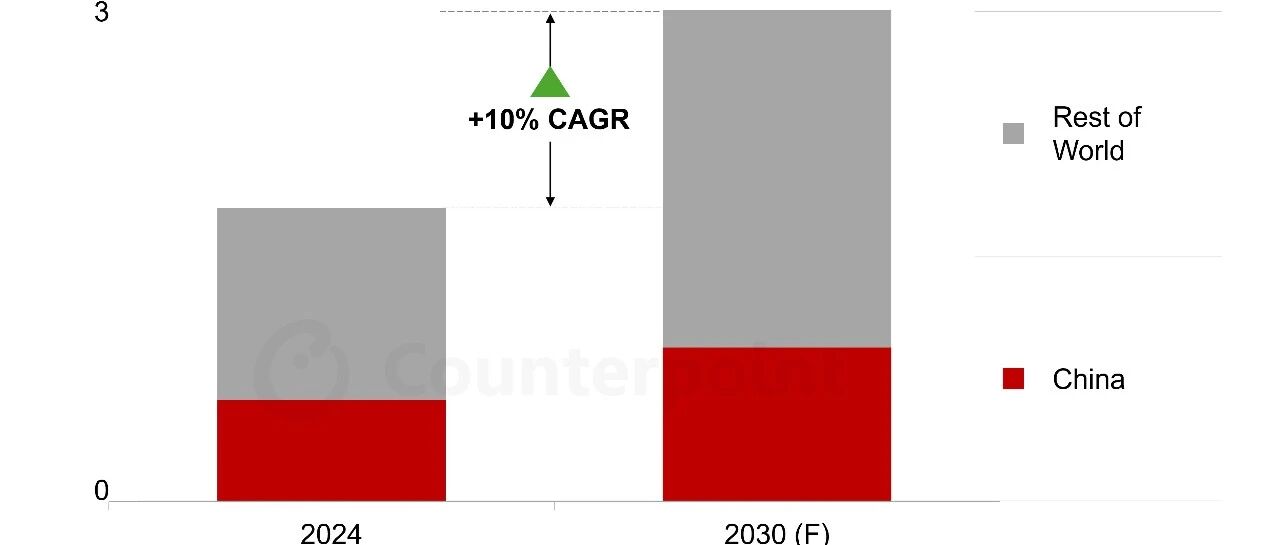
Core Insights - The global smart meter installation is projected to exceed 1.8 billion units by the end of 2024, with a compound annual growth rate (CAGR) of 10%, expected to surpass 3 billion units by the end of 2030, driven by grid modernization and regulatory policies [4][5]. Market Dynamics - North America has the highest penetration rate of smart electric meters at approximately 81% by the end of 2024, with China and Europe also showing high adoption rates. In contrast, regions like Latin America, Africa, and South Asia present significant growth opportunities due to their lower penetration rates [5][9]. - Smart electric meters currently dominate the market, with continued growth expected in regions where their adoption is still low. In developed areas with established infrastructure, smart water and gas meters are anticipated to see earlier growth, particularly after 2027 in emerging economies [5][9]. Technological Trends - The smart meter market is rapidly evolving in terms of connectivity technologies, transitioning from traditional power line communication (PLC) and RF Mesh networks to low-power wide-area network (LPWA) technologies, including NB-IoT and LTE-M. This shift is expected to increase the share of cellular connections, particularly 4G Cat 1 bis, NB-IoT, and LTE-M, which will become mainstream choices [8][9]. - By 2030, it is estimated that nearly two-thirds of new smart meters will utilize cellular communication technologies, especially in remote or large-scale deployment environments [9]. Regional Insights - Chinese smart meter manufacturers are leading the adoption of 4G Cat 1 bis technology, leveraging its cost-effectiveness and performance balance. Key players include Sanxing Electric, Holley Technology, Jiangsu Linyang Energy, Suntron Technology, and GoldCard Smart Group, with expectations for continued leadership in 4G Cat 1 bis deployment [9]. Research Reports - Counterpoint Research offers detailed reports on the global smart meter market, analyzing trends, growth drivers, and competitive landscapes from 2022 to 2030, covering over five regions and more than 15 leading brands [10].

Counterpoint Research:受益新兴市场需求拉动 2025年Q1蜂窝物联网模组出货量同比增长16%
智通财经网· 2025-06-19 03:05
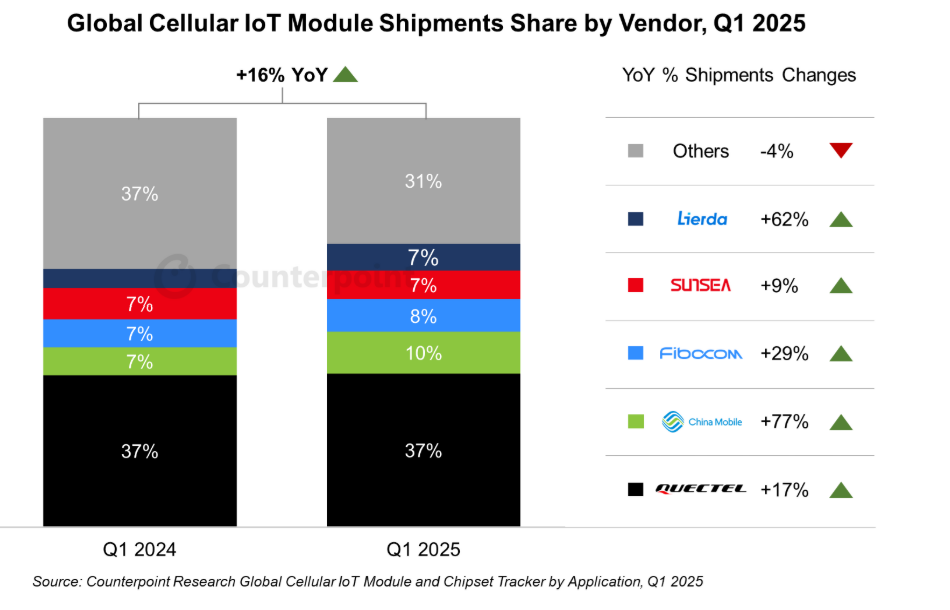
Core Insights - The global cellular IoT module shipments are expected to continue their growth trend, with a year-on-year increase of 16% in Q1 2025, driven by strong demand in India, China, and Latin America for smart meters, POS terminals, and asset tracking [1] - India leads the growth with a remarkable 32% year-on-year increase, while North America and some Asia-Pacific markets experience a decline due to weak demand and macroeconomic headwinds [1] - 5G technology is the fastest-growing segment, with a year-on-year growth of 37%, followed closely by Cat 1 bis technology, which also shows strong growth at 35% [1] Market Dynamics - China maintains its leadership in the global IoT module market with a 19% year-on-year growth, supported by the adoption of 5G and Cat 1 bis technologies in various sectors [1] - The average selling prices of modules and chips are decreasing, leading to increased price pressure from Chinese competitors, prompting companies to seek breakthroughs in higher-margin areas [4] - Qualcomm remains the leader in the chip market, with ASR and UNISOC following in second and third place, respectively [5] Manufacturer Performance - Quectel retains the top position in global cellular IoT module shipments, with China Mobile and Fibocom following closely, collectively accounting for over 50% of global shipments [4] - China Mobile's market share has surpassed double digits due to strong domestic demand for 4G Cat 1 bis modules [4] - u-blox has exited the cellular IoT module business to focus on its core strengths in GNSS and short-range connectivity [4] Future Outlook - The cellular IoT module market is expected to grow steadily in 2025, driven by demand for smart interconnected devices, asset tracking, and automotive applications in emerging markets [6] - Geopolitical tensions, strategic adjustments by manufacturers, and supply chain dynamics may constrain growth [6] - Chinese manufacturers are likely to maintain their global dominance, while Western manufacturers may benefit from demand recovery and easing geopolitical tensions [6]