
AI智算交换机

Search documents
星融元完成新一轮融资,厦门联合、湖南财信出手
Sou Hu Cai Jing· 2026-01-16 04:14
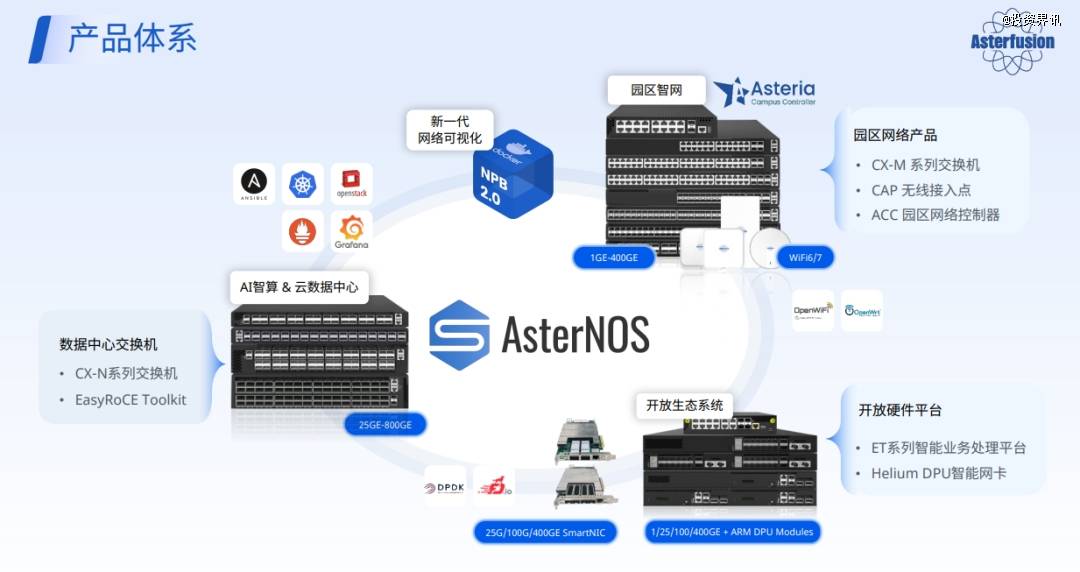
Group 1 - Asterfusion has completed a new round of financing, with investments from Xiamen United and Hunan Caixin, alongside historical investors such as Huaye Tianc, Shanghai Jinpu, and Shenzhen High-tech Investment [1] - The company has established a core technology system focused on "cloud-network integration and open decoupling," aiming to provide full-stack network solutions for IT infrastructure in the AI era [1] - Asterfusion offers neutral and open network connectivity capabilities that are application scenario-centered and intelligently optimized for operational cost management [1] Group 2 - Asterfusion has developed a rich product matrix covering data centers, cloud/intelligent computing centers, and wide-area network edges [3] - The latest generation of Asterfusion's AI Fabric high-performance network solutions has been deployed at scale with several leading clients, effectively supporting stable and efficient operation of AI clusters at thousands to tens of thousands of nodes [3] - The company provides a range of products including network operating systems, data center switches, AI computing switches, campus switches, DPU network cards, P4 programmable hardware platforms, and network visualization products [3]

AI成民营银行下一个十年的 关键变量
Di Yi Cai Jing· 2025-07-30 00:29
Core Viewpoint - The overall performance of private banks in China is under significant pressure, with a notable decline in net profits and increasing asset quality issues, while AI technology is seen as a potential key to future growth and differentiation in the industry [1][4]. Group 1: Industry Performance - In 2024, 19 private banks reported a total net profit of 18.776 billion yuan, a year-on-year decline of 8.14% [1]. - The net interest margin remained relatively high at 4.11%, but narrowed by 0.28 percentage points during the year [1]. - The non-performing loan ratio rose to 1.66%, reaching a historical high, while the provision coverage ratio fell to a near four-year low [1][3]. Group 2: Market Segmentation - The private banking sector has experienced significant "dumbbell-shaped" differentiation, with leading institutions like WeBank and MYbank leveraging strong shareholder ecosystems and technological advantages to capture market resources [2]. - As of the end of 2024, WeBank and MYbank had total asset sizes of 651.776 billion yuan and 471.035 billion yuan, respectively, while most private banks remained below 100 billion yuan in total assets [2]. - Many smaller banks are facing shrinking survival space, with some reporting revenue growth but declining profits [2][3]. Group 3: Technological Transformation - AI technology is viewed as a critical variable for the transformation of private banks, with a shift from scale expansion to in-depth customer engagement being necessary [4][5]. - WeBank announced its transition to an AI-native bank, developing a three-layer AI capability system integrated into its financial operations [5]. - MYbank is focusing on the productization of AI, creating tailored AI solutions for small and micro enterprises, significantly enhancing operational efficiency [5]. Group 4: Challenges and Regulatory Environment - Some smaller private banks are struggling with technological capabilities due to over-reliance on third-party platforms, which hampers their self-research and development efforts [6]. - Industry experts call for regulatory adjustments to provide a more conducive environment for innovation and competition among private banks [6].