
AISPEECH DFM语言计算大模型

Search documents
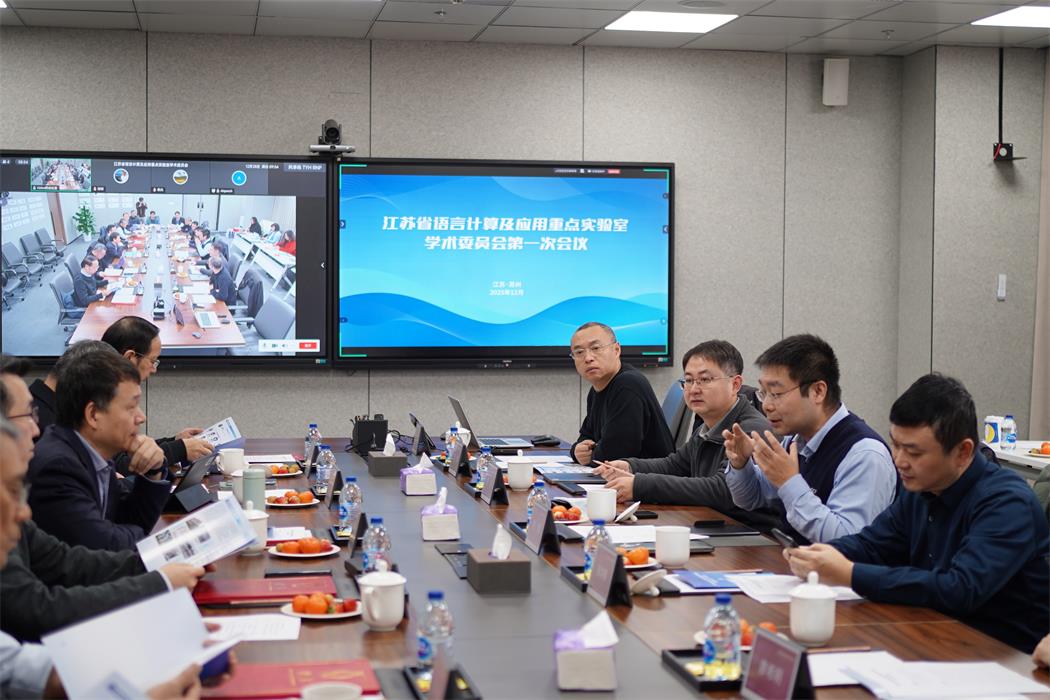
江苏省语言计算及应用重点实验室召开学术委员会第一次会议
Jiang Nan Shi Bao· 2025-12-31 07:28
Core Insights - The Jiangsu Provincial Language Computing and Application Key Laboratory has successfully held its first academic committee meeting, focusing on the transition from generative to executable AI technologies [1][3] - The laboratory aims to become a leading center for original innovation in language computing within three years, contributing to high-quality development in China's AI sector [3][12] Group 1: Laboratory Overview - The laboratory is the first AI key laboratory in Jiangsu led by a company, highlighting the province's emphasis on AI industry development and enterprise-driven technological innovation [7] - It is established in collaboration with Shanghai Jiao Tong University and Suzhou University, leveraging top-tier research resources to focus on core language computing technologies [7] - The laboratory emphasizes a "reliability-first" approach in cross-modal general intelligence, targeting key technologies such as trustworthy speech and multi-modal perception [7] Group 2: Academic Committee Insights - The academic committee, chaired by Zhang Bo, includes experts from various prestigious institutions, providing constructive feedback on the laboratory's mid-to-long-term development plans [5][9] - Experts recommend strengthening foundational research and core technology breakthroughs, particularly in multi-modal perception, agent communication, and reliability enhancement [3][9] Group 3: Industry Applications - The laboratory's AI technologies have been successfully implemented in smart travel, smart office, and smart IoT sectors, demonstrating effective integration of research and application [9][10] - In the smart travel sector, the laboratory's solutions have been adopted by major automotive brands, enhancing in-car language processing and user experience [9][10] - The smart IoT solutions have been deployed in key areas such as smart robotics and consumer electronics, collaborating with leading companies to drive industry transformation [10] Group 4: Future Directions - The laboratory plans to deepen collaboration with local universities and enterprises to accelerate the application of technological achievements in various key scenarios [3][12] - The focus will be on core technology breakthroughs and fostering high-end talent in general AI to enhance Jiangsu's competitiveness in the AI industry [7][12]

【“数”话江苏新实践④】瞧,AI大模型让多场景应用提速
Yang Zi Wan Bao Wang· 2025-12-04 12:45
Core Insights - The articles highlight the integration of advanced AI technologies into various sectors, emphasizing their practical applications in enhancing productivity and learning experiences [1][4][7]. Group 1: AI in Office and Communication - AISPEECH DFM language model enables office tools to understand dialects and automatically summarize spoken content, enhancing workplace efficiency [1]. - The AI office tool, Turbo, can transcribe meetings in real-time, generate mind maps, and filter out redundant information, achieving a significant reduction in time spent on meeting summaries [3]. - The technology supports 17 dialects and 9 foreign languages, maintaining high accuracy even in challenging environments [3]. Group 2: AI in Education - The AI classroom experience at Qingrui Intelligent Technology showcases features like pronunciation correction and intelligent essay grading, significantly improving teaching and learning efficiency [5][6]. - The Ms. Aryn AI tutor has evolved to cover multiple subjects, employing an inquiry-based approach to enhance students' core competencies [6]. - AI tools are being implemented in over 30,000 public schools across hundreds of cities, demonstrating widespread adoption and impact on educational outcomes [5]. Group 3: AI in Industrial Applications - The "Wolong Mingli" multimodal model developed by Xianwei Information Technology integrates language, vision, and predictive capabilities, supporting various industrial applications [7][8]. - The model has been successfully applied in sectors such as transportation, manufacturing, and energy, facilitating data-driven decision-making processes [8]. - A case study involving a subsidiary of China Aluminum Group illustrates the model's ability to manage extensive data types and indicators for operational efficiency [8]. Group 4: Industry Development and Future Directions - The development of large models in Jiangsu is driven by advancements in computational infrastructure, data resource aggregation, and algorithm upgrades [9]. - Recommendations for enhancing the large model industry include strengthening technological innovation, deepening industry applications, and optimizing the ecosystem for better collaboration [9].
