AlphaFold 2

Search documents
29岁哈佛学霸,1年开发出“药界ChatGPT”,OpenAI连投三轮,估值92亿
创业邦· 2025-12-21 03:09
Core Viewpoint - The article discusses the significant advancements in AI-driven drug discovery, particularly highlighting the emergence of Chai Discovery and its innovative AI models, Chai-1 and Chai-2, which are set to revolutionize the pharmaceutical industry by drastically reducing the time and cost associated with drug development [4][19][25]. Financing and Growth - Chai Discovery completed a Series B funding round on December 16, 2025, raising $130 million, bringing its post-money valuation to $1.3 billion (approximately 920 million RMB) [4][5]. - The company has raised a total of $230 million since its inception in 2024, with notable investors including OpenAI, Thrive Capital, and Menlo Ventures [5][6]. Technological Advancements - Chai Discovery aims to transform biology from a descriptive science into an engineering discipline by developing a "molecular computer-aided design suite" [4]. - The company has developed two AI models: Chai-1, which predicts and reprograms biochemical molecules, and Chai-2, which has achieved a success rate of 15%-20% in zero-shot antibody design, compared to a mere 0.1% success rate using traditional methods, marking a hundredfold efficiency improvement [4][19][20]. Market Impact - Chai-2 is referred to as the "ChatGPT of the pharmaceutical industry" because it enables the creation of new proteins directly from target information, significantly shortening the drug discovery timeline from years to weeks [21][24]. - The advancements made by Chai Discovery are expected to address the long-standing challenges of high investment and low output in the pharmaceutical industry, potentially allowing biologists to design life molecules in a programmable manner [25]. Industry Context - The article notes that the AI-driven drug discovery sector is rapidly evolving, with numerous companies globally and in China making strides in this field, indicating a competitive landscape focused on generative AI capabilities [25][26].

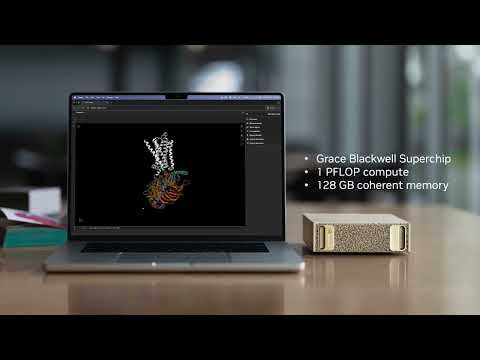
A Personal AI Supercomputer for Accelerated Protein AI
NVIDIA· 2025-09-17 20:22
AI Transformation in Disease Research - AI is revolutionizing disease understanding and treatment, particularly in protein study [1] - AlphaFold 2 reduces protein structure determination from months to minutes using deep learning [1] NVIDIA DGX Spark Performance - NVIDIA DGX Spark delivers data center-class performance for protein AI with the Grace Blackwell architecture [2] - DGX Spark offers up to 1 Petaflop of compute and 128GB of coherent memory [2] - It eliminates GPU memory bottlenecks on MSA databases and the need for shared HPC or cloud clusters [2] Accessibility and Capabilities - DGX Spark enables private folding of proteome-scale datasets beyond laptop or desktop capabilities [3] - It's a personal AI supercomputer for digital biology, bringing capabilities to researchers everywhere [3]

The Future of Thinking: How AI Redefines Intelligence | Karola Xenia Kassai | TEDxGyőr
TEDx Talks· 2025-07-17 16:02
AI's Impact on Cognitive Abilities - AI's increasing reliance is linked to diminished critical thinking abilities due to reduced deep reflective thinking [7] - AI hallucinations, with legal queries showing hallucination rates of 60% to 80%, hinder problem-solving and communication skills [8][9] - Using AI for decision-making can decrease brain functions related to questioning assumptions and generating alternative solutions [15][16] - Cognitive offloading, delegating mental tasks to machines, can weaken cognitive abilities in the long run [18] Human Intelligence vs AI - Human intelligence integrates reasoning, problem-solving, memory, language, perception, creativity, and pattern recognition [12] - AI exhibits functional creativity but lacks the emotional depth, contextual understanding, and interdisciplinary thinking of human creativity [14] - World Economic Forum lists creativity as a top 5 skill needed to succeed in 2025 [15] Neuroplasticity and Mitigation Strategies - Neuroplasticity allows the brain to adapt, and whether AI alters brain structure depends on active engagement with data [22] - Actively assessing AI outputs maintains brain activity, while passively consuming them decreases cognitive functions [23][24] - Reading high-quality literature enhances empathy, critical thinking, and creativity [26] - The average human attention span has shrunk to 825% seconds as of 2015, shorter than a goldfish's 9 seconds [30]

融资6亿美元,诺贝尔奖团队开发AI制药大模型
3 6 Ke· 2025-07-03 01:22
Core Insights - Demis Hassabis, founder of DeepMind and Isomorphic Labs, has made significant contributions to AI, particularly in drug development and protein structure prediction, with his work leading to the 2024 Nobel Prize in Chemistry for AlphaFold [5][10][19] - Isomorphic Labs, established in 2021, focuses on AI-driven drug discovery, leveraging AlphaFold's technology to enhance the drug development process [3][10][19] Company Overview - Isomorphic Labs has developed a unified AI drug design engine that utilizes multiple next-generation AI models applicable across various therapeutic areas [3][10] - The company recently secured $600 million in funding, led by Thrive Capital, to further develop its AI drug design engine and advance treatment solutions into clinical stages [3][10] Technological Advancements - AlphaFold 3, released in May 2024, significantly improves the prediction of protein structures and molecular interactions, enhancing drug development efficiency by at least 50% compared to traditional methods [14][16] - The AI drug design engine integrates advanced AI technologies, including diffusion models and multi-task reinforcement learning, to streamline the drug discovery process, reducing the timeline from an average of 5-10 years to 1-2 years [16][17] Market Potential - The global AI drug discovery market is projected to reach $20 billion by 2025, with a compound annual growth rate exceeding 30% [19] - The industry is witnessing a surge in investment, with over a hundred startups and large pharmaceutical companies actively engaging in AI research and development [19][20] Strategic Collaborations - Isomorphic Labs has formed strategic partnerships with major pharmaceutical companies, including Novartis and Eli Lilly, to co-develop AI-assisted drug discovery projects [10][11] - These collaborations aim to explore challenging drug targets and expand the scope of AI applications in drug development [11][19]