Autonomous Underwater Vehicle (AUV)

Search documents
自主水下机器人:在“深海盲盒”中开辟最优航路
机器人大讲堂· 2026-01-12 06:42
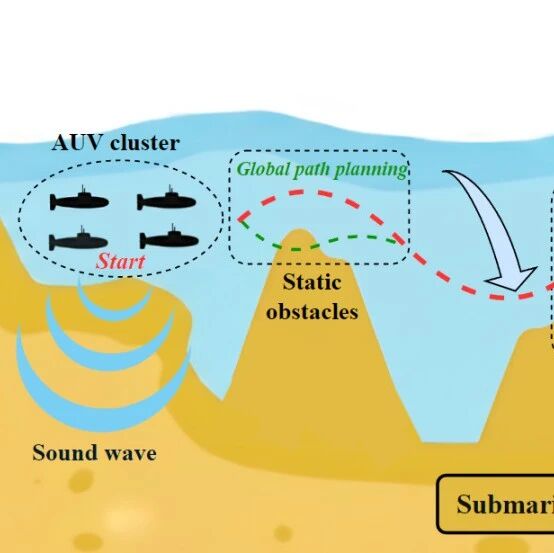
Core Viewpoint - The article discusses the advancements in Autonomous Underwater Vehicles (AUVs) and their path planning capabilities in complex underwater environments, emphasizing the transition from traditional methods to intelligent, data-driven approaches [1][4]. Group 1: AUV Path Planning Framework - A comprehensive path planning framework for AUVs must consider three key elements: AUV motion characteristics, external environment modeling, and task optimization strategies [7]. - AUVs are modeled as six degrees of freedom (6-DoF) rigid body systems, utilizing computational fluid dynamics (CFD) combined with semi-empirical or data-driven methods to balance efficiency and accuracy in motion constraints [7][8]. Group 2: Environmental Modeling and Task Optimization - High-precision external environment modeling is crucial for path planning, with deep learning techniques effectively addressing data sparsity in underwater terrain reconstruction [8]. - Task optimization strategies focus on minimizing energy consumption for single AUVs and optimizing task allocation and communication in multi-AUV scenarios, utilizing distributed reinforcement learning and game theory to enhance collaborative operations [9]. Group 3: Traditional Algorithms in Path Planning - Traditional algorithms for AUV path planning are categorized into global and local planning, each with strengths and limitations. Global planning methods like Dijkstra and A* are effective in known environments but face challenges in high-dimensional spaces [10][11]. - Local path planning methods, such as Artificial Potential Field (APF) and Dynamic Window Approach (DWA), provide real-time obstacle avoidance but may struggle with local minima and global coherence in complex terrains [11]. Group 4: Machine Learning in AUV Navigation - The evolution of AUV path planning is shifting from rule-based to data-driven paradigms, with machine learning significantly enhancing autonomous decision-making capabilities in dynamic marine environments [12]. - Supervised learning is used for environmental feature extraction, while unsupervised learning aids in task allocation for multi-AUV systems, improving computational efficiency in resource optimization [12][13]. Group 5: Future Directions for AUV Technology - Future research aims to enhance AUV capabilities through meta-learning and lifelong learning mechanisms, enabling rapid adaptation to new environments with minimal data [16]. - The integration of multimodal perception technologies and lightweight models with edge computing is expected to improve environmental modeling reliability and real-time path planning efficiency [17].

Petrobras Awards $150M Long-Term RSV Contract to DOF Group
ZACKS· 2025-12-31 15:20
Core Insights - Petrobras has awarded a four-year contract worth approximately $150 million to DOF Group for the deployment of the Skandi Commander, a remotely operated support vessel, starting in January 2027 [1][9] - The contract enhances Petrobras' offshore operations and solidifies its long-term partnership with DOF Group, which has a 25-year history in Brazil [6][10] Contract Details - The Skandi Commander is equipped with advanced technology, including a Remote Operated Vehicle (ROV) and an Autonomous Underwater Vehicle (AUV), which will enhance underwater inspection and maintenance capabilities for Petrobras [3][4] - The ROV will facilitate critical subsea activities, while the AUV will streamline underwater surveys, providing high-quality data and reducing operational costs [4][5] Strategic Importance - This contract represents a significant milestone for DOF Group in Brazil, contributing to a contract backlog exceeding $2 billion, which positions the company as a key player in the Brazilian offshore market [7][8] - Long-term contracts like this one provide DOF Group with financial stability and a steady revenue stream, allowing for future investments in fleet development [8] Technological Advancements - The Skandi Commander’s multi-functional design allows for various tasks, including pipeline inspection, underwater construction, and environmental monitoring, essential for maintaining Petrobras' infrastructure [5][12] - The incorporation of advanced vessels like the Skandi Commander is crucial for Petrobras to maintain its competitive edge in challenging deepwater environments [12][13] Future Outlook - DOF Group aims to expand its presence in Brazil and other global offshore markets, leveraging its long-term partnerships and technological innovations to drive growth [11][14] - The collaboration between Petrobras and DOF Group is expected to enhance operational efficiency and support Petrobras' ambitious targets in offshore exploration and production [10][13]


Oceaneering International(OII) - 2024 Q4 - Earnings Call Transcript
2025-02-20 19:24
Financial Data and Key Metrics Changes - For Q4 2024, the company reported net income of $56.1 million or $0.55 per share, a 26% year-over-year increase [11] - Consolidated revenue for Q4 2024 was $713 million, a 9% increase compared to the same period last year, with operating income rising 64% to $77.9 million [11][12] - Adjusted EBITDA for Q4 2024 reached $102 million, representing a 35% increase year-over-year [11][12] - For the full year 2024, consolidated revenue increased 10% to $2.7 billion, with operating income improving by 36% to $246 million [21][22] Business Segment Data and Key Metrics Changes - Subsea Robotics (SSR) operating income for Q4 2024 was $63.5 million, a 26% increase year-over-year, with an EBITDA margin improvement to 36% from 32% [13][14] - Manufactured Products segment revenue for Q4 2024 was $143 million, an 8% increase year-over-year, but operating income margin declined to 3% due to reserves taken on a project [15][16] - Offshore Projects Group (OPG) achieved record revenue and operating income in Q4 2024, with operating income improving to $39.3 million and revenue increasing 14% to $184 million [17][18] - Integrity Management and Digital Solutions (IMDS) saw a decrease in operating income despite a revenue increase, primarily due to acquisition-related costs [18][19] Market Data and Key Metrics Changes - The company ended 2024 with a cash balance of $498 million and a free cash flow of $94.5 million [12][13] - The year-end backlog was $604 million, a decrease of $17 million compared to the previous year [16] - The book-to-bill ratio for 2024 was 0.7, down from 1.31 in 2023, indicating a slowdown in order intake [16] Company Strategy and Development Direction - The company is focused on leveraging market dynamics in 2025, with expectations for mid to high single-digit revenue growth across all segments [28][29] - Continued pricing progression and favorable project mix are expected to drive revenue growth [29][30] - The company is actively pursuing M&A opportunities, particularly in disruptive technologies, and has seen an increase in potential targets [87][88] Management's Comments on Operating Environment and Future Outlook - Management expressed confidence in the stability of defense-related markets and the overall outlook for 2025, despite potential geopolitical risks [27][28] - The forecast for 2025 includes expectations for EBITDA in the range of $380 million to $430 million, representing a 17% increase over 2024 [30][31] - The company anticipates generating positive free cash flow of $110 million in 2025, with capital expenditures projected between $130 million and $140 million [31][32] Other Important Information - The company achieved a 56% reduction in high potential incidents, with a total recordable incident rate of 0.29% for the year [9][10] - The acquisition of Global Design Innovation Limited (GDI) is expected to enhance the company's digital and software capabilities [8][10] Q&A Session Summary Question: Pricing increase in ROVs - Management indicated that the pricing increase in ROVs has been driven by both drilling support and vessel-based work, with expectations for continued upward pricing progression despite flat activity levels [46][49] Question: Guidance on orders and book-to-bill - Management did not provide specific guidance on orders or book-to-bill but noted a healthy sales pipeline [50][52] Question: ROV utilization assumptions - Management expects rig activity to remain flattish, with a focus on higher quality assets and increased market share in Brazil [58][61] Question: Update on outsourced manufacturing - Management expressed confidence in the quality of outsourced manufacturing and noted ongoing discussions with customers for larger volume orders [62][64] Question: Margin improvement in manufactured products - Management highlighted that margin improvement is driven by better pricing in backlog and operational efficiencies [67][69] Question: Strength in offshore projects - Management discussed the growth in light well intervention and rework of infrastructure as key drivers for OPG's performance [78][80] Question: Visibility in the vessel class ROV market - Management noted strong utilization in the vessel class and ongoing demand for ROVs in various projects [82][85] Question: M&A opportunities - Management indicated an increase in M&A opportunities and expressed excitement about potential targets that align with the company's strategic goals [87][89]