BYD Electric Vehicles

Search documents
伊朗战争“避风港”:比亚迪3月大涨,电车股成恒科最佳之一
Hua Er Jie Jian Wen· 2026-03-27 00:48
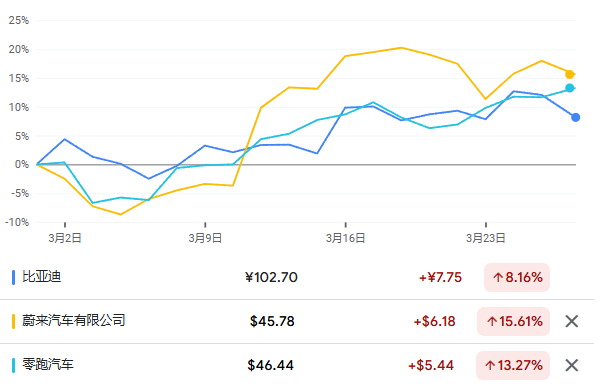
Core Viewpoint - The surge in oil prices due to the Iran conflict has unexpectedly catalyzed the Chinese electric vehicle (EV) sector, with BYD's Hong Kong stock rising 8% in March, marking its best monthly performance in over a year. The overseas market has become a key driver for valuation amid a backdrop of weak domestic demand and ongoing price wars [1][4]. Group 1: Market Dynamics - The increase in oil prices is reshaping the investment logic for electric vehicles, with BYD's stock performance being significantly influenced by overseas market demand [1][4]. - Strong momentum in overseas markets is a crucial support for the current rebound, with BYD's overseas sales in the first two months of the year surging by 50% year-on-year, particularly in markets like the Philippines and Indonesia [3][4]. - The conflict in Iran has directly stimulated consumer interest in electric vehicles in emerging Asian markets, leading to reports of consumers queuing to purchase EVs [4]. Group 2: Company Performance and Strategy - BYD's overseas delivery volume reached 1.05 million units last year, with a target of selling 1.3 million units outside China this year. The company’s proprietary fast-charging technology could address key bottlenecks in charging speed and infrastructure [4]. - Analysts highlight that BYD's cost advantages from in-house battery production enable strong profitability in its export business, effectively capturing demand shifts driven by rising oil prices [4]. - There is a growing divergence in market sentiment regarding BYD, with short positions increasing from 0.7% to 3.2% of free-floating shares, indicating some investors' skepticism about the sustainability of the rebound [6]. Group 3: Future Outlook - Investors are focusing on the upcoming earnings report and full-year guidance to assess the sustainability of the export-driven recovery [3][6]. - Despite the strong performance, BYD's stock is still down over 30% from its historical high in May of last year, making the upcoming earnings release a critical point for determining whether the current rebound can evolve into a sustained trend [6].


Meredith Whitney CEO on why EVs will be a massive play in Europe
Youtube· 2025-12-08 17:19
Core Insights - The electric vehicle (EV) market is witnessing significant competition, particularly from BYD, which has surpassed Tesla as the largest EV producer [2][3] - BYD is planning to expand into the European luxury market, posing a substantial threat to European luxury car manufacturers [3][6] - The company has a significant production capacity, with a $4.5 billion factory in Hungary expected to produce 150,000 vehicles annually, potentially exceeding this target [3][4] Company Overview - BYD originated as a battery company and has successfully transitioned into the EV sector, demonstrating remarkable growth and production capabilities [2][3] - The company employs around 1 million people, with a notable engineering workforce of 125,000, which is significantly higher than that of major competitors [9][10] Market Dynamics - China holds a competitive advantage in rare earth elements and magnets, which are crucial for EV production, allowing BYD to dominate the market and exert pressure on European manufacturers [5][6] - European automakers are at a disadvantage due to limited resources, making them more reliant on EVs, while BYD is positioned to capture a large market share [8][6] Product Performance - BYD's high-end vehicles have been described as superior in performance compared to luxury competitors, showcasing advanced features and capabilities [4][6] - The production strength and operational efficiency of BYD are highlighted as key factors that will impact the competitive landscape in the EV market [7][10]
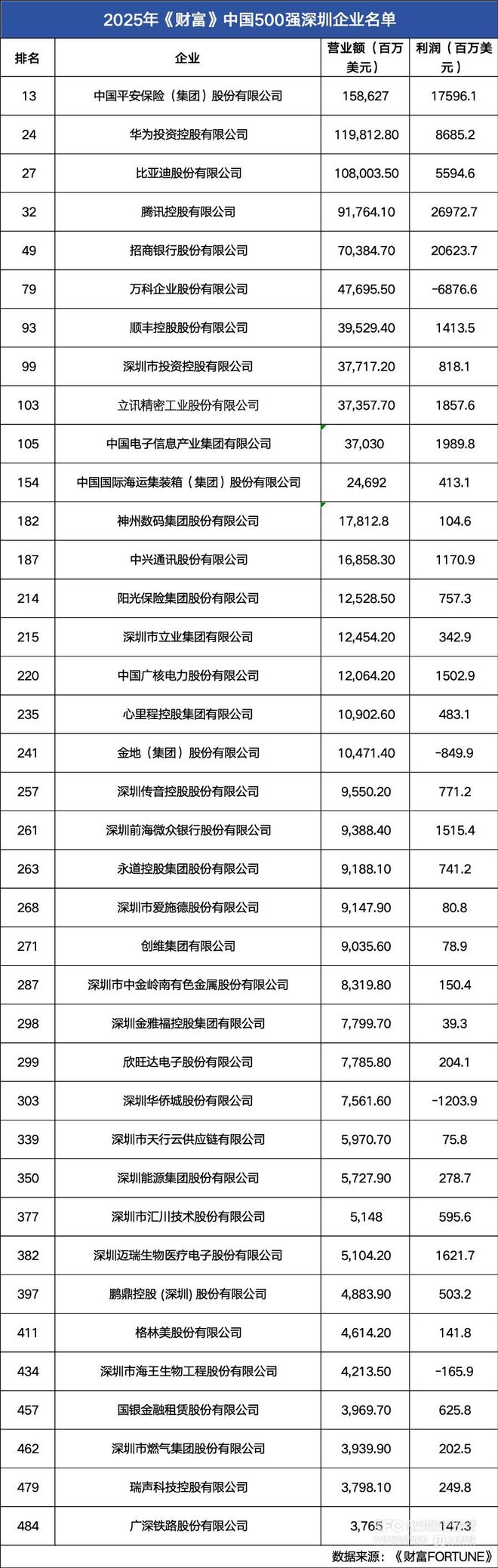
38家深企上榜《财富》中国500强,腾讯、平安最赚钱
2 1 Shi Ji Jing Ji Bao Dao· 2025-07-23 09:36
Core Insights - The 2025 Fortune China 500 list features 38 companies from Shenzhen, highlighting the city's growing economic significance [1][4] - Notable Shenzhen companies in the top 100 include China Ping An, Huawei, BYD, Tencent, and others, with China Ping An ranked highest at 13th [1][4] - The list reflects Shenzhen's economic transformation towards new growth drivers, particularly in emerging industries like renewable energy [2][3] Company Performance - China Ping An reported a revenue of $158.63 billion and a profit of $17.60 billion in 2024, with significant investments in AI [4][5] - Tencent's net profit exceeded $26.9 billion in 2024, showing a growth of over 65% year-on-year, driven by strategic investments in various sectors [4][5] - Huawei achieved a revenue of $86.21 billion, with a profit of $8.69 billion, and invested $27.97 billion in R&D, representing 20.8% of its total revenue [5][6] Industry Trends - Shenzhen's companies are diversifying across various sectors, including electronics, renewable energy, AI, and logistics, with a strong focus on new energy vehicles [2][10] - BYD sold 4.27 million electric vehicles globally in 2024, maintaining its position as the world's leading EV manufacturer [5][10] - The renewable energy sector is thriving, with companies like Grinmei and Xinnengda making significant advancements in battery technology and global market presence [10][11] Emerging Companies - Three companies made their debut on the Fortune list: Yongdao Holdings, AAC Technologies, and Guangshen Railway, indicating a broadening of Shenzhen's corporate landscape [6][8] - Grinmei and Xinnengda have shown remarkable ranking improvements, reflecting their growing influence in the renewable energy sector [6][10] Economic Impact - Shenzhen's industrial output reached over $5.4 trillion in 2024, with a 9.7% year-on-year growth, solidifying its status as China's industrial powerhouse [10][12] - The city is actively developing its AI and robotics sectors, with companies like Huichuan Technology making significant strides in humanoid robotics [11][12]