
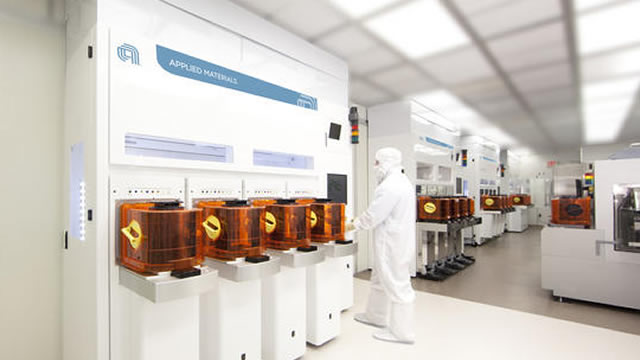
Chip manufacturing equipment

Search documents
MU, LRCX, AMAT, GEV All Added to the S&P 100 As AI Stocks Gain Influence
247Wallst· 2026-03-06 23:05
Core Viewpoint - The S&P 100 has added four companies—Micron Technology (MU), Lam Research (LRCX), Applied Materials (AMAT), and GE Vernova (GEV)—reflecting the growing influence of AI stocks in the market [1][2] Group 1: S&P 100 Rebalancing - The S&P 100 rebalancing included four AI-related companies, signaling a shift in the index towards AI infrastructure [1] - Companies removed from the index include PayPal (PYPL), MetLife (MET), American International Group (AIG), and Target (TGT) [1] - The S&P 100 tracks the largest U.S. companies by market cap, and inclusion leads to mandatory buying from index funds and ETFs [1] Group 2: Company Highlights - **Micron Technology (MU)**: Current stock price is $370.30, up 316.17% year-over-year. Revenue for the last quarter was $13.64 billion, a 56.6% increase year-over-year, with a strong demand outlook extending into 2027 [1][2] - **Lam Research (LRCX)**: Current stock price is $199.33, up 162.58% year-over-year. Revenue for the last quarter was $5.34 billion, a 22.1% increase year-over-year, with guidance for the next quarter at approximately $5.70 billion [1][2] - **Applied Materials (AMAT)**: Current stock price is $324.74, up 116.24% year-over-year. Revenue for the last quarter was $7.01 billion, with record DRAM revenue at 34% of its Semiconductor Systems segment [1][2] - **GE Vernova (GEV)**: Current stock price is $789.44, up 169.88% year-over-year. Orders surged 65% to $22.20 billion in Q4, with a total backlog reaching $150 billion [1][2] Group 3: Industry Implications - The inclusion of these companies in the S&P 100 reflects the foundational role of AI infrastructure in the U.S. economy [1][2] - The demand for AI-related products and services is expected to continue growing, with significant investments in memory and semiconductor manufacturing [1][2]





This AI Stock Is a Money-Making Machine
Yahoo Finance· 2026-02-24 17:22
Company Performance - Taiwan Semiconductor Manufacturing (TSMC) has experienced significant growth, with revenue increasing by over 350% since 2015, driven by rising demand for semiconductors, particularly during the COVID-19 pandemic and the subsequent AI boom [4][6] - The company's gross profit has surged over 460%, with gross margin expanding from less than 49% a decade ago to nearly 60% today, indicating effective cost control and efficient manufacturing processes [5][6] - Operating income has increased more than seven times, and operating margin has improved by almost 13 percentage points to 50.8%, showcasing the company's operational efficiency [6] Financial Metrics - Net income has climbed almost 475% over the past decade, supported by a greater than nine percentage point increase in net margin [6] - Return on equity rose more than five percentage points to 35.4% in 2025, reflecting strong profitability and effective capital management [7] - The company has increased its cash and marketable securities position by 27%, while also raising dividend distributions to shareholders by 29% compared to 2024 [7]

US grants annual approval to TSMC for chipmaking tool exports to China
Reuters· 2025-12-31 20:27
Core Insights - The U.S. government has issued an annual license to Taiwan Semiconductor Manufacturing Company (TSMC) to import chip manufacturing equipment to its facilities located in Nanjing, China [1] Company Summary - Taiwan Semiconductor Manufacturing Company (TSMC) has received approval from the U.S. government for an annual license [1] - The license allows TSMC to bring in essential chip manufacturing equipment to enhance its operations in Nanjing, China [1]

US approves Samsung, SK Hynix chipmaking tool shipments to China for 2026, sources say
Yahoo Finance· 2025-12-30 04:14
Group 1 - The U.S. government has granted an annual license to Samsung Electronics and SK Hynix to import chip manufacturing equipment to their facilities in China for 2026, providing temporary relief for these South Korean firms [1][2] - The annual approval system for exports of chipmaking tools to China was introduced by Washington, following the end of the validated end user status on December 31, which previously allowed certain companies to ship American chipmaking tools without licenses [2][3] - Samsung and SK Hynix are significant players in the memory chip market, with China being a key production base, especially for traditional memory chips, which have seen price surges due to increased demand from AI data centers and supply constraints [4]
Applied Materials Sees $710M Hit From China Curbs. Here's What You Should Know
Investopedia· 2025-10-03 13:10
Core Insights - Applied Materials expects a revenue hit of $710 million due to new restrictions on exports to China, which is a significant pressure on its shares [1][7] - The new rule from the Commerce Department's Bureau of Industry and Security, effective September 29, further restricts the company's ability to export certain products and services to specific Chinese customers without a license [2][4] - The company anticipates a reduction of $110 million in net revenue for the fourth quarter and around $600 million for fiscal 2026 as a result of these restrictions [2][3] Company Performance - Applied Materials shares have increased by nearly 40% in 2025, driven by the AI boom and rising demand for chips [1][3] - Despite the overall increase, shares were down approximately 3% in premarket trading following the announcement of the new export restrictions [5] Market Context - China represents over a third of Applied Materials' total revenue, making it the largest market for the company [4] - The new licensing requirements mean that U.S. companies will need licenses to export to entities that are 50% or more owned by companies on the entity list, closing a significant loophole [4][7]
Why KLA Stock Triumphed on Thursday
Yahoo Finance· 2025-09-18 20:49
Group 1 - KLA's stock rose nearly 6% due to a significant deal in the chip industry, outperforming the S&P 500's 0.7% increase [1] - Nvidia announced a $5 billion investment in Intel, marking a major collaboration between the two companies [2] - The investment from Nvidia, along with an $8.9 billion federal investment and a $2 billion investment from SoftBank, aims to revitalize Intel and strengthen the domestic chipmaking sector [3] Group 2 - The influx of capital into Intel is expected to positively impact various chip stocks, including KLA, which manufactures equipment used in chip production [4] - Although KLA is not directly involved in the recent transactions, it stands to benefit from the overall positive sentiment in the chip production chain [5] - The Motley Fool Stock Advisor has identified other stocks as better investment opportunities compared to KLA, despite the current enthusiasm for chip stocks [6][7]

