
Coking coal

Search documents
CONSOL Energy (CEIX) - 2025 Q4 - Earnings Call Presentation
2026-02-12 15:00
Fourth Quarter 2025 Earnings Supplement February 12, 2026 FORWARD-LOOKING STATEMENTS This communication contains certain "forward-looking statements" within the meaning of federal securities laws. Forward-looking statements may be identified by words such as "years ahead," "look forward" and similar expressions. Forward-looking statements are not statements of historical fact and reflect Core's current views about future events. No assurances can be given that the forward-looking statements contained in thi ...

MONGOL MINING盘中涨超15% 旗下BKH金矿投产放量
Xin Lang Cai Jing· 2026-02-11 03:27
Core Viewpoint - MONGOL MINING (00975) is transitioning from a single Coking coal producer to a multi-mineral producer, including gold and copper, with significant growth expected in the coming years [1][6] Group 1: Company Growth and Production - The company is expected to develop new mining sites for gold and copper by 2025, completing its transition as indicated by its name "Mining" [1][6] - MONGOL MINING holds a 50% stake in EM Company, which has substantial gold resources, with the BKH gold mine projected to commence production in Q4 2025 and reach a capacity of 85,000 ounces by 2026 [1][6] - The estimated production for the BKH gold mine in 2026 is 76,500 ounces, with a projected gold price of $5,200 per ounce and an all-in sustaining cost (AISC) of $1,200 per ounce, potentially contributing $97 million to net profit attributable to shareholders, accounting for approximately 40% of the 2024 profit [1][6] Group 2: Financial Health and Dividend Potential - Following a debt restructuring in 2017, the company's balance sheet has gradually improved, with plans to complete the repayment of perpetual securities and the replacement of high-interest notes between 2023 and 2025, which will further eliminate dividend barriers and reduce financing costs [2][7] - The company has entered a "low net debt" phase, and with the peak capital expenditure for the BKH project behind, there is potential for dividend distribution as profitability from coal and gold improves in 2026 [2][7] - The forecasted net profit attributable to shareholders for 2026 is $274 million, with potential dividend payout ratios of 30% and 50%, leading to dividend yields of 5.2% and 8.7% based on the market capitalization as of February 6, 2026 [2][7]

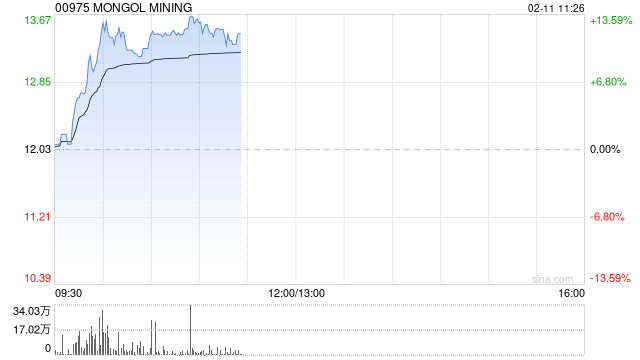
MONGOL MINING盘中涨超15% 旗下BKH金矿投产放量 公司分红限制逐步解除
Zhi Tong Cai Jing· 2026-02-11 02:59
Core Viewpoint - Mongol Mining is transitioning from a single coking coal producer to a multi-mineral producer, with significant developments in gold and copper mining expected by 2025 [1][2] Group 1: Company Developments - Mongol Mining's stock price increased by over 15% during trading, currently at 13.45 HKD with a trading volume of 64.33 million HKD [1] - The company has a 50% stake in EM, which has rich gold resources, and the BKH gold mine is expected to commence production in Q4 2025, aiming for an annual capacity of 85,000 ounces by 2026 [1] - The projected output for the BKH gold mine in 2026 is 76,500 ounces, with an estimated gold price of 5,200 USD/ounce and an all-in sustaining cost (AISC) of 1,200 USD/ounce, potentially contributing 9.7 million USD to net profit attributable to shareholders, accounting for approximately 40% of the 2024 profit [1] Group 2: Financial Outlook - Following the debt restructuring in 2017, the company's balance sheet has gradually improved, with plans to complete the repayment of perpetual securities and high-yield notes between 2023 and 2025, which will further eliminate dividend barriers and reduce financing costs [2] - The company is now in a "low net debt" phase, and with the peak capital expenditure for the BKH project behind, the combined profitability from coal and gold in 2026 may allow for dividend distributions [2] - The forecasted net profit attributable to shareholders for 2026 is 27.4 million USD, with potential dividend payout ratios of 30% and 50%, leading to dividend yields of 5.2% and 8.7% respectively based on the market capitalization as of February 6, 2026 [2]
中国煤炭 - 煤炭专家电话会议核心要点-China Coal-Coal Expert Key Call Takeaways
2025-11-19 01:50
Key Takeaways from China Coal Industry Conference Industry Overview - The conference focused on the coal industry in China, particularly thermal and coking coal imports and prices for 2026 [1][2][6]. Core Insights 1. **Coal Import Projections**: - Total coal imports for 2026 are expected to decline to approximately 480 million tonnes (mnt), down from 493 mnt projected for 2025. This includes thermal coal at 373 mnt and coking coal at 107 mnt for 2026, compared to 383 mnt and 110 mnt in 2025 [2][9]. 2. **Price Forecasts**: - The average thermal coal price is forecasted to be Rmb 735 per tonne in 2026, an increase from Rmb 710-720 per tonne in 2025. Short-term price corrections are anticipated before winter heating demand potentially drives prices up to Rmb 850-900 per tonne [3][9]. 3. **Inventory Levels**: - Inventory levels across the supply chain are reported to be below seasonal averages, particularly at mines and ports. Slow stockpiling due to lower production and increased restocking by traders may lead to upward price pressure if inventory drawdowns continue [4][9]. 4. **Production Growth**: - A coal production increase of 1.1-1.5% is expected for 2026. Downstream demand from heating (+2%) and coal chemicals (+6%) is anticipated to offset declines in building materials (-0.3%) and steelmaking (-2%) [6][9]. 5. **Market Dynamics**: - The widening import price arbitrage between domestic and Indonesian coal since September is expected to increase import arrivals towards the end of the year, although logistics and the December rainy season may cause disruptions [2][4]. Additional Important Points - The production in November-December 2025 is expected to rebound slightly but will continue to show negative year-on-year growth due to ongoing overproduction inspection checks [9]. - Coking coal prices are projected to average Rmb 1,430-1,450 per tonne in 2026, up from Rmb 1,360 per tonne in 2025, while Mongolia coal prices are expected to be around Rmb 930 per tonne in 2026, compared to Rmb 900 per tonne in 2025 [9]. Conclusion - The coal industry in China is facing a complex landscape with declining imports, fluctuating prices, and tight inventory levels. The anticipated production growth and downstream demand may provide some stability, but external factors such as logistics and seasonal weather patterns could impact market dynamics significantly [1][6][9].
FT Live: Anglo American CEO reaffirms merger as Teck slashes forecasts
Yahoo Finance· 2025-10-09 18:29
Core Viewpoint - Anglo American's CEO Duncan Wanblad remains confident in the $50 billion merger with Teck Resources despite recent cuts in copper production forecasts from Teck [1][2]. Merger Insights - Wanblad stated that the merger's value is not affected by Teck's revised production forecasts, emphasizing the extensive due diligence conducted prior to the merger [2]. - The merger will result in Anglo American holding a 50% stake in the new Anglo Teck company [2]. Production Forecasts - Teck Resources has lowered its 2025 output projection for the Quebrada Blanca copper mine in Chile from 210,000–230,000 tonnes to 170,000–190,000 tonnes, marking a decrease of 17% to 19% [2]. - This revision is the second in three months, with the first reduction occurring in July [3]. Strategic Direction - Wanblad highlighted the need for a new approach to mining, indicating that the merger aligns with a future-facing strategy [4]. - The company is restructuring by divesting from nickel, diamonds, platinum, and coal to focus on a more streamlined portfolio [4]. Coal Business Developments - Anglo American is currently in arbitration with Peabody Energy after Peabody withdrew its $3.78 billion bid for Anglo American's Australian coking coal assets, citing a Material Adverse Change (MAC) event [5]. - Wanblad expressed confidence that the situation does not constitute a MAC event, asserting that there is no damage to the asset [5]. - The company plans to remarket its coal business, aiming for a market entry by late this year or early next year [6].

BHP to suspend operations, cut jobs at Australian coking coal mine
Yahoo Finance· 2025-09-17 00:30
Core Viewpoint - BHP will suspend operations and cut 750 jobs at its Queensland coking coal mine due to low prices and high state government royalties impacting returns [1][2][3] Group 1: Company Actions - BHP Mitsubishi Alliance's Saraji South will be placed into care and maintenance from November 2025, with a production of 8.2 million metric tons of coking coal in the year to June 2025 [1][2] - The decision to suspend operations is a response to the unsustainable coal royalties imposed by the Queensland Government and current market conditions [2][3] Group 2: Market Conditions - Coking coal prices, which peaked above $600 a ton post-Russia's invasion of Ukraine, have normalized to around $190 [4] - Medium-term demand for hard coking coal remains strong, but maintaining operations in lower margin areas is not sustainable under current conditions [3] Group 3: Regulatory Environment - Queensland raised coal royalties in July 2022 to 20% for prices above A$175 ($117) per ton, with a top tier of 40% for prices over A$300, significantly increasing the financial burden on mining operations [3] - The Mining and Energy Union recently won a Federal court ruling that affects pay rises for contracted workers, leading to increased salaries for around 1,800 employees by A$20,000 to A$30,000 on top of an average coal salary of A$120,000 [4][5]

Alpha Metallurgical Coal: Domestic Contracting Cycle Looms Large (NYSE:AMR)
Seeking Alpha· 2025-09-14 08:02
Group 1 - Alpha Metallurgical Coal is the largest domestic producer of coking coal for steel production [1] - The company has been compared to peers such as Warrior Met Coal and Arch [1]


中国煤炭:在结构性低迷中选择-Selective amid a structural downturn
2025-09-04 15:08
Summary of Key Points from the Conference Call Industry Overview - **Industry**: China's Coal Segment - **Current Status**: The coal segment is in structural decline due to the energy transition, with thermal coal facing slight oversupply while coking coal is broadly balanced for the year [1][4] Core Insights - **Thermal Coal**: - Demand is expected to decline by approximately 1% YoY to around 4.17 billion tons (bnt) in 2025, driven by a 2.5% drop in power-sector coal consumption and a 6% decrease in construction-related consumption [3][19] - Total thermal coal supply is projected to increase by about 1% YoY to 4.3 billion tons in 2025, despite a 12% YoY drop in imports [3][18] - The average price of thermal coal has corrected by 22% YoY, with domestic prices hitting lows of RMB 677 per ton [18] - **Coking Coal**: - Supply is expected to remain flat at approximately 592 million tons (mnt) in 2025, with demand also flat at 591 mnt, supported by stable pig iron production [4][22] - The market is expected to face rising supply pressure in the coming years, despite current balance [4] Policy Context - **Regulatory Environment**: The current industry backdrop is different from the 2015 supply-side reform, with fewer loss-makers and greater consolidation. The share of output from large, advanced mines has increased, making broad cuts unlikely [2][16] - **Safety and Environmental Checks**: Supply discipline is more likely to come from tighter safety and environmental checks rather than blanket quotas [2][16] Stock Implications - **Investment Ratings**: - Shenhuo Coal & Power initiated at Overweight (OW) due to strong aluminum contributions [6][26] - Shenhua (H) remains OW, while Yankuang H is moved to Equal Weight (EW) and Yancoal Australia to Underweight (UW) [6][10] - China Coal (A) is rated UW, reflecting a weaker outlook [6][10] Risks and Opportunities - **Key Risks**: Implementation of anti-involution measures could lead to deeper production cuts, driving prices up for both thermal and coking coal [5][28] - **Other Risks**: Stricter inspections could lead to material supply reductions, while stronger-than-expected thermal power demand could increase coal demand [31] Additional Insights - **Market Preferences**: Coal is ranked lower among commodities, with preferences for copper, aluminum, and steel over coal [24] - **Dividend Yields**: Coal producers typically offer high dividend payouts, around 5%, which may attract yield-focused investors despite the structural downturn [27] Conclusion - The coal industry in China is navigating a complex landscape marked by declining demand, regulatory scrutiny, and shifting market dynamics. While coking coal remains relatively balanced, thermal coal faces significant challenges. Investment strategies should consider the potential for regulatory impacts and the overall commodity landscape.






中国煤炭行业_炼焦煤与动力煤专家观点提炼 China coal sector _Met coal and thermal coal experts takeaways_ Ding
2025-08-05 03:20
Summary of Key Points from the Conference Call Industry Overview - **Industry**: China Coal Sector - **Focus**: Coking Coal and Thermal Coal Core Insights 1. **Overproduction Issues**: - 22% of sampled coking coal mines are experiencing overproduction, impacting 26% of their volume [2][3] - 14% of sampled thermal coal mines have overproduction issues, affecting 3% of total capacity [4][7] 2. **Market Dynamics**: - The met coal price is expected to become attractive for imports when it reaches approximately Rmb1300/ton [2][3] - Thermal coal prices are projected to rebound to Rmb670/ton during the summer but may soften to Rmb610/ton by year-end [4] 3. **Government Policies**: - The National Energy Administration (NEA) and local governments are expected to implement moderate execution of overcapacity policies to balance production stability and local economic interests [3] - The tone from the Xinjiang NDRC appears more lenient compared to Henan and Ordos, indicating varying regional approaches to overproduction management [3] 4. **Production and Cost Analysis**: - The all-in cost for most Chinese met coal is between Rmb600-1,000/ton, leading to losses earlier in the year but returning to profitability recently [3] - Current daily output of met coal is approximately 1.9 million tons, which is 5% higher than the year's low but still 10% below the peak of 2.1-2.2 million tons expected in 2024 [3] 5. **Future Projections**: - The thermal coal production target for Shanxi is set at 1.3 billion tons for 2025, with 662 million tons produced in the first half of 2025 [4] - The expert anticipates a smaller volume impact from overproduction in the current cycle, at most 50% of what was seen in the previous cycles [4] Stock Implications - **Company Exposure**: - Among coal companies, Yankuang has the highest exposure to coking coal and coal spot sales, with 75% of its sales being spot sales, making it the most sensitive to coal price fluctuations [5] Additional Considerations - **Risks**: - Key risks include economic conditions, government policies affecting coal prices, and the balance of supply and demand in the coal sector [8] - Potential for higher-than-expected growth in fixed asset investment (FAI) in the coal sector and looser government policies could impact market dynamics [8] Conclusion - The coal sector in China is facing significant challenges with overproduction, but there are opportunities for price recovery and strategic adjustments in response to government policies. Investors should closely monitor these developments, particularly in relation to specific companies like Yankuang, which are more exposed to market fluctuations.
中国煤炭行业_解读中国潜在的煤矿检查-China coal sector_ Read on China‘s potential coal mine inspections
2025-07-28 01:42
Summary of Key Points from the Conference Call Industry Overview - **Industry**: China Coal Sector - **Key Focus**: Upcoming inspections of coal mines in eight provinces to ensure compliance with production capacities [2][3] Core Insights and Arguments 1. **Inspection Requirements**: The National Energy Administration (NEA) will inspect coal mines for compliance with approved production capacities, particularly focusing on any monthly output exceeding 10% of the approved capacity from January to June 2025 [2] 2. **Overcapacity Concerns**: The overcapacity issue is less significant at the provincial level, with only Xinjiang exceeding 10% and Shaanxi over 2% in 2024. In 2025, only Xinjiang showed minor excess capacity in June [3] 3. **Market Impact**: The expected volume impact from inspections is modest compared to previous cycles, with a significant reduction in overproduction incentives due to current coal prices ranging from Rmb600-700 per ton [3] 4. **Coal Price Trends**: Historical data indicates that both coking and thermal coal prices rallied significantly in the second half of 2023 due to mine accidents and safety inspections, with expectations of sustained price increases amid uncertainties [4] 5. **Price Projections**: Assuming a volume cut of 5-10 million tons per month, a price increase of Rmb30-50 per ton (5-8%) for thermal coal is anticipated [4] Company-Specific Insights 1. **Yankuang Energy**: This company is particularly sensitive to coal price changes, with 75% of its sales being spot sales, making it the most exposed among its peers [5] 2. **Comparative Exposure**: Other companies like Shaanxi Coal and Shenhua have lower exposure to spot sales (40% and 20% respectively), indicating a varied sensitivity to price fluctuations [5] Additional Considerations 1. **Regulatory Risks**: Key risks to the coal sector include economic conditions and government policies that could affect coal prices and supply-demand balance, such as higher-than-expected growth in fixed asset investment (FAI) in the coal sector and looser policies on coal consumption [12] 2. **Valuation Methodology**: Different valuation methodologies are applied for companies within the sector, with targeted yield approaches for Shenhua and Shaanxi Coal, and a price-to-book value-return on equity approach for Yankuang [13] Conclusion - The coal sector in China is facing regulatory scrutiny with upcoming inspections aimed at controlling production capacities. While overcapacity issues appear manageable, coal prices are expected to remain volatile, influenced by market dynamics and regulatory actions. Companies like Yankuang Energy are particularly sensitive to these price changes, highlighting the need for investors to consider individual company exposures when making investment decisions.