CycleVLA

Search documents
CycleVLA:让 VLAs 具备“预判初期失败、回溯重试恢复”的能力
具身智能之心· 2026-01-07 03:33
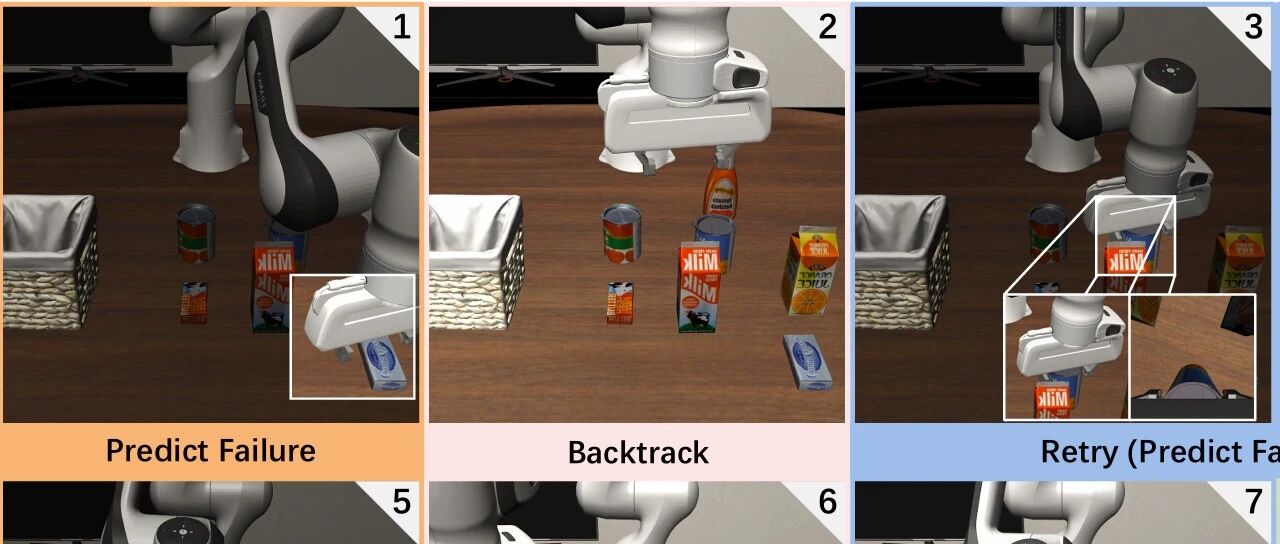
Core Insights - The article discusses CycleVLA, a proactive self-correcting framework for Vision-Language-Action models, aimed at improving task execution by enabling models to anticipate and correct failures before they occur [2][3]. Group 1: Background and Motivation - Traditional methods for robotic task execution often rely on reactive correction after failures occur, while CycleVLA aims to implement proactive measures to prevent failures by predicting them in advance [2]. - The key limitation of existing Vision-Language-Action models is their inability to perceive task progress and identify critical failure points during task execution [2]. Group 2: Core Design - CycleVLA is structured around three main modules: progress perception, failure prediction, and backtracking for retries, creating a self-correcting loop [3]. - The progress perception module enhances the model's ability to track task completion by breaking down tasks into atomic subtasks and aligning them with timestamps [5][8]. - The failure prediction module utilizes existing Vision-Language Models (VLMs) to assess the likelihood of failure as subtasks near completion, allowing for targeted corrections [9]. Group 3: Experimental Results - CycleVLA achieved an average success rate of 95.3% across various task suites, significantly outperforming traditional methods, particularly in long-horizon tasks where it reached a success rate of 93.6% compared to 53.7% for OpenVLA [12][15]. - The model demonstrated the ability to perform multiple cycles of failure prediction, backtracking, and retries within single long tasks, leading to successful completions [12][18]. Group 4: Adaptability to Under-Trained Models - CycleVLA showed consistent performance improvements for under-trained models, with success rates increasing from 73.2% to 80.0% for a model trained for 200K steps, indicating its effectiveness in compensating for insufficient training data [20][21]. Group 5: Key Findings and Limitations - The combination of task progress perception and VLM failure prediction effectively captures high-risk transition points, enabling proactive corrections, especially for long-horizon tasks [31]. - The MBR decoding method enhances success rates without requiring additional training, making it particularly beneficial for under-trained models [31]. - Limitations include dependency on reversible state assumptions, which may fail in dynamic environments, and the need for optimization in efficiency for high-frequency control tasks [31].