
Dance Studio

Search documents
lululemon Faces Softer Consumer Demand: But Brand Loyalty Holds Strong
ZACKS· 2025-11-05 18:21
Core Insights - lululemon athletica inc. (LULU) reported second-quarter fiscal 2025 results that highlighted a changing consumer environment and product challenges in the U.S. market, with earnings exceeding estimates but revenues falling short, leading to a reduction in fiscal 2025 guidance [1][9] Group 1: Consumer Behavior and Product Strategy - The company recognized an over-reliance on established lounge and social product lines, which failed to attract higher-value customers, resulting in decreased spending and purchase frequency [2] - Despite these challenges, lululemon's loyalty and engagement metrics remain strong, with membership nearing 30 million and growth in performance categories like yoga and running, indicating that the issue lies in stale product offerings rather than a lack of demand [3] Group 2: Management Response and Future Outlook - Management is treating the current period as a reset, aiming to increase the share of new styles from 23% to approximately 35% by spring 2026, with new product launches already underway [4] - The company is also focusing on faster go-to-market processes and improved vendor collaboration to capitalize on successful products more quickly, alongside strong international growth, particularly in China [4] Group 3: Financial Performance and Market Position - lululemon's shares have decreased by 58% year-to-date, compared to a 20.4% decline in the industry [8] - The forward price-to-earnings ratio for LULU stands at 12.72X, which is lower than the industry average of 15.56X, indicating potential valuation opportunities [10] - The Zacks Consensus Estimate suggests an 11.8% year-over-year decline in fiscal 2025 earnings, with a slight growth forecast of 1.1% for fiscal 2026, reflecting a mixed outlook [11]


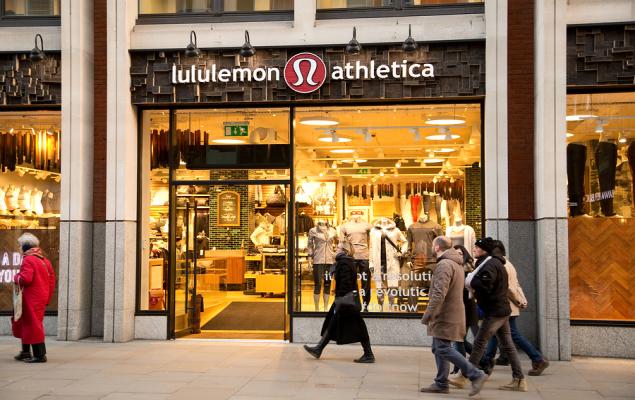
lululemon Dips Below 50-Day SMA: Buy Now or Stay on the Sidelines?
ZACKS· 2025-10-31 17:51
Core Insights - lululemon athletica inc. (LULU) shares have experienced a significant decline, losing 56.1% year-to-date, underperforming both the Zacks Textile – Apparel industry and the broader Zacks Consumer Discretionary sector [6][7][24] - The stock has fallen below its 50-day and 200-day simple moving averages (SMA), indicating a bearish sentiment and a long-term downward trend [1][9][24] - The company has cut its fiscal year 2025 guidance due to sluggish U.S. demand and increased tariff-related costs, leading to a cautious outlook from analysts [9][14][25] Performance Metrics - LULU's stock closed at $170.30 on October 29, 2025, below the 50-day SMA of $178.55 [1] - The stock is currently trading 1.1% above its 52-week low of $159.25 and 60.3% below its 52-week high of $423.32 [10] - The company anticipates net revenues of $10.85-$11 billion for fiscal 2025, reflecting a 2-4% year-over-year growth [14] Competitive Landscape - LULU's performance is notably weaker than its competitor NIKE Inc., which has declined 14.3% year-to-date, and other competitors like Gildan Activewear and Ralph Lauren, which have seen growth of 25.1% and 39.8%, respectively [7][24] - The current forward 12-month price-to-earnings (P/E) multiple for LULU is 12.92X, lower than the industry average of 16.13X and the S&P 500's average of 24.03X, indicating a relatively cheap valuation [20][21] Financial Outlook - Analysts have revised down earnings estimates for LULU, reflecting skepticism about the company's near-term growth potential [18] - For fiscal 2025, the Zacks Consensus Estimate suggests a revenue growth of 3.7% year-over-year, while EPS is expected to decline by 11.8% [19] - Management expects a decline in operating margin by 390 basis points for fiscal 2025 due to tariff pressures and markdowns [13] Strategic Initiatives - The company is undergoing a reset phase, aiming to rebalance its merchandise mix and accelerate innovation, with plans to increase the share of new styles from 23% to 35% by spring 2026 [16] - Despite strong international performance, particularly in China, the execution gap in the U.S. market and margin pressures are contributing to the stock's decline [16][24]

lululemon(LULU) - 2026 Q2 - Earnings Call Transcript
2025-09-04 21:32
Financial Data and Key Metrics Changes - For Q2, total net revenue rose 7% to $2.5 billion, with comparable sales increasing 1% [26] - Gross profit was $1.48 billion, representing 58.5% of net revenue, down from 59.6% in Q2 2024 [27][28] - Net income for the quarter was $371 million, or $3.10 per diluted share, compared to $3.15 in the same period last year [30] Business Line Data and Key Metrics Changes - Men's revenue increased 6%, women's revenue increased 5%, and accessories and other grew 15% [27] - Performance apparel continues to grow, while lounge and social product offerings have become stale, impacting sales negatively [12][13] Market Data and Key Metrics Changes - In the U.S., revenue was flat, with comparable sales down 3% [26] - China revenue increased 25%, with comparable sales up 16% [27] - The rest of the world segment saw a revenue growth of 19%, with comparable sales increasing by 9% [27] Company Strategy and Development Direction - The company is focusing on increasing the number and frequency of new styles in its product assortment, aiming to raise new styles from 23% to 35% [16] - A new Chief AI and Technology Officer has been appointed to enhance product innovation and agility [18] - The company plans to navigate increased costs from tariffs through strategic pricing and supply chain initiatives [25][22] Management's Comments on Operating Environment and Future Outlook - Management expressed dissatisfaction with current U.S. results and acknowledged the need for product innovation to meet consumer expectations [6][24] - The company expects revenue growth of 4% to 6% for the year, with a decline in U.S. revenue projected at 1% to 2% [22][32] - Management remains optimistic about international growth, particularly in China, where growth is expected to be 20% to 25% [22][32] Other Important Information - The company ended the quarter with $1.16 billion in cash and cash equivalents, and inventory increased 21% to $1.7 billion [31] - Capital expenditures for the quarter were approximately $178 million, reflecting timing of store openings [31] Q&A Session Summary Question: What changes are being made in the product department? - The focus is on maintaining momentum in performance activities, introducing new styles in lounge and social, and refreshing iconic items [46] Question: How are recent tariff increases affecting pricing strategy? - Modest price increases are being instituted on a small portion of the assortment, with ongoing evaluations of pricing strategies [49] Question: What is the right mix of casual and performance products? - A 60/40 split is considered a good benchmark, with ongoing adjustments based on consumer response to new styles [53] Question: How will the company manage inventory and course corrections before 2026? - New processes are in place to improve agility and speed in responding to consumer demand [79] Question: What impact does the de minimis exemption removal have on e-commerce? - Approximately two-thirds of U.S. e-commerce orders are fulfilled through Canada, and the removal of the exemption has a significant impact [80]
lululemon(LULU) - 2026 Q2 - Earnings Call Transcript
2025-09-04 21:30
Financial Data and Key Metrics Changes - For Q2, total net revenue rose 7% to $2.5 billion, with comparable sales increasing 1% [25][26] - Gross profit was $1.48 billion, representing 58.5% of net revenue, down from 59.6% in Q2 2024 [26][27] - Net income for the quarter was $371 million, or $3.10 per diluted share, compared to $3.15 in the same period last year [28] Business Line Data and Key Metrics Changes - Men's revenue increased 6%, women's revenue increased 5%, and accessories and other grew 15% [26] - Performance apparel continues to grow, while lounge and social product offerings have become stale, impacting sales negatively [11][12] Market Data and Key Metrics Changes - In the U.S., revenue was flat, with comparable sales down 3% [25][26] - China mainland revenue increased 25%, with comparable sales up 16% [26][21] - The rest of the world segment saw a revenue growth of 19%, with comparable sales increasing by 9% [26] Company Strategy and Development Direction - The company is focusing on increasing the number and frequency of new styles in its product assortment, aiming to raise new styles from 23% to 35% by spring 2026 [15][16] - A new Chief AI and Technology Officer has been appointed to enhance product innovation and agility [17] - The company plans to navigate increased costs from tariffs and the removal of the de minimis exemption through strategic pricing and supply chain initiatives [24][20] Management's Comments on Operating Environment and Future Outlook - Management expressed concerns over the U.S. business performance and the impact of tariffs on guidance [5][20] - The company expects revenue growth of 4% to 6% for the year, with a decline in U.S. revenue projected at 1% to 2% [20][31] - Management remains optimistic about international growth, particularly in China, where growth is expected to be 20% to 25% [20][31] Other Important Information - The company ended the quarter with $1.16 billion in cash and cash equivalents, and inventory increased 21% to $1.7 billion [30] - Capital expenditures for the quarter were approximately $178 million, reflecting timing of store openings [29] Q&A Session Summary Question: Insights on product department changes and impact on the back half of the year - The company is focusing on three key areas: maintaining momentum in performance activities, introducing new styles in lounge and social, and refreshing iconic items [47] Question: Impact of recent tariff increases on pricing strategy - The company is implementing modest price increases on a small portion of its assortment and will continue to evaluate pricing as a lever [50] Question: Context on lifestyle assortment and performance versus casual - The company believes a 60/40 split between performance and casual is a good benchmark, with ongoing innovation in both segments [54] Question: Timeline for new innovation to offset pressure from casual platforms - The company expects the new styles introduced in spring 2026 to help offset pressures from casual offerings [59] Question: Speed of supply chain improvements and lead times - The company is working to improve lead times and agility in its supply chain processes, aiming to reduce lead times significantly [66] Question: Inventory management and de minimis exemption impact - The company fulfills approximately two-thirds of U.S. e-commerce orders through Canada, which previously benefited from the de minimis exemption [81]
lululemon(LULU) - 2026 Q2 - Earnings Call Transcript
2025-09-04 21:30
Financial Data and Key Metrics Changes - For Q2 2025, total net revenue rose 7% to $2.5 billion, with comparable sales increasing by 1% [27][28] - Gross profit was $1.48 billion, representing 58.5% of net revenue, a decrease from 59.6% in Q2 2024 [28][29] - Net income for the quarter was $371 million, or $3.10 per diluted share, compared to $3.15 in the same period last year [30] Business Line Data and Key Metrics Changes - Men's revenue increased by 6%, women's by 5%, and accessories and other grew by 15% [28] - The casual segment, which constitutes about 40% of the assortment, is experiencing fatigue, particularly in core franchises like Scuba and SoftStream [49][56] - Performance apparel continues to grow, with strong sales across key activities such as yoga, run, and train [12][20] Market Data and Key Metrics Changes - In China, total revenue increased by 25%, with comparable sales up by 16% [28][20] - The Americas saw revenue growth of 1%, with comparable sales down by 3% [27][28] - The rest of the world segment grew by 19%, with comparable sales increasing by 9% [28] Company Strategy and Development Direction - The company is focusing on increasing the number and frequency of new styles in its product assortment, aiming to raise new styles from 23% to 35% by spring 2026 [17][19] - A new Chief AI and Technology Officer has been appointed to enhance product innovation and agility [19] - The company plans to navigate increased costs from tariffs through strategic pricing and supply chain initiatives [26][22] Management's Comments on Operating Environment and Future Outlook - Management expressed dissatisfaction with current U.S. results and acknowledged the need for a reset in product offerings [6][24] - The company expects revenue growth of 4%-6% for the year, with a decline of 1%-2% in the U.S. market [23][32] - Management remains optimistic about international growth, particularly in China, where they anticipate continued strong performance [20][24] Other Important Information - The company ended Q2 with $1.16 billion in cash and cash equivalents, and inventory increased by 21% to $1.7 billion [31] - Capital expenditures for the quarter were approximately $178 million, reflecting timing of store openings [31] Q&A Session Summary Question: Insights on product department changes and impact on sales - Management highlighted a focus on performance activities and new styles in lounge and social categories, with two new items launching in the back half of the year [48] Question: Impact of recent tariff increases on pricing strategy - The company is implementing modest price increases on a small portion of its assortment and is pleased with the initial results [52] Question: Context on casual segment performance and timeline for new innovations - Management indicated that the casual segment is about 40% of the mix, with new styles expected to offset current pressures [49][63] Question: Supply chain initiatives and lead time improvements - The company is working to improve lead times and agility in its supply chain processes, with a focus on vendor partnerships [68] Question: Marketing strategy and brand engagement - Management plans to maintain current marketing spend as a percentage of revenue while focusing on grassroots community engagement [71] Question: Annualized impact of tariffs and pricing as a mitigation tool - The CFO noted that pricing will be a significant part of the mitigation strategy, alongside expense actions [76]