ERMV框架

Search documents
ERMV框架:针对操作任务的数据增强,显著提升VLA模型跨场景成功率
具身智能之心· 2025-07-28 13:19
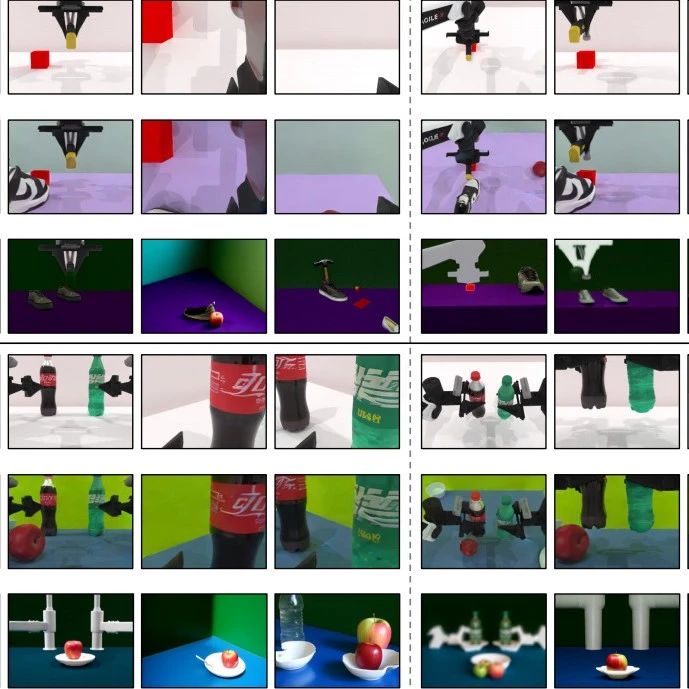
Core Insights - The article discusses the limitations of current data collection methods for robotic imitation learning, particularly the scarcity and high cost of high-quality 4D multi-view sequence images, which restrict the generalization and application of embodied intelligence strategies like visual-language-action (VLA) [4] - A new data augmentation framework called ERMV (Editing Robotic Multi-View 4D data) is introduced, which efficiently edits entire multi-view sequences based on single-frame editing and robot state conditions, addressing key challenges in the field [6] Research Background - The reliance on high-quality 4D multi-view sequence images for robotic imitation learning is highlighted, with existing data augmentation methods being inadequate for the needs of VLA models [4] Core Challenges and Solutions - ERMV addresses three main challenges: ensuring geometric and appearance consistency over dynamic views and long time ranges, expanding the working window under low computational costs, and maintaining semantic integrity of key objects like robotic arms [6] Visual Guidance Condition - ERMV employs a visual guidance strategy to overcome ambiguities in text prompts for image editing, using a globally informative frame as a visual blueprint to ensure consistent editing across all views and time steps [7] Robotic and Camera State Injection - The framework injects explicit state information to accurately render scenes from the robot's camera perspective, enhancing the model's performance [9] Sparse Spatio-Temporal Module (SST) - SST reduces computational costs by transforming the long sequence problem into a single-frame multi-view problem through sparse sampling, allowing the model to handle wider time ranges within fixed computational budgets [10] Epipolar Motion-Aware Attention (EMA-Attn) - EMA-Attn addresses the challenge of maintaining geometric consistency in sparse frames by learning motion-induced pixel offsets, ensuring robust cross-view correspondence in dynamic scenes [14] Feedback Intervention Mechanism - ERMV introduces a feedback intervention mechanism to mitigate quality degradation in long sequence editing due to error accumulation, utilizing a multi-modal large language model for consistency checks [21] Experimental Validation - ERMV demonstrates significant improvements in editing performance over traditional methods in simulation environments, with metrics such as SSIM, PSNR, and LPIPS showing superior results [25] - In real-world experiments, ERMV enhances the success rates of robotic tasks, indicating its robustness and effectiveness in practical applications [30] Extended Capabilities - The framework can predict and generate corresponding multi-view spatiotemporal image sequences based on initial images and action sequences, serving as a low-cost strategy validation tool [35] - ERMV effectively bridges the sim-to-real gap by editing simulation images to generate "pseudo-real" 4D trajectories, reducing reliance on high-fidelity physical simulations [37] Ablation Studies - The necessity of motion information injection is validated through experiments showing that removing motion dynamic conditions leads to a failure in generating realistic motion blur [39] - SST's ability to expand the working window while reducing GPU memory requirements is confirmed, enhancing model performance [41]