EfficientFlow

Search documents
56倍加速生成式策略:EfficientFlow,迈向高效具身智能
具身智能之心· 2025-12-17 00:05
Core Insights - The article discusses the development of a new generative policy learning method called EfficientFlow, which addresses key limitations in embodied AI and robotics, particularly in data efficiency and inference speed [1][3]. Group 1: Key Innovations - EfficientFlow integrates equivariant modeling with flow matching to enhance data efficiency and significantly reduce the number of iterations required during inference, achieving state-of-the-art (SOTA) performance across multiple robotic operation benchmarks [1][3]. - The method introduces an acceleration regularization term in its loss function to encourage smoother and faster trajectory generation, inspired by physical intuition that real-world movements typically have low acceleration [5][6]. - EfficientFlow employs an equivariant network design that allows the model to generalize actions across different orientations of visual scenes, effectively multiplying the data utility from a single observation [9][10]. Group 2: Technical Mechanisms - The flow acceleration bound (FABO) is introduced as an easily computable proxy loss that helps regularize the model's generated strategies, enhancing stability and robustness [7][8]. - A time-consistency strategy is implemented to ensure coherent action sequences over time, utilizing overlapping predictions to maintain continuity in the generated actions [15][16]. - The model's inference efficiency is highlighted, with EfficientFlow achieving a 56-fold speed increase in single-step inference compared to existing methods, while also demonstrating competitive performance with fewer data and iterations [17].

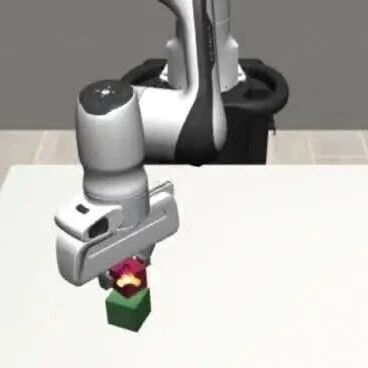
56倍加速生成式策略:西交大提出EfficientFlow,迈向高效具身智能
机器之心· 2025-12-16 04:11
Core Insights - The article discusses the development of a new generative policy learning method called EfficientFlow, which addresses two major challenges in embodied AI: reliance on large-scale demonstration data and slow inference times [2][3]. Group 1: Technical Highlights - EfficientFlow integrates equivariant modeling with efficient flow matching, significantly improving data efficiency and reducing the number of iterations required for inference, achieving state-of-the-art (SOTA) performance across multiple robotic operation benchmarks [2][19]. - The method introduces an acceleration regularization term in the loss function to encourage smoother and faster trajectory generation, inspired by physical intuition that smooth movements typically have low acceleration [6][19]. - The model employs equivariant networks that allow it to generalize learned actions across different orientations, effectively multiplying the data utility by enabling the model to learn from a single perspective and apply it to various rotations [11][19]. Group 2: Inference Efficiency - EfficientFlow demonstrates remarkable inference efficiency, achieving near-equivalent performance to existing SOTA methods with significantly fewer data and iterations. For instance, it reaches close to the performance of EquiDiff with 100 iterations in just 1 step, resulting in a 56-fold increase in single-step inference speed and nearly 20 times faster for 5-step inference [19]. - The model incorporates a time consistency strategy to ensure coherent action sequences during execution, utilizing overlapping predictions to maintain continuity in behavior [15][19]. - Periodic resets are implemented to enhance the model's ability to explore diverse behaviors while maintaining time consistency, ensuring minimal additional overhead during inference [17][19].