FARS(Fully Automated Research System)

Search documents
MOSS孙天祥新公司要让AI自己写100篇论文,还要全网直播一个月
3 6 Ke· 2026-02-12 09:52
Core Insights - The article discusses a month-long live demonstration of an AI system named FARS, which aims to autonomously conduct the entire research process, producing 100 complete research papers without human intervention [1][20]. Company Overview - Analemma, the company behind FARS, was founded less than a year ago and has secured tens of millions of dollars in angel funding from notable investors such as Sequoia China and Meituan [1]. - The founder, Tianxiang Sun, was a key developer of MOSS, a significant model in the AI field, which gained attention for its capabilities [11][12]. Technology and Architecture - FARS, or Fully Automated Research System, is a multi-agent system composed of four modules: Ideation, Planning, Experiment, and Writing, which collaborate in a shared file system [2][4]. - The system utilizes APIs from various closed-source models, including Claude, GPT, and Gemini, along with self-developed models for certain tasks [5]. Research Focus and Methodology - FARS focuses on AI research itself, allowing for fully automated experiments that do not require physical laboratories [8]. - The system is designed to produce "short papers" that emphasize clear hypotheses and reliable validation, diverging from traditional academic publishing norms [7]. Quality Control and Evaluation - Each paper produced by FARS will undergo review by at least three team members with over five years of research experience before being uploaded to arXiv, ensuring a level of quality control [8]. - The team plans to invite peer reviews rather than submitting to traditional academic conferences, focusing on the practical citation and value of the results [8]. Competitive Landscape - FARS is part of a growing trend in automated research systems, competing with others like Sakana AI's AI Scientist and AI-Researcher from Hong Kong University [17][19]. - Unlike its competitors, FARS aims for real-time, large-scale, and fully transparent public deployment, which is a bold move in the field [19]. Future Directions - The live demonstration of FARS will begin on the company's website and social media platforms, marking a significant step in evaluating the system's capabilities [20]. - The results of this experiment could provide insights into the potential of AI to conduct research autonomously, a question that remains to be answered through the quality of the 100 papers produced [20][21].

刚刚,MOSS孙天祥创业,直播AI4AI大规模科研
3 6 Ke· 2026-02-12 09:12
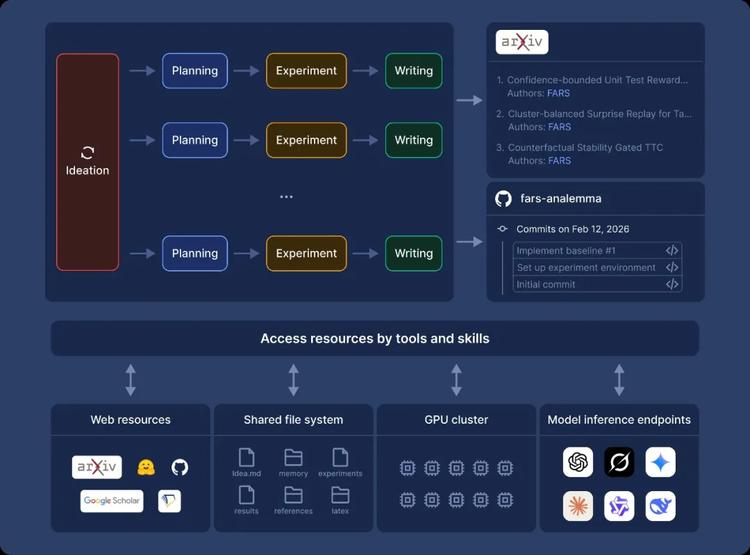
Core Viewpoint - Analemma, a startup led by Dr. Sun Tianxiang, is set to conduct a groundbreaking live broadcast of its Fully Automated Research System (FARS), aiming to autonomously produce 100 research papers over the course of a month, marking a significant milestone in AI-driven research [2][21]. Group 1: FARS Overview - FARS is designed as a fully automated research system that operates without human intervention, capable of conducting literature reviews, hypothesis generation, coding, experimental execution, and paper writing [5][7]. - The system consists of four intelligent agent modules: Ideation, Planning, Experiment, and Writing, interconnected through a shared file system that serves as both a workspace and memory [8][10]. Group 2: Live Broadcast Details - The live broadcast will showcase the deployment of FARS, with the goal of completing 100 research papers, and will be available for viewing at https://analemma.ai/fars/ [4][2]. - The broadcast is expected to be a unique event in the AI field, with the potential for both successful outcomes and unexpected challenges [2][4]. Group 3: Research Directions and Infrastructure - Suggested research directions for FARS include reinforcement learning with verifiable rewards, automated evaluation of advanced language models, and innovations beyond Transformer architectures, among others [10]. - Analemma has invested in a powerful infrastructure, including a cluster of 160 GPUs, to support the FARS system in its ambitious goal [10][12]. Group 4: Team Background and Funding - Analemma's team is notably young, with an average age under 30, and includes key contributors to major AI models like MOSS and InternLM [19][21]. - The company has successfully completed a multi-million dollar angel round of funding from notable investors, indicating strong financial backing for its innovative projects [21].

刚刚,MOSS孙天祥创业,直播AI4AI大规模科研
机器之心· 2026-02-12 04:00
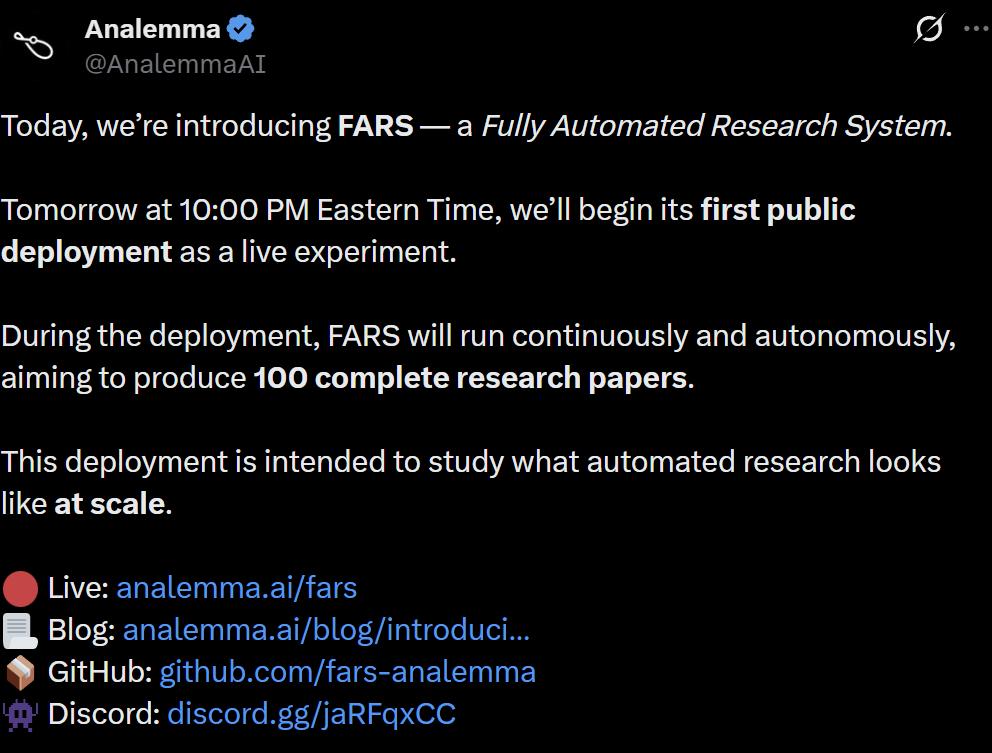
Core Viewpoint - Analemma, a startup team, is set to conduct a groundbreaking live broadcast of their Fully Automated Research System (FARS), aiming to autonomously produce 100 research papers over a month-long period, marking a significant milestone in AI-driven research [2][3][4]. Group 1: FARS Overview - FARS is designed as an end-to-end research system that operates without human intervention, automating the entire research process from literature review to hypothesis generation, coding, experimentation, and writing [11][13]. - The system consists of four intelligent agents: Ideation, Planning, Experiment, and Writing, which are interconnected through a shared file system that serves as both a workspace and memory [15][18]. - The project aims to explore various research directions, including reinforcement learning, automated evaluation of large language models, and innovations beyond Transformer architectures [19]. Group 2: Team and Background - Analemma, founded by Dr. Tianxiang Sun, has a young team with an average age under 30, many of whom have contributed to significant AI models like MOSS and InternLM [26][32]. - The company has successfully raised tens of millions of dollars in angel funding from notable investors, indicating strong financial backing and confidence in their innovative approach [34]. Group 3: Expectations and Future Outlook - The team expresses both excitement and apprehension about the outcomes of their first large-scale public experiment with FARS, predicting that its citation count will surpass that of its creators by the end of 2026 [34]. - The live broadcast is anticipated to showcase the capabilities of AI in conducting research autonomously, potentially transforming the landscape of scientific inquiry [35][36].