
AI4AI

Search documents
MOSS孙天祥新公司要让AI自己写100篇论文,还要全网直播一个月
3 6 Ke· 2026-02-12 09:52
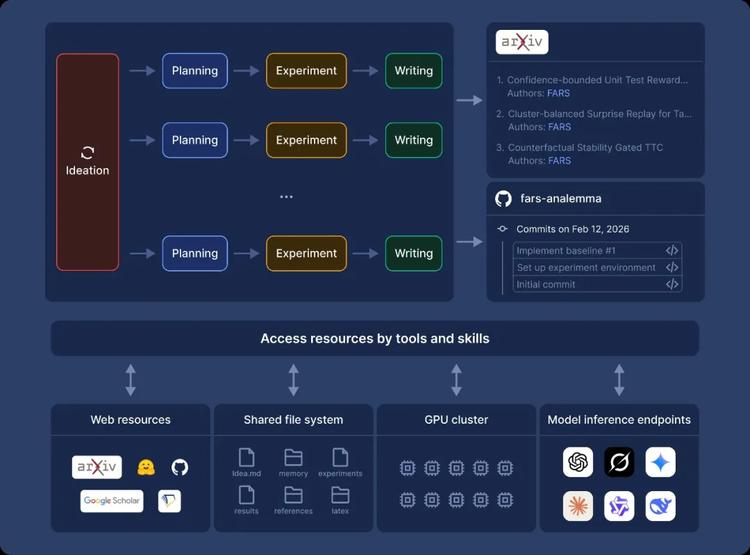
Core Insights - The article discusses a month-long live demonstration of an AI system named FARS, which aims to autonomously conduct the entire research process, producing 100 complete research papers without human intervention [1][20]. Company Overview - Analemma, the company behind FARS, was founded less than a year ago and has secured tens of millions of dollars in angel funding from notable investors such as Sequoia China and Meituan [1]. - The founder, Tianxiang Sun, was a key developer of MOSS, a significant model in the AI field, which gained attention for its capabilities [11][12]. Technology and Architecture - FARS, or Fully Automated Research System, is a multi-agent system composed of four modules: Ideation, Planning, Experiment, and Writing, which collaborate in a shared file system [2][4]. - The system utilizes APIs from various closed-source models, including Claude, GPT, and Gemini, along with self-developed models for certain tasks [5]. Research Focus and Methodology - FARS focuses on AI research itself, allowing for fully automated experiments that do not require physical laboratories [8]. - The system is designed to produce "short papers" that emphasize clear hypotheses and reliable validation, diverging from traditional academic publishing norms [7]. Quality Control and Evaluation - Each paper produced by FARS will undergo review by at least three team members with over five years of research experience before being uploaded to arXiv, ensuring a level of quality control [8]. - The team plans to invite peer reviews rather than submitting to traditional academic conferences, focusing on the practical citation and value of the results [8]. Competitive Landscape - FARS is part of a growing trend in automated research systems, competing with others like Sakana AI's AI Scientist and AI-Researcher from Hong Kong University [17][19]. - Unlike its competitors, FARS aims for real-time, large-scale, and fully transparent public deployment, which is a bold move in the field [19]. Future Directions - The live demonstration of FARS will begin on the company's website and social media platforms, marking a significant step in evaluating the system's capabilities [20]. - The results of this experiment could provide insights into the potential of AI to conduct research autonomously, a question that remains to be answered through the quality of the 100 papers produced [20][21].

刚刚,MOSS孙天祥创业,直播AI4AI大规模科研
3 6 Ke· 2026-02-12 09:12
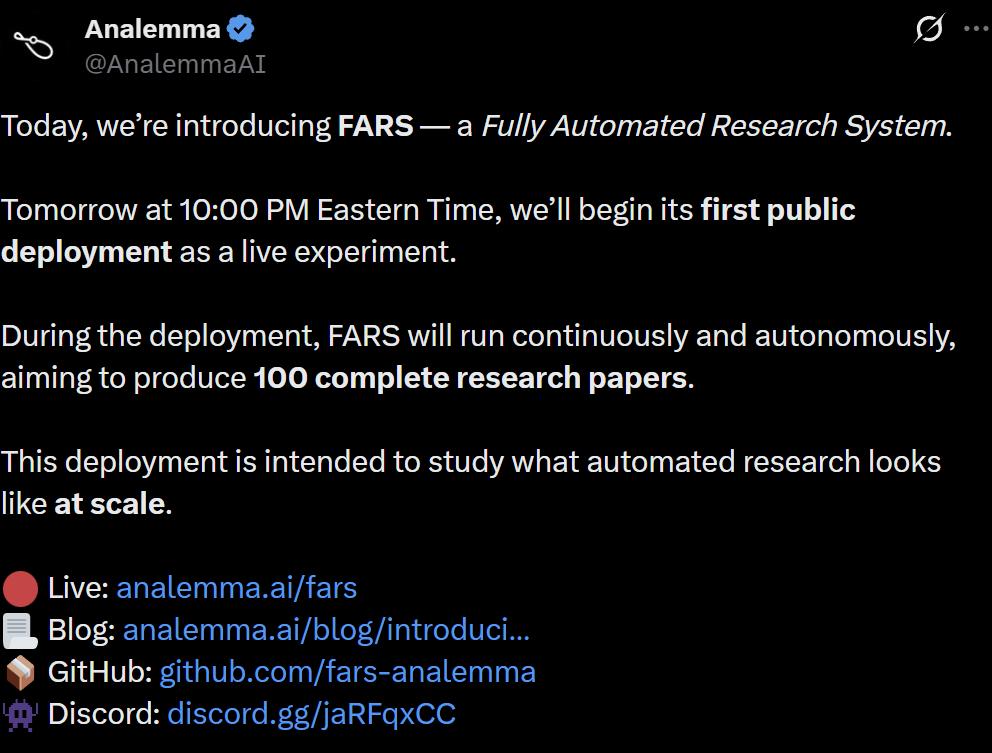
Core Viewpoint - Analemma, a startup led by Dr. Sun Tianxiang, is set to conduct a groundbreaking live broadcast of its Fully Automated Research System (FARS), aiming to autonomously produce 100 research papers over the course of a month, marking a significant milestone in AI-driven research [2][21]. Group 1: FARS Overview - FARS is designed as a fully automated research system that operates without human intervention, capable of conducting literature reviews, hypothesis generation, coding, experimental execution, and paper writing [5][7]. - The system consists of four intelligent agent modules: Ideation, Planning, Experiment, and Writing, interconnected through a shared file system that serves as both a workspace and memory [8][10]. Group 2: Live Broadcast Details - The live broadcast will showcase the deployment of FARS, with the goal of completing 100 research papers, and will be available for viewing at https://analemma.ai/fars/ [4][2]. - The broadcast is expected to be a unique event in the AI field, with the potential for both successful outcomes and unexpected challenges [2][4]. Group 3: Research Directions and Infrastructure - Suggested research directions for FARS include reinforcement learning with verifiable rewards, automated evaluation of advanced language models, and innovations beyond Transformer architectures, among others [10]. - Analemma has invested in a powerful infrastructure, including a cluster of 160 GPUs, to support the FARS system in its ambitious goal [10][12]. Group 4: Team Background and Funding - Analemma's team is notably young, with an average age under 30, and includes key contributors to major AI models like MOSS and InternLM [19][21]. - The company has successfully completed a multi-million dollar angel round of funding from notable investors, indicating strong financial backing for its innovative projects [21].

刚刚,MOSS孙天祥创业,直播AI4AI大规模科研
机器之心· 2026-02-12 04:00
Core Viewpoint - Analemma, a startup team, is set to conduct a groundbreaking live broadcast of their Fully Automated Research System (FARS), aiming to autonomously produce 100 research papers over a month-long period, marking a significant milestone in AI-driven research [2][3][4]. Group 1: FARS Overview - FARS is designed as an end-to-end research system that operates without human intervention, automating the entire research process from literature review to hypothesis generation, coding, experimentation, and writing [11][13]. - The system consists of four intelligent agents: Ideation, Planning, Experiment, and Writing, which are interconnected through a shared file system that serves as both a workspace and memory [15][18]. - The project aims to explore various research directions, including reinforcement learning, automated evaluation of large language models, and innovations beyond Transformer architectures [19]. Group 2: Team and Background - Analemma, founded by Dr. Tianxiang Sun, has a young team with an average age under 30, many of whom have contributed to significant AI models like MOSS and InternLM [26][32]. - The company has successfully raised tens of millions of dollars in angel funding from notable investors, indicating strong financial backing and confidence in their innovative approach [34]. Group 3: Expectations and Future Outlook - The team expresses both excitement and apprehension about the outcomes of their first large-scale public experiment with FARS, predicting that its citation count will surpass that of its creators by the end of 2026 [34]. - The live broadcast is anticipated to showcase the capabilities of AI in conducting research autonomously, potentially transforming the landscape of scientific inquiry [35][36].
AI动态汇总:上交AI智能体表现亮眼,AlphaEvolve生成代码反超人类
China Post Securities· 2025-07-08 14:03
Quantitative Models and Construction Methods Model Name: ML-Master - **Model Construction Idea**: The ML-Master model is designed to simulate human expert cognitive strategies, addressing the three major bottlenecks in existing AI4AI systems: low exploration efficiency, limited reasoning ability, and module fragmentation[12] - **Model Construction Process**: - **Balanced Multi-Trajectory Exploration Module**: Utilizes a parallelized Monte Carlo tree search to model the AI development process as a dynamic decision tree, with each node representing a potential solution state. This module dynamically allocates computing resources based on the potential value of 75 Kaggle task branches, avoiding local optima and improving medium difficulty task medal rates to 20.2%, 2.2 times the baseline method[13] - **Controllable Reasoning Module**: Overcomes the static decision limitations of large language models by filtering key code fragments, performance metrics, and cross-node insights from historical explorations through an adaptive memory mechanism. This ensures the reasoning process is based on verifiable execution feedback rather than probabilistic guesses, improving high difficulty task performance by 30%, significantly surpassing Microsoft's system's 18.7%[13] - **Adaptive Memory Mechanism**: Integrates the exploration and reasoning modules, creating a closed-loop evolution system. The results of code execution collected during the exploration phase are embedded into the reasoning model's "think" phase after intelligent filtering, and the optimized solutions from the reasoning output guide subsequent exploration paths. This dual empowerment allows ML-Master to reach the Grandmaster level among the top 259 global Kaggle participants after 900 machine hours of training, with solution quality improving by 120% over multiple iterations[15] - **Model Evaluation**: The ML-Master model demonstrates significant advantages in exploration efficiency, reasoning ability, and module integration, making it a leading system in the AI4AI field[12][13][15] Model Backtesting Results - **ML-Master**: - **Average Medal Rate**: 29.3%[12] - **Effective Submission Rate**: 93.3%[19] - **Task Performance**: 44.9% of tasks outperform more than half of human participants, with 17.3% of tasks winning gold medals[19] Quantitative Factors and Construction Methods Factor Name: OpenEvolve - **Factor Construction Idea**: OpenEvolve is designed to autonomously evolve code, achieving significant performance improvements in GPU kernel optimization tasks[22] - **Factor Construction Process**: - **Algorithm Layer**: Through 25 generations of evolutionary iterations, OpenEvolve autonomously discovered three key optimization strategies. For example, the SIMD optimization for Apple Silicon demonstrated the system's precise grasp of hardware characteristics, perfectly matching the hardware's SIMD width when processing 128-dimensional attention heads[23] - **Technical Implementation**: Utilizes a multi-model collaborative evolutionary architecture. The main model, Gemini-2.5-Flash, is responsible for rapid exploration, while the auxiliary model, Gemini-2.5-Pro, performs deep optimization. The system divides the Metal kernel function source code into evolvable blocks, retaining the integration code with the MLX framework unchanged, and evolves five subpopulations in parallel using the island model, with each generation having a population size of 25 individuals[24] - **Performance Evaluation**: The evaluation phase adopts a high-robustness design, including Metal command buffer protection, memory access violation handling, and exponential backoff retry mechanisms, ensuring the system can boldly attempt aggressive optimizations without worrying about crashes[25] - **Factor Evaluation**: OpenEvolve redefines the boundary of human-machine collaboration, demonstrating the potential for AI to autonomously explore optimization paths that require deep professional knowledge[22][23][24] Factor Backtesting Results - **OpenEvolve**: - **Average Performance Improvement**: 12.5% in decoding speed, 14.4% in pre-filling speed, and 10.4% in overall throughput[25] - **Peak Performance Improvement**: 106% in decoding speed for repetitive pattern generation tasks[25] - **Accuracy and Error Rate**: Maintains 100% numerical accuracy and zero GPU errors[25]