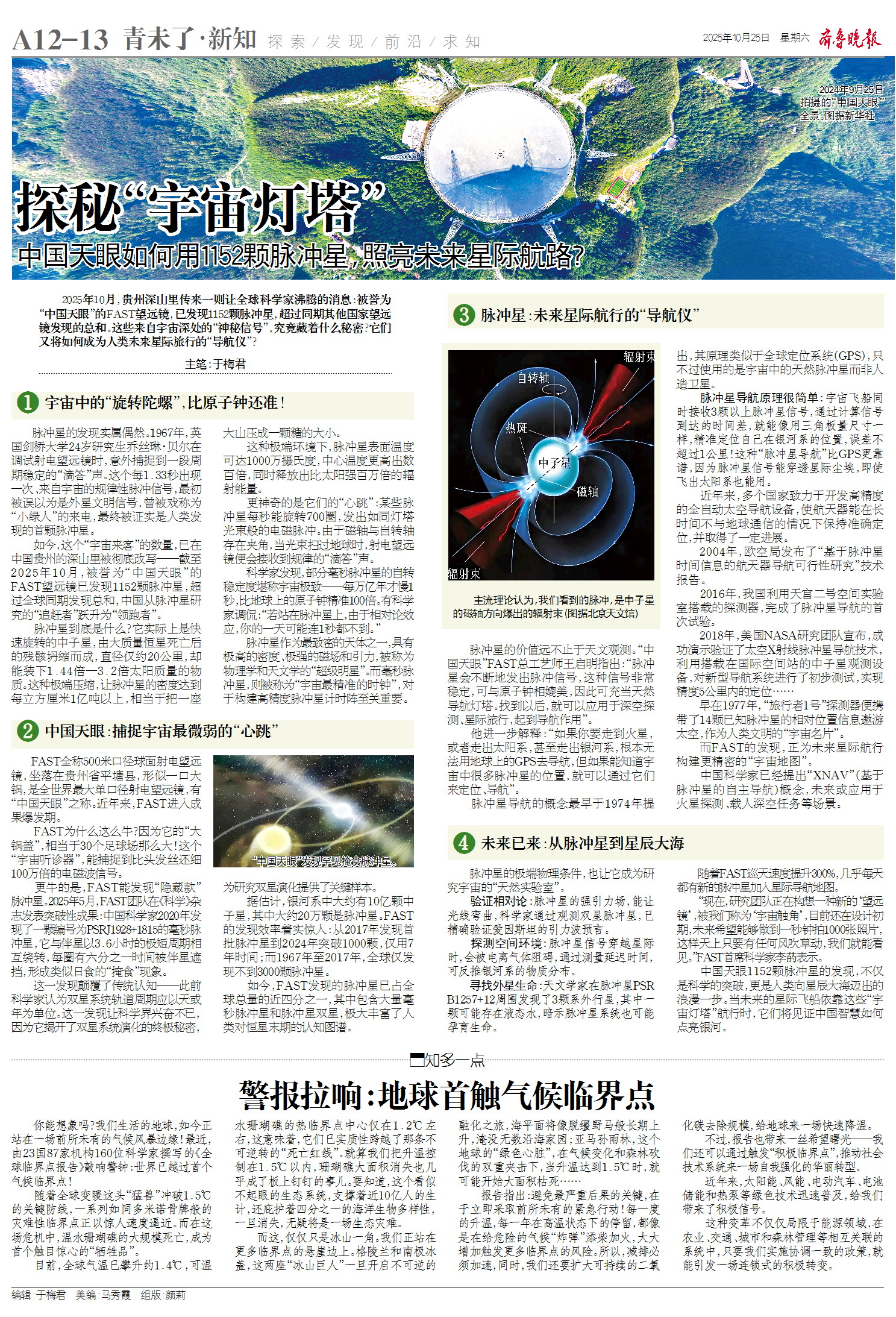
FAST望远镜

Search documents
立竿见影,原来古人这样测四时节气(字载匠心·惊艳时光的中国智慧)
Ren Min Ri Bao Hai Wai Ban· 2025-12-23 22:59
Core Viewpoint - The article discusses the historical significance and scientific contributions of the ancient Chinese astronomical instrument, the gnomon, which reflects the pursuit of scientific exploration and the integration of human civilization with the cosmos [6][12]. Group 1: Measurement of Time - In ancient times, the Chinese viewed the night sky as a "heavenly clock," leading to the development of the gnomon for measuring time based on the sun's shadow [7]. - The gnomon consists of two parts: the "gnomon" (a vertical stick) and the "scale" (a horizontal base with markings) [7]. - The earliest known gnomon was discovered at the Shanxi Taosi site, dating back approximately 4,300 to 4,000 years [7][8]. Group 2: Calendar Development - The need for a unified time standard for coordinating activities led to the establishment of calendars based on astronomical observations [9]. - The gnomon was crucial for observing the sun's shadow changes, which provided data for creating calendars, including the 24 solar terms [9]. - The 24 solar terms were documented in the Han Dynasty, indicating a well-established system that integrated astronomy, agriculture, and social practices [9]. Group 3: Continuous Exploration - The gnomon was not only a time-measuring tool but also essential for determining geographical orientation and site selection for capitals [10]. - The peak of Chinese astronomy occurred during the Yuan Dynasty, where advancements in gnomon design significantly improved measurement accuracy [10]. - The construction of the Star Observatory in Dengfeng, led by Guo Shoujing, exemplified these advancements, featuring a large gnomon that enhanced observational precision [10][11]. Group 4: Historical Impact - The gnomon transcended mere measurement, symbolizing the legitimacy and sacred order of dynasties in ancient China [12]. - The term "guinance" originated from the gnomon, representing standards and principles, reflecting its cultural significance [12]. - Despite modern advancements in astronomy, the wisdom embodied in the gnomon continues to inspire contemporary exploration of the cosmos [13].


新知|脉冲星:未来星际航行的“导航仪”
Qi Lu Wan Bao· 2025-10-25 06:28
Core Viewpoint - The FAST telescope in Guizhou, China, has discovered 1,152 pulsars by October 2025, surpassing the total number discovered by other countries during the same period, marking China's transition from a follower to a leader in pulsar research [12][18]. Group 1: Pulsar Characteristics - Pulsars are rapidly rotating neutron stars formed from the remnants of massive stars, with a diameter of about 20 kilometers and a mass 1.44 to 3.2 times that of the Sun [12][14]. - The density of pulsars exceeds 100 million tons per cubic centimeter, and their surface temperatures can reach 10 million degrees Celsius [12]. - Some millisecond pulsars have an incredible rotational stability, losing only one second over a trillion years, making them 100 times more accurate than atomic clocks [14] [18]. Group 2: FAST Telescope Capabilities - The FAST telescope, with a diameter of 500 meters, is the world's largest single-dish radio telescope, capable of detecting electromagnetic signals a million times thinner than a human hair [15]. - FAST's sensitivity is 2.5 times greater than that of other telescopes, allowing it to discover pulsars at an unprecedented rate [15][17]. - From its first pulsar discovery in 2017 to surpassing 1,000 by 2024, FAST's efficiency is remarkable compared to the global total of fewer than 3,000 pulsars discovered from 1967 to 2017 [17]. Group 3: Pulsar Navigation Potential - Pulsars emit stable signals that can serve as natural navigation beacons for deep space exploration, akin to GPS systems on Earth [18][20]. - The concept of pulsar navigation allows spacecraft to determine their position in the galaxy with an accuracy of less than one kilometer by receiving signals from three or more pulsars [20]. - The development of pulsar-based navigation systems is being pursued by multiple countries, with successful tests already conducted by China and NASA [23]. Group 4: Scientific Implications - Pulsars serve as natural laboratories for studying extreme physical conditions, validating theories such as Einstein's predictions about gravitational waves [25]. - The signals from pulsars can help map the distribution of matter in the Milky Way by measuring delays caused by ionized gas [25]. - Discoveries around pulsars may also indicate the potential for extraterrestrial life, as evidenced by the detection of exoplanets in pulsar systems [25]. Group 5: Future Developments - The FAST team is conceptualizing a new type of telescope, referred to as "cosmic tentacles," aimed at significantly increasing the speed of pulsar discovery [27]. - The ongoing discoveries of pulsars will contribute to a more precise cosmic map, facilitating future interstellar travel and exploration [27].