
Fast LCD屏幕

Search documents
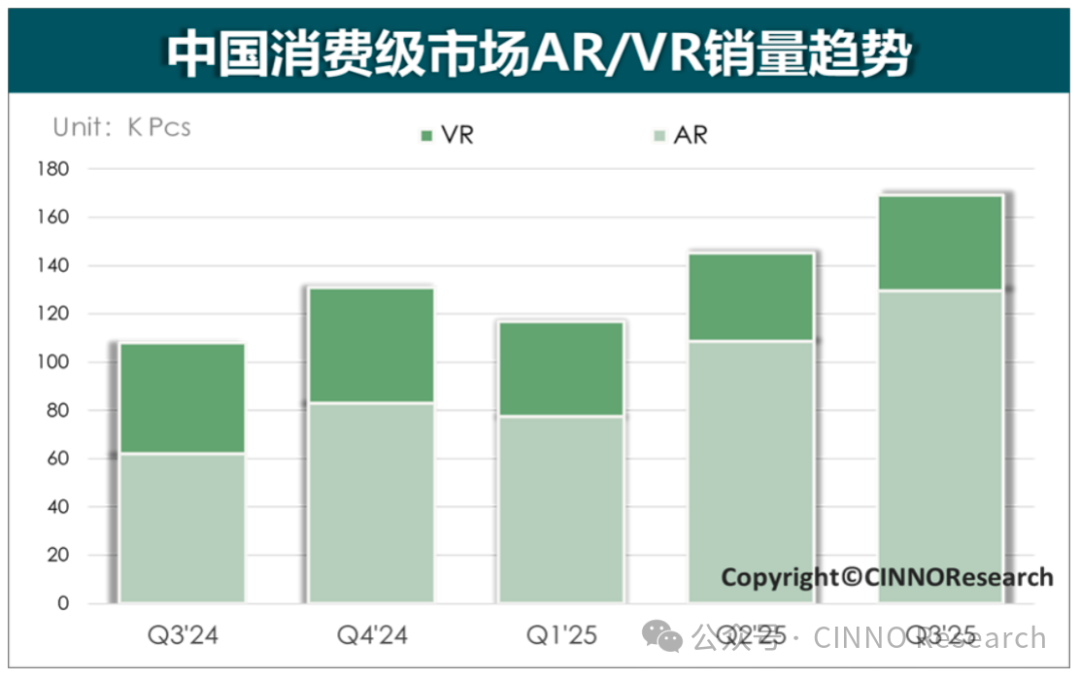
CINNO Research:第三季度国内消费级XR市场销量达16.9万台 同比增长57%
Zhi Tong Cai Jing· 2025-11-12 23:49
Core Insights - The Chinese consumer-grade AR/VR glasses market is projected to reach sales of 169,000 units in Q3 2025, reflecting a quarter-over-quarter growth of 17% and a year-over-year growth of 57% driven by new AR device launches, cost optimization in the supply chain, and deep integration of AI technology [1][3]. Market Performance - The overall XR market in China reached 169,000 units in Q3 2025, with a 17% increase from the previous quarter and a 57% increase year-over-year. Consumer-grade AR devices were the main growth driver, achieving sales of 130,000 units, a 109% year-over-year increase. VR device sales reached 40,000 units, with an 8% quarter-over-quarter growth, supported by Meta's low-price strategy [3][4]. Technological Innovations - Fast LCD screens have captured 91% of the market share in the mid-to-low-end VR segment, with BOE holding a leading position at 43%. Micro OLED technology, despite facing high costs and ecosystem adaptation challenges, remains significant in the high-end market with a 73% share in AR devices. The introduction of LCoS technology by Meta Display is expected to boost sales in the short term [4][5]. Brand Dynamics - The AR market is led by Thunder, which continues to innovate and recently launched the AIR4 and AIR4PRO models featuring HDR display technology and AI 3D video capabilities. Rokid has emerged as a strong competitor with its new Rokid Glasses, ranking second in sales [5][6]. Investment Trends - In Q3 2025, the global AR/VR industry saw 33 financing deals totaling approximately 5.5 billion yuan, with 18 deals occurring in China. Companies in the upstream hardware and terminal sectors are attracting significant investment, indicating a strong interest in the future of AR/VR technology. The integration of AI is expected to enhance the interactivity and applicability of AR/VR devices, driving further digital transformation [7].

机构预测:2025年国内消费级XR整体销量同比增长6.5% 主要受AR设备带动
Feng Huang Wang· 2025-08-19 09:47
Core Insights - The domestic XR consumer market in China is experiencing a significant divergence, with VR device sales declining while AR device sales are growing rapidly [1] VR Market - In the first half of 2025, domestic consumer-grade VR device sales reached only 75,000 units, marking the lowest sales for the same period in nearly three years [2] - The decline is attributed to insufficient investment in the domestic VR content ecosystem and a lack of major new product releases [2] - The market share is relatively stable, with PICO leading at 46%, followed by Meta at 28%, and Goovis at 7% [2] - Major VR manufacturers are focusing on cost control and ecosystem integration to maintain their core market shares [2] - Fast LCD screens regained an 87% market share in VR devices, while Micro OLED screens remain primarily in high-end products [2] AR Market - In contrast to VR, domestic consumer-grade AR device sales reached 186,000 units in the first half of 2025, showing a year-on-year growth of 35% and a quarter-on-quarter growth of 28% [3] - This growth is driven by the continuous release of new AR glasses and government subsidies combined with promotional events like the "618" e-commerce festival [3] - The AR market is becoming increasingly competitive, with Thunder Innovation leading at 35% market share, followed by XREAL at 22% and Xingji Meizu in third place [3] - Micro OLED screens dominate the AR device market with an 87% share, while domestic screen manufacturer Visionary Technology has increased its market share by 30 percentage points through partnerships [3] - The market share for waveguide technology remains stable at 13%, with companies like Kunyou Optoelectronics and Zhige Technology reducing costs and enhancing product features [3] Annual Forecast - CINNO Research predicts that the overall sales of domestic consumer-grade XR devices will reach 606,000 units in 2025, representing a year-on-year growth of 6.5%, primarily driven by the continued strength of AR devices [4]