
Hardwood Pulp

Search documents
MERC vs IP: Paper and Packaging Giants Go Head-to-Head
247Wallst· 2026-03-17 13:25
Core Insights - Mercer International (MERC) reported a significant Q4 loss with an EPS of -$4.61, missing the consensus estimate of -$0.83, primarily due to a $238.7 million impairment on its Peace River hardwood pulp mill [5][6][7] - International Paper (IP) achieved an adjusted EBITDA of $859 million, a 28% sequential increase, while divesting its Global Cellulose Fibers business for $1.5 billion, aiming to transition into a pure-play global packaging company [5][9][10] Company Performance - Mercer International's revenue for Q4 was $449.5 million, with shareholders' equity plummeting to $68 million, down 84% year-over-year, and total liabilities at $1.97 billion against total assets of $2.04 billion [7][5] - International Paper's revenue for Q3 was $6.22 billion, with adjusted EBITDA of $859 million and operating cash flow of $605 million, indicating a stronger financial position despite facing restructuring charges [6][7] Strategic Direction - Mercer is facing existential pressure due to a downturn in the commodity pulp cycle, with CEO Juan Carlos Bueno indicating that the company is considering all options regarding its Peace River mill asset [2][8] - International Paper is strategically exiting low-margin pulp assets to focus on building a diversified packaging business, with CEO Andy Silvernail emphasizing the commitment to their transformation plan [2][9] Market Position and Outlook - Mercer trades at $1.46, down approximately 76% over the past year, while International Paper trades at $37.54, down about 24% in the same period, highlighting the contrasting financial health and strategic positioning of the two companies [13] - The future for Mercer hinges on the recovery of pulp prices and the success of its cost-saving program, while International Paper's focus on packaging may provide it with better pricing leverage and market stability [11][12]




全球纸浆与造纸- 全球纸浆库存:硬件出货量上升,库存下降-Global Pulp & Paper_ Global pulp inventories – HW shipments up, inventories down
2026-03-03 08:28
Summary of Global Pulp & Paper Equities Conference Call Industry Overview - The report focuses on the global pulp and paper industry, specifically analyzing hardwood (HW) and softwood (SW) pulp dynamics and inventory levels [1][8]. Key Points Pulp Inventory and Shipments - Total pulp mill inventories increased by two days month-over-month (m-o-m) in January, reaching 43 days, which aligns with the five-year average for January [1] - Hardwood inventories rose by two days m-o-m to 39 days, which is five days below the five-year monthly average [1] - Softwood inventories increased by three days m-o-m to 50 days, exceeding the five-year monthly average by seven days [1] Hardwood Pulp Dynamics - Hardwood shipments increased by 3.5% year-over-year (y-o-y) in January, with notable increases in North America (+23.8%, +60k tons), Other Asia/Africa (+10.4%, +36k tons), Latin America (+16.1%, +35k tons), and China (+2.9%, +27k tons) [2] - The operating rate for hardwood averaged 85% in January, up 3 percentage points (ppt) y-o-y [2] - Global demand for hardwood is expected to ease in 2026 after a strong performance driven by substitution and inventory effects [2] Softwood Pulp Dynamics - Softwood shipments declined by 5.5% y-o-y in January, with decreases reported across all regions except Latin America (+3.2%, +2k tons) [3] - Significant declines were noted in North America (-11.3%, -39k tons) and Western Europe (-7.7%, -29k tons) [3] - The operating rate for softwood averaged 87% in January, down 3 ppt y-o-y [3] Supply and Demand Dynamics - The lower shipments of hardwood pulp in January were attributed to weaker sales of bleached softwood and unbleached kraft pulp, leading to increased inventories [4] - Supply disruptions are improving hardwood pulp dynamics, with Suzano announcing price hikes for shipments to Asia and other regions [5] - Factors contributing to improved dynamics include Suzano's decision to produce approximately 3.5% below its nominal annual capacity in 2026, the revocation of a forestry concession license in Indonesia, and delays in the startup of APP's Oki project [5] - No new supply is expected to start this year, which is anticipated to result in higher pulp prices through 2026 [5] Market Data - Total shipments in January were reported at 4,562k tons, a decrease of 14.7% m-o-m [9] - The capacity utilization rate for total pulp was 86%, down 12 ppt from the previous month [9] - Specific regional data showed North America with 636k tons shipped, Western Europe with 888k tons, and China with 1,701k tons, all reflecting varying degrees of decline [9] Additional Insights - The report indicates a gradual improvement in hardwood pulp industry dynamics due to supply constraints, which may lead to increased prices in the near future [5] - The overall market sentiment reflects cautious optimism regarding hardwood pulp, while softwood pulp faces challenges due to declining shipments [3][5] This summary encapsulates the key findings and insights from the conference call regarding the global pulp and paper industry, highlighting both opportunities and challenges within the sector.
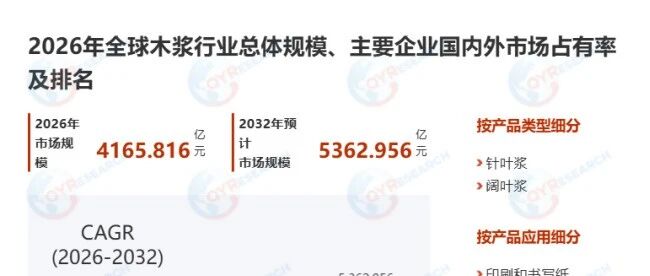
行业聚焦:全球木浆市场规模及主要企业排名情况
QYResearch· 2026-03-02 02:01
Core Insights - The global wood pulp market is projected to reach $78.89 billion by 2032, with a compound annual growth rate (CAGR) of 4.3% over the coming years [4][20]. Market Overview - Wood pulp is the most commonly used pulp, derived from wood processed into a form suitable for various paper products, including printing paper, magazines, and household items [2]. - The top five global wood pulp manufacturers are expected to hold approximately 38.0% of the market share by 2025 [6]. Product Type Segmentation - Hardwood pulp currently represents the largest demand source, accounting for about 55.5% of the market share [8]. Application Segmentation - Printing and writing paper is the leading application segment, capturing approximately 55.9% of the market share [10]. Key Drivers - The exponential growth of online retail has significantly increased the demand for corrugated boxes and shipping containers, which rely heavily on virgin and recycled pulp [13]. - The trend of replacing plastic with paper in food packaging and shopping bags is accelerating due to plastic bans and corporate sustainability commitments [13]. - Rising disposable incomes in emerging markets are driving demand for high-quality folding cartons used in cosmetics and consumer goods [13]. - Population growth and aging demographics are contributing to stable demand for adult incontinence products [13]. - Increasing hygiene standards in developing countries are boosting the consumption of sanitary products like toilet paper and tissues [13]. Major Challenges - The digitalization trend has led to a permanent decline in demand for newsprint, magazines, and office paper, posing a significant structural challenge [15]. - The closure or conversion of printing paper mills by major producers has resulted in substantial capital expenditures and asset impairments [15]. - The shift in demand from traditional paper products to packaging and specialty uses requires costly grade conversions [15]. - Structural shortages of domestic wood fiber in regions like Northern Europe and parts of Japan and China are forcing companies to rely on imported wood chips or logs [15]. - Competition from bioenergy, driven by government subsidies for biomass power generation, is increasing raw material costs [15].
纸浆与造纸:2026 年全球纸浆-值得关注的十大主题-Pulp & Paper_ 2026 Global Pulp_ 10 Key Themes to Watch
2026-01-29 02:42
Summary of Global Pulp Industry Conference Call Industry Overview - The global pulp market is undergoing a structural transformation, primarily influenced by China's integrated capacity addition, which lowers cost support and leads to an oversupply of paper domestically, limiting pulp price gains during up cycles [1][4] - The expectation is for lower lows and lower highs in pulp price cycles, resulting in weaker overall profitability, a trend anticipated to continue into 2026 [1] Key Themes for 2026 1. **Structural Changes in the Market**: The pulp market is expected to face ongoing challenges due to China's capacity expansion and domestic oversupply [1] 2. **Investment in Efficiency**: Global producers are investing in lower-cost and more efficient capacities, focusing on cost improvements and lobbying for import tariffs [2] 3. **Regional Competitiveness**: Brazilian producers are well-positioned due to scale, cost advantages, and operational stability, while Chilean producers are expected to catch up as investments mature [3] 4. **China's Capacity Growth**: An additional 2.6 million tons per annum (mtpa) of pulp capacity is expected to enter the market in 2026-27, driven by industrial investments and competitive funding costs [24][25] 5. **Deflationary Trends in Europe**: Early signs of deflationary pulp costs in Europe are emerging, with wood costs declining significantly [50] 6. **North American Challenges**: North American pulp production faces competitiveness issues, with a 30% decline over the last decade and ongoing capacity cuts due to negative EBITDA margins [53][55] Company-Specific Insights - **Suzano**: Maintained as a Buy due to relative valuation and the end of the capital expenditure cycle [5] - **Klabin**: Rated Neutral due to rich valuation and slow deleveraging [5] - **CMPC**: Neutral rating due to a leveraged balance sheet and rising capex [5] - **COPEC**: Rated Sell due to multi-year free cash flow pressure [5] Project Updates - **Arauco's Sucuriu Project**: Board-approved and ongoing, expected to contribute significantly to capacity [16] - **CMPC's Natureza Project**: Expected board approval by 2Q26, with attractive economics [19] - **Bracell's Bataguassu Project**: Anticipated to obtain installation license by March 2026 [19] - **APP's OKI Expansion**: Expected to add 2.8 mtpa of pulp capacity by 2027, with significant progress on capex [39][40] Risks and Considerations - **Wood Supply Disruptions**: Potential challenges in accessing competitive woodchips globally could balance the market and impact profitability [4][41] - **Geopolitical Risks**: Macro uncertainties and geopolitical tensions are expected to influence price dynamics [4] - **North American Production Cuts**: The region faces the highest risk of production cuts globally, with significant capacity reductions already observed [56] Conclusion The global pulp industry is navigating a complex landscape characterized by structural changes, regional competitiveness, and significant project developments. Investors should closely monitor these dynamics, particularly in relation to capacity expansions in China and Brazil, as well as the evolving cost structures in Europe and North America.

Suzano (NYSE:SUZ) 2025 Investor Day Transcript
2025-12-11 14:02
Summary of Suzano's Investor Day Conference Call Company Overview - **Company**: Suzano - **Industry**: Pulp and Paper Key Points and Arguments Strategic Focus - Suzano is transitioning from a five-pronged strategy to a focus on two main avenues: competitiveness and value extraction from existing projects [2][4] - The company is finalizing a cycle of capital allocation, with significant investments in projects such as Cerrado, Limeira, and Aracruz [3][4] Market Outlook - Forecasts a solid growth of hardwood pulp demand, estimating an increase of 4.5 million tons until 2029, driven by tissue grades, paperboard, and specialty papers [6][7] - The share of hardwood pulp is expected to grow, with an additional demand of 700,000 tons in 2025 alone [8] Competitive Landscape - Verticalization in China is a concern, with 6 million tons of hardwood pulp projects confirmed, potentially reducing the addressable market for Suzano [10][11] - The company is monitoring the dynamics of operating rates and wood chip availability, which could impact costs [12][13] Demand and Supply Dynamics - Demand growth is projected at 3.1 million tons until 2029, while supply capacity is expected to increase by 4 million tons, leading to a demand-to-capacity ratio below optimum levels [16][17] - The current market scenario is unsustainable, with 15 million tons of pulp production losing money [21] Innovations and Initiatives - Suzano is actively engaging over 70 customers in its fiber-to-fiber agenda, achieving a 12 percentage point increase in hardwood usage among a control group of tissue players [26] - The company is investing in enhanced eucalyptus fibers to improve product quality and performance [28] Consumer Goods Strategy - In Brazil, Suzano has achieved an 18% price premium compared to competitors, with plans to increase market share through brand innovation and product launches [33][34] - The joint venture with Kimberly-Clark is expected to close by mid-2026, aiming for operational gains of $175 million [36][38] Competitiveness in Paper and Packaging - Suzano is focusing on reducing cash costs and improving competitiveness in its paper and packaging business, with a target of 21% cash cost reduction over the coming years [46][48] - The company is expanding its operations in the U.S. and leveraging long-term contracts to enhance market position [42][44] Sustainability and Forest Management - Suzano's forestry strategy emphasizes resilience against climate change, with investments in silviculture and genetics to increase productivity [53][54] - The company is committed to sustainability, with 40% of its debt linked to sustainability targets [62] Financial Projections - Projected total operational disbursement of BRL 1,983 per ton in 2027, reflecting a disciplined approach to cost management [59] Additional Important Content - The company is utilizing digital tools to enhance operational efficiency, including the use of digital twins in production processes [50][51] - Suzano's sustainability strategy is integrated across all business units, focusing on water, climate, biodiversity, and social impact [61][62]
纸浆和纸张月度追踪报告— 2025年5月
Goldman Sachs· 2025-06-11 02:50
Investment Rating - The report does not explicitly state an investment rating for the pulp and paper industry [1]. Core Insights - Chinese pulp prices for May decreased by 13% month-over-month (m/m) for hardwood and 11% m/m for softwood, with hardwood resale prices declining by 5% and softwood resale prices decreasing by 2% m/m [5]. - In Europe, pulp prices remained stable, with hardwood prices flat m/m and softwood prices increasing by 1% m/m [5]. - China's paper prices showed mixed results, with most grades experiencing flat to low single-digit declines m/m, while containerboard prices slightly increased [5]. - Compared to their 5-year historical averages, paper margins are 38% below for ivoryboard and 15% below for tissue, while 5% above for uncoated woodfree (UWF) and 13% above for coated woodfree (CWF) [5]. - China’s pulp port inventories increased by 3% m/m to 2.2 million tons (Mt), exceeding the historical average of 1.8 Mt [5]. - European port inventories declined by 13% m/m in April, reaching 1.3 Mt, aligning with the historical average [5]. Summary by Region Global - The report includes a comprehensive overview of global pulp and paper prices, production, and consumption trends [6]. China - Pulp prices in China for hardwood are at $517 per ton, down 13% m/m, while softwood prices are at $712 per ton, down 11% m/m [7]. - Paper prices in China show a range of changes, with coated woodfree at 5,475 CNY per ton, down 4% m/m [7]. Europe - Hardwood pulp prices in Europe are stable at $1,194 per ton, while softwood prices increased to $1,597 per ton, up 1% m/m [7]. - Containerboard prices in Europe have risen by 1% to 3% m/m [5]. USA - In the US, coated woodfree prices are at $1,515 per ton, stable m/m, while uncoated woodfree prices are at $1,610 per ton, also stable m/m [7]. Latin America - The report highlights trends in containerboard shipments in Brazil, indicating a year-over-year growth [70].