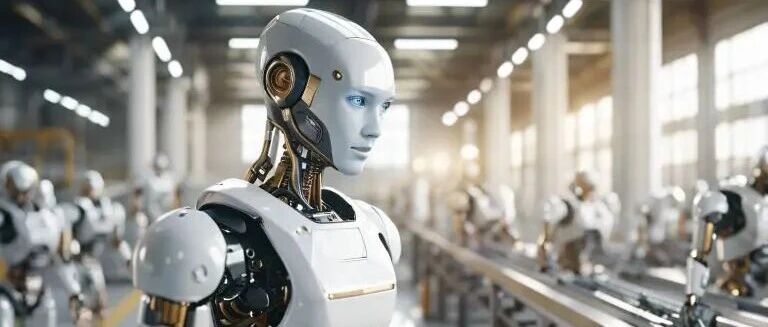
IRON Humanoid Robot

Search documents
狂飙与悬崖:2025,机器人驶出浅滩
机器人大讲堂· 2026-01-03 09:14
Core Insights - The year 2025 marks a historic turning point for the global robotics industry, with the concept of embodied intelligence and robotics moving towards large-scale application, transitioning humanoid robots from experimental technology to production tools in factories [1][2] - The industry has achieved multiple breakthroughs in technology, commercial implementation, and ecosystem construction, while also facing challenges such as bubble risks, technical bottlenecks, and commercialization tests [1] Group 1: Core Transformation - Embodied intelligence is the driving force behind the evolution of the robotics industry in 2025, fundamentally rewriting the underlying logic of industry development [4] - The shift from a linear framework of perception-planning-execution to a collaborative evolution model using AI large models as the brain and robots as the body allows robots to understand environments and make autonomous decisions [4] - This trend has permeated various fields, including industrial robots, service robots, and special robots, enhancing their capabilities in complex environments [4] Group 2: Market and Capital - The robotics sector has become a darling of the capital market in 2025, with mergers, IPOs, and financing surging, although underlying risks and market differentiation exist [9] - The industry is entering a deep integration phase, with mergers shifting from mere scale pursuit to capability enhancement and ecosystem building [9] - Over 30 companies in the robotics supply chain initiated IPO processes, with Hong Kong becoming the preferred listing location [11] Group 3: Scene Implementation - The application of robots has expanded from traditional industries to service, special environments, and consumer markets, with real orders confirming commercial value [17] - Industrial manufacturing remains the primary scene for robot commercialization, with domestic companies accelerating high-end breakthroughs [17] - Service robots are increasingly used in logistics and cleaning, while special robots demonstrate value in extreme environments [19] Group 4: Technology and Ecosystem - The robotics industry achieved significant breakthroughs in core components, technical standards, and ecosystem collaboration in 2025 [22] - The focus of global competition has shifted from hardware parameters to the construction of underlying capabilities [22] - Domestic companies have significantly improved their international standing in the field of embodied intelligence, with new standards being established [24] Group 5: Challenges and Outlook - Despite notable achievements, the robotics industry faces challenges such as the need for breakthroughs in core technologies and commercial viability [28] - The period from 2025 to 2026 is seen as a critical window for the industry to transition from validation to scaling [28] - The robotics sector is poised to become a trillion-dollar industry, reshaping manufacturing, services, and human lifestyles [29]

Tesla Rival Xpeng To Release 3 Robotaxi Models, Says Technology Does Not Depend On LiDAR — Optimus Rival IRON Could Be A 'Tour Guide' - XPeng (NYSE:XPEV)
Benzinga· 2025-11-18 10:19
Core Insights - Xpeng Inc. is set to launch three new Robotaxi models in 2026 as part of its autonomous driving initiative [2] - The company plans to begin pilot Robotaxi operations in China next year and will open source its VLA 2.0 autonomous driving system for global commercial partners [2] - Volkswagen will be the initial launch customer for the VLA 2.0 model, and Xpeng's Robotaxi service will utilize Alibaba's Amap mapping platform [3] Group 1: Robotaxi Development - Xpeng's CEO announced the launch of three Robotaxi models planned for 2026 [2] - The autonomous driving software developed by Xpeng does not rely on high-definition maps or LiDAR technology [2] - Pilot operations for the Robotaxi service are expected to commence in China next year [2] Group 2: Humanoid Robot Initiative - Xpeng's humanoid robot, named IRON, is intended for commercial applications such as tour guiding and retail assistance, with mass production targeted for 2026 [4] - The company anticipates selling over 1 million units of the IRON robot annually by 2030 [4] - Comparisons have been made between Xpeng's IRON and Tesla's Optimus line of humanoid robots [5] Group 3: Market Performance - Xpeng's stock experienced a decline of 1.87%, trading at $22.01 during pre-market hours [5]