Investment Gold Bar

Search documents
女子一次性出手8公斤金条套现近900万,花一个多小时办理业务,工作人员:近期千万元级别套现每天都有
Xin Lang Cai Jing· 2026-02-11 03:05
Core Viewpoint - The gold market is experiencing significant fluctuations, leading to a shift in investor sentiment towards risk management strategies [1][4]. Group 1: Investor Behavior - A notable increase in large cash-outs has been observed, with one investor selling 8 kilograms of gold bars for nearly 9 million yuan, indicating a trend of significant liquidations among investors who had previously accumulated gold [4][10]. - Many investors are opting to sell portions of their gold holdings to mitigate risks, despite maintaining a long-term positive outlook on gold prices [4][10]. - The preference for smaller weight gold bars has surged, as investors are increasingly making multiple smaller purchases rather than large single transactions to manage risk [5][11]. Group 2: Market Dynamics - The gold retail environment is bustling, with high customer traffic at stores like Caibai Jewelry, reflecting a strong demand for gold despite price volatility [1][4]. - Recent adjustments in business strategies by gold retailers include the suspension of gold buyback services on non-trading days and the implementation of limits on buyback transactions to control cash outflow [5][11]. - The fluctuation in gold prices has led to a sharp decline in transactions during price drops, as consumers exhibit a "buy high, sell low" mentality [11][13]. Group 3: Pricing and Costs - The buyback price for gold bars is currently set at 1,120 yuan per gram, with a handling fee of 3.8 yuan per gram, highlighting the costs associated with liquidating gold investments [4][10]. - The cost structure for purchasing gold bars varies, with larger bars (100 grams) having a lower processing fee per gram compared to smaller bars (20 grams), influencing purchasing decisions among investors [11][13].


视频丨黄金白银价格再冲新高 市场白银消费量增加
Yang Shi Xin Wen· 2026-01-27 19:21
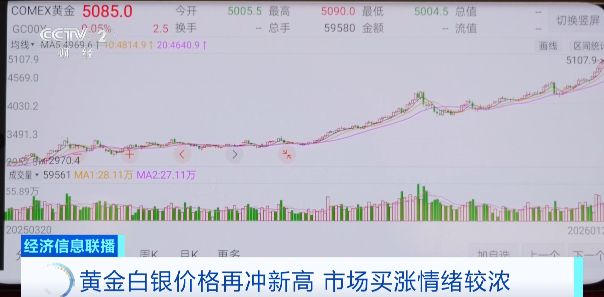
Group 1 - The international gold price has surpassed $5000 per ounce, while silver has also reached new highs, with London silver exceeding $108 per ounce and a daily increase of over 6% [1] - As of January 27, New York COMEX gold futures are approximately $5085 per ounce, up from $5004.8 per ounce the previous trading day; COMEX silver is around $110 per ounce, also showing an increase from the prior closing price. Year-to-date, gold futures have risen over 17%, while silver has surged by 55% [3] - The gold-silver ratio has dropped to around 50, marking a 13-year low, attributed to the rapid increase in silver prices compared to gold [5] Group 2 - There is a noticeable increase in silver consumption as market sentiment leans towards rising prices, with some enterprises reporting higher demand [7] - Demand for investment in gold and silver bars has surged alongside positive market expectations, although industries such as photovoltaics and gold/silver plating are seeking to adopt "de-gold" and "de-silver" technologies due to high procurement costs [9] - The A-share precious metals sector has strengthened, with a single-day increase of nearly 4% and a cumulative rise of nearly 70% since the beginning of the year. Additionally, various metal commodities have also experienced upward trends [11] - The non-ferrous metals sector has seen a rotational increase since last year, with significant excess returns in base metals like copper and aluminum, as well as in new energy metals such as lithium carbonate, cobalt, and nickel [13]
金价破1400,囤金还是买基?
Sou Hu Cai Jing· 2026-01-15 02:47
Core Insights - The financial market at the beginning of 2026 is divided between the fervor for gold and the calmness of funds, with gold prices reaching historical highs and a significant increase in demand for gold products among young investors [2][4][5] Group 1: Factors Driving Gold Price Surge - The recent surge in gold prices is attributed to a combination of global macroeconomic conditions, policy directions, and consumer demand, driven by geopolitical risks and central bank purchases [4][5] - Geopolitical tensions, including military actions and ongoing conflicts, have accelerated the influx of safe-haven investments into gold, with a notable increase in global gold ETF holdings [5][6] - Central banks, particularly in emerging markets, have been increasing their gold reserves, with China's reserves reaching approximately 2306.32 tons, contributing to a long-term support for gold prices [5][6] Group 2: Investment Choices and Their Characteristics - Young investors are divided into two camps: those buying gold and those sticking with funds, reflecting different value preservation logic and risk profiles [7][9] - Gold investments are categorized into three types: jewelry, investment bars, and gold ETFs, each with varying levels of value preservation and risk [9][10] - Gold ETFs have seen significant growth, with assets under management increasing from $55 billion to $178 billion, offering a low-cost and flexible investment option [10][11] Group 3: Comparative Analysis of Gold and Funds - The intrinsic value preservation of gold is based on its scarcity and risk-hedging properties, while funds rely on asset appreciation and are more sensitive to macroeconomic conditions [11][12] - The performance of equity funds has lagged behind gold, with average global stock index gains around 20% compared to gold's 67% increase in 2025 [10][12] - Investment strategies vary based on risk tolerance and investment horizon, with recommendations for different asset allocations between gold and funds [14][15][16] Group 4: Conclusion and Future Outlook - The surge in gold prices reflects a broader anxiety among ordinary investors in uncertain markets, highlighting the need for balanced asset allocation strategies [17][19] - The financial landscape in 2026 will continue to be influenced by factors such as interest rate changes, geopolitical risks, and economic recovery, emphasizing the importance of a long-term investment approach [19][20]