KargoBot Space运输机器人

Search documents
卡尔动力CEO韦峻青:不追求100%无人化
Mei Ri Jing Ji Xin Wen· 2025-12-04 13:30
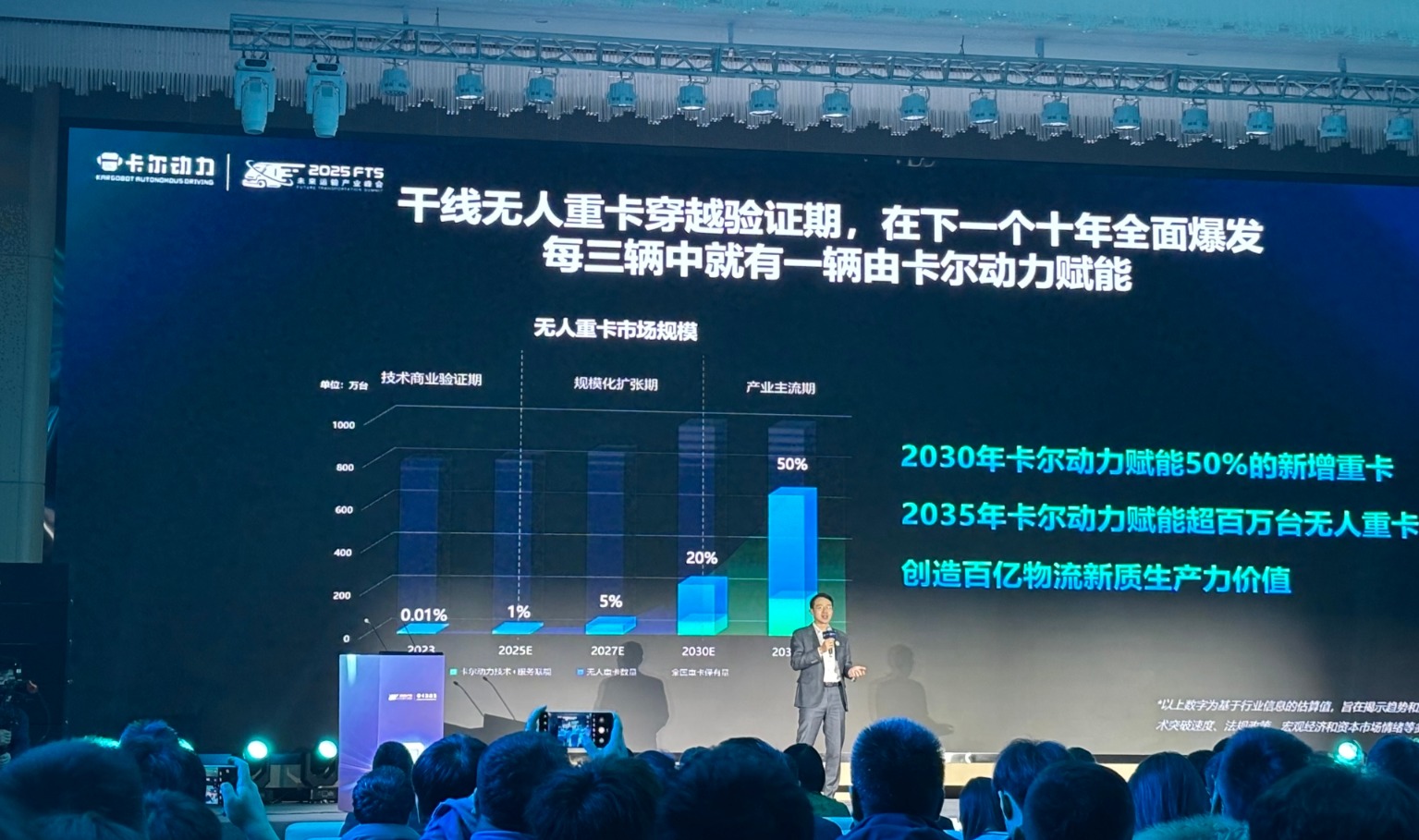
Core Insights - The focus on L2 and L3 level autonomous driving and Robotaxi is prevalent, but the company emphasizes that autonomous heavy trucks represent a high-value, high-potential market for L4 level autonomous driving [1][4] - The global market for autonomous trucks is expected to exceed 400 billion yuan by 2030, entering a phase of large-scale verification of fully unmanned products starting in 2025 [1][4] - The company prioritizes commercial viability over achieving 100% automation, aiming for significant cost savings and operational efficiency [2][3] Company Overview - Founded in 2021 and incubated by Didi, the company has built a fleet of over 400 autonomous trucks, accumulating over 35 million kilometers of operational mileage and transporting a total of 1.2 billion tons [2][5] - The company achieved the first commercial operation qualification for autonomous freight in the country and has realized a positive economic model for single-route operations [2][5] - The annual revenue is approximately 500 million yuan, with hardware costs around 90,000 yuan, offset by savings of over 100,000 yuan in driver costs, leading to a payback period of about six months [2][5] Market Strategy - The company aims to reduce overall logistics costs by 20% to 25% through autonomous driving platooning technology, with further efficiency gains expected from warehouse transport robots [2][3] - The focus is on achieving a 50% to 80% reduction in labor costs while ensuring scalable operations, which is deemed to have significant commercial value [3][5] - The company plans to conduct unmanned testing of its KargoBot Space transport robot by 2026, with expectations of one million unmanned transport vehicles on the road within the next decade [3][5] Industry Context - The commercial progress of autonomous trucks has faced challenges, as evidenced by the acquisition of Embark and the delisting of TuSimple, highlighting the difficulties in achieving large-scale commercial operations [4][5] - The company has taken a pragmatic approach, focusing on freight scenarios and planning to achieve unmanned testing in 2024 and unmanned operations in 2025 [5] - The company has successfully achieved profitability on specific routes with autonomous vehicles, marking a significant milestone in the commercial vehicle sector [6]
自动驾驶重卡商业价值远超Robotaxi?卡尔动力韦峻青:不追求100%无人化,更关注路线级盈利
Mei Ri Jing Ji Xin Wen· 2025-12-02 09:08
Core Insights - The focus of the industry is shifting towards L4 autonomous driving, particularly in the heavy-duty truck sector, which is seen as a high-value market with significant potential for commercialization [1][5] - The global market for autonomous trucks is expected to exceed 400 billion yuan by 2030, with full automation entering a validation phase by 2025 [1][5] - The company emphasizes that achieving profitability and scaling operations is more critical than pursuing 100% automation [1][4] Company Overview - The company, established in 2021 and incubated by Didi, has built a fleet of over 400 autonomous trucks, accumulating over 35 million kilometers in operational mileage and transporting a total of 1.2 billion tons [3][5] - The annual revenue of the company is approximately 500 million yuan, with a hardware cost of about 90,000 yuan per unit, offset by savings of over 100,000 yuan in driver costs annually [3][5] - The company aims to reduce overall logistics costs by 20% to 25% through autonomous driving technology and expects further efficiency gains from warehouse transport robots [3][5] Market Strategy - The company plans to focus on practical applications of autonomous driving, targeting a 50% to 80% reduction in labor costs while achieving scalable operations [4][5] - The company has received the first commercial operation qualification for autonomous freight transport in the country and aims to validate profitability on specific routes before scaling up [3][6] - The company has completed approximately 300 million yuan in Series A+ financing and does not currently face funding pressures, indicating strong market confidence in the potential of the autonomous truck sector [5][6] Future Projections - The company expects to add over 50 autonomous driving licenses by the end of the year, with plans to reach hundreds in the following year [6] - The company anticipates that the penetration rate of autonomous vehicles will double annually, with the potential for rapid scaling of profitable routes [6] - The company has developed seven mass-produced vehicle models and is accelerating the replication of successful operational models in new markets [6]