
自动驾驶重卡

Search documents
小马智行获跨省自动驾驶重卡示范许可 单车日均净收入338元
Xin Lang Cai Jing· 2026-03-11 21:10
Core Insights - Xiaoma Zhixing has made significant progress in autonomous driving freight and taxi services, attracting institutional attention [1] Recent Events - On March 10, 2026, Xiaoma Zhixing became the first company to obtain cross-province autonomous heavy truck demonstration application permission from the Tianjin Municipal Transportation Commission, Tianjin Municipal Bureau of Industry and Information Technology, and Tianjin Public Security Bureau [2] - The company will collaborate with China Foreign Transport to provide autonomous highway freight services on the Beijing-Tianjin-Tanggu Expressway, with a total test route length exceeding 100 kilometers and a maximum test speed of 90 kilometers per hour, which is expected to promote the integrated development of smart logistics in the Beijing-Tianjin-Hebei region [2] - On March 5, 2026, Xiaoma Zhixing announced that its seventh-generation Robotaxi achieved monthly single-vehicle operational profitability in Shenzhen as of February 2026, with an average net income per vehicle per day of 338 yuan and a stable average daily order volume of 23 orders [2] - During the Spring Festival, order activity increased, with an average of 26 paid orders per vehicle per day, driven by user demand growth and cost control, including a 70% reduction in autonomous driving kit costs [2] Stock Performance - Over the past week (March 4 to March 11, 2026), Xiaoma Zhixing-W (02026.HK) experienced significant stock price fluctuations, with a range of -6.26% and an amplitude of 16.47% [3] - The highest price was recorded on March 5 at 109.60 HKD, while the lowest was on March 9 at 91.70 HKD [3] - The latest closing price on March 11 was 101.90 HKD, with a single-day increase of 0.30% and a trading volume of approximately 725,200 HKD [3] - During the same period, the US stock of Xiaoma Zhixing (PONY.OQ) had a range of -0.08%, with the latest price at 12.90 USD as of March 11 [3] Institutional Insights - On March 6, 2026, Guohai Securities released a report on Robotaxi, highlighting Xiaoma Zhixing as a leading player in the domestic market, with potential for further expansion in first-tier city operating areas supported by a favorable policy environment for L4-level autonomous driving commercialization [4] - The report emphasized the escalating competition between China and the US in the Robotaxi sector, noting that China is accelerating scale through pilot expansions and model innovations, with Xiaoma Zhixing having a first-mover advantage in technology accumulation and urban coverage [4]
小马智行到访长久物流 共商物流智能化升级
Zheng Quan Ri Bao· 2026-02-04 07:11
Core Insights - The meeting between Pony.ai and Changjiu Logistics focused on the commercialization of autonomous driving technology in logistics scenarios [1] - Pony.ai, established in 2016, is a leading global player in autonomous driving, with operations in Robotaxi, Robotruck, and technology licensing [1] - Changjiu Logistics is a pioneer in the automotive logistics sector in China, collaborating with over 60 automotive brands and more than 80 major manufacturers [1] Company Overview - Pony.ai has achieved full autonomous driving commercialization and operates in various regions including Europe, East Asia, and the Middle East [1] - Changjiu Logistics owns over 2,400 self-owned middle-axle car carriers, emphasizing its significant presence in the automotive logistics industry [1] Meeting Focus - The discussion centered on the technical and commercial feasibility of applying Pony.ai's autonomous heavy trucks in specific scenarios [1] - The goal is to enhance the digital transformation of Changjiu Logistics' fleet, improving operational efficiency and safety [1]

盘前:纳指期货跌0.22% 美联储决议倒计时
Xin Lang Cai Jing· 2025-12-10 13:44
Group 1 - Global stock markets experienced mild fluctuations as investors await the Federal Reserve's policy statement, focusing on interest rate outlook for 2026 and potential earnings results in the AI sector [2][3] - Oracle's earnings report is highly anticipated, as the company is viewed as a bellwether in the AI space, with concerns about high valuations and the potential return on investment in AI [3] - The U.S. Treasury yields continue to rise, with the 10-year yield reaching 4.20%, the highest level since the first week of September, amid expectations that the rate-cutting cycle is nearing its end [3] Group 2 - The market expects the Federal Reserve to announce a third consecutive rate cut, with attention on the updated dot plot and economic forecasts [4] - Seasonal trends indicate that December is typically a weaker month for the S&P 500, except for the last two weeks, which usually see a "Santa Claus rally" [5] - The probability of a 25 basis point rate cut to 3.50%-3.75% is at 89%, but expectations for further cuts in January are only at 21% [5] Group 3 - Recent economic data suggests the U.S. economy is cooling as desired by the Federal Reserve, but not weak enough to accelerate rate cuts, with inflation still above target levels [6] - The Japanese yen is under pressure due to widening interest rate differentials, but is expected to strengthen slightly as the Bank of Japan is anticipated to tighten policy [6][7] - Silver prices surged past $60, driven by supply constraints and expectations of further monetary easing from the Federal Reserve, reaching a historical high of $61.6145 [8][9] Group 4 - GE Vernova shares rose 6.6% after raising revenue guidance and stock buyback plans to $10 billion [9] - GameStop shares fell 6.3% as Q3 revenue and earnings per share missed expectations [10] - Photronics shares jumped 15% after the company projected first-quarter revenue exceeding expectations [10]

自动驾驶重卡商业价值远超Robotaxi?卡尔动力韦峻青:不追求100%无人化,更关注路线级盈利
Mei Ri Jing Ji Xin Wen· 2025-12-02 09:08
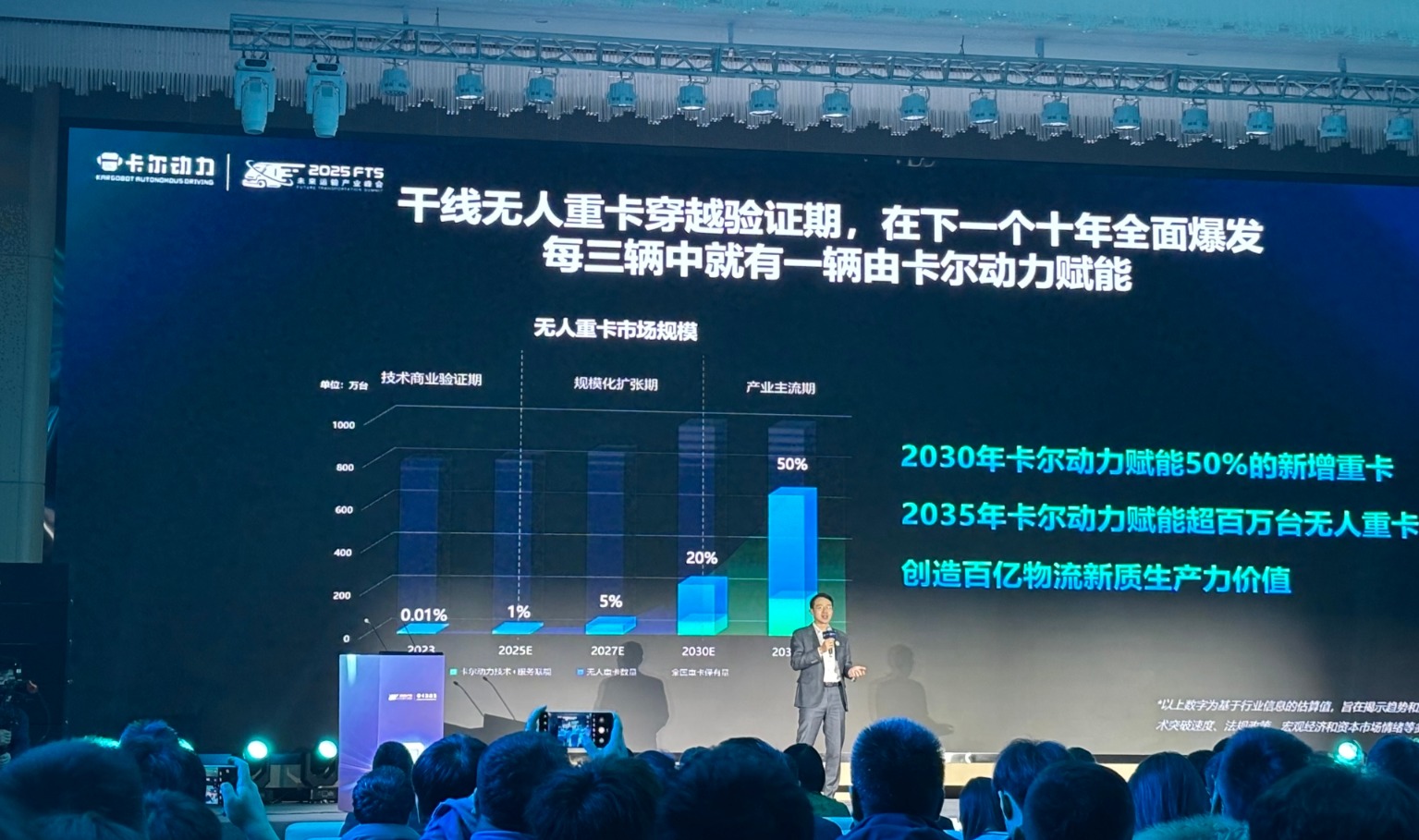
Core Insights - The focus of the industry is shifting towards L4 autonomous driving, particularly in the heavy-duty truck sector, which is seen as a high-value market with significant potential for commercialization [1][5] - The global market for autonomous trucks is expected to exceed 400 billion yuan by 2030, with full automation entering a validation phase by 2025 [1][5] - The company emphasizes that achieving profitability and scaling operations is more critical than pursuing 100% automation [1][4] Company Overview - The company, established in 2021 and incubated by Didi, has built a fleet of over 400 autonomous trucks, accumulating over 35 million kilometers in operational mileage and transporting a total of 1.2 billion tons [3][5] - The annual revenue of the company is approximately 500 million yuan, with a hardware cost of about 90,000 yuan per unit, offset by savings of over 100,000 yuan in driver costs annually [3][5] - The company aims to reduce overall logistics costs by 20% to 25% through autonomous driving technology and expects further efficiency gains from warehouse transport robots [3][5] Market Strategy - The company plans to focus on practical applications of autonomous driving, targeting a 50% to 80% reduction in labor costs while achieving scalable operations [4][5] - The company has received the first commercial operation qualification for autonomous freight transport in the country and aims to validate profitability on specific routes before scaling up [3][6] - The company has completed approximately 300 million yuan in Series A+ financing and does not currently face funding pressures, indicating strong market confidence in the potential of the autonomous truck sector [5][6] Future Projections - The company expects to add over 50 autonomous driving licenses by the end of the year, with plans to reach hundreds in the following year [6] - The company anticipates that the penetration rate of autonomous vehicles will double annually, with the potential for rapid scaling of profitable routes [6] - The company has developed seven mass-produced vehicle models and is accelerating the replication of successful operational models in new markets [6]
IPO前“互掐”,两家智驾公司同日敲钟
创业邦· 2025-11-06 03:44
Core Insights - Two Robotaxi companies, Pony.ai and WeRide, simultaneously listed on the Hong Kong Stock Exchange, with market capitalizations of HKD 52.2 billion and HKD 24.1 billion respectively [2] - WeRide became the first global Robotaxi company to go public on NASDAQ in October 2024, while Pony.ai's stock price fell below its IPO price during its NASDAQ listing [4] - Both companies focus on autonomous driving systems, with Robotaxi as their core application, but they have different strategies for commercialization [14][17] Company Background - Both founders of WeRide and Pony.ai previously worked at Baidu's autonomous driving division [6][12] - WeRide was founded by Han Xu and Wang Jin after leaving Baidu, while Pony.ai was co-founded by Peng Jun [12][13] Business Strategies - WeRide employs a platform strategy, applying its autonomous driving technology across various scenarios, while Pony.ai focuses on a more vertical approach with two main business lines: Robotaxi and autonomous freight [14][17] - WeRide's revenue from Robotaxi is expected to grow significantly by 2025, while its other autonomous vehicle services already contribute over 40% of total revenue [16][20] Financial Performance - WeRide's revenue has shown a decline from CNY 530 million in 2022 to CNY 360 million in 2024, while Pony.ai's revenue has been steadily increasing from USD 68 million in 2022 to USD 75 million in 2024 [30] - Both companies are currently unprofitable, with WeRide losing CNY 2.5 billion and Pony.ai losing nearly CNY 2 billion in 2024 [29][30] Market Expansion - WeRide has expanded its operations internationally, obtaining autonomous driving licenses in six countries and conducting business in 30 cities [31] - Pony.ai is focusing on domestic market expansion, being one of the first companies to receive operating permits in major Chinese cities [32]
天津市“十四五”时期交通强市建设迈出坚实步伐
Zhong Guo Fa Zhan Wang· 2025-11-03 08:45
Core Insights - The article discusses the achievements and progress made by Tianjin in transportation infrastructure during the "14th Five-Year Plan" period, emphasizing the city's commitment to building a strong transportation network and supporting national strategies [1][2][3][4][5][6][7] Group 1: Transportation Infrastructure Development - Tianjin has established a comprehensive three-dimensional transportation network, achieving 88% completion of the planned "nine horizontal and six vertical" expressway network, with a total of 1,358 kilometers of operational routes [2] - The city has increased its high-speed rail intercity mileage by 32%, reaching 410 kilometers, and improved road network density, with 95% of roads classified as secondary or above [2] - The total length of the city's road network is approximately 15,000 kilometers, enabling efficient access to high-speed rail stations and highways within 30 minutes and 15 minutes, respectively [2] Group 2: Port and Shipping Enhancements - Tianjin Port has transitioned from a major port to a strong global port, with container shipping routes increasing by 18 since 2020, totaling 148 routes [3] - The port's cargo throughput is projected to reach approximately 591 million tons by 2025, ranking eighth nationally and ninth globally, with an average annual growth rate of 3.5% [3] - The city has been approved as a central hub for the China-Europe Railway Express in North China, with expected container volumes exceeding 75,000 standard containers by 2025 [3] Group 3: Integration and Service Improvements - The integration of transportation in the Beijing-Tianjin-Hebei region has improved, with 12 high-speed rail stations opened and 49 national and provincial road interfaces established [4] - New transportation services, such as customized express buses and interprovincial public transport, have been introduced to enhance commuter convenience [4] - The city has implemented quality improvement actions across ten transportation sectors, with significant increases in passenger volumes for railways, aviation, and urban transit [5] Group 4: Innovation and Sustainability - Tianjin is advancing smart, green, and high-quality transportation development, with initiatives like automated driving tests and the establishment of a digital transformation demonstration area [6] - The city has achieved a high percentage of new energy vehicles in public transport, with 87.2% of city buses and 74% of taxis being electric [6] - Safety measures in the transportation sector have been strengthened, with a stable safety production situation and effective risk prevention strategies [7] Group 5: Future Goals - The city aims to continue enhancing its transportation network, focusing on projects like the Tianjin-Weifang high-speed rail and improving port facilities [7] - Ongoing efforts will be made to facilitate transportation integration and improve service quality in public transport sectors [7] - The goal is to build a modern, efficient, and resilient transportation system that supports the broader objectives of China's modernization efforts [7]
