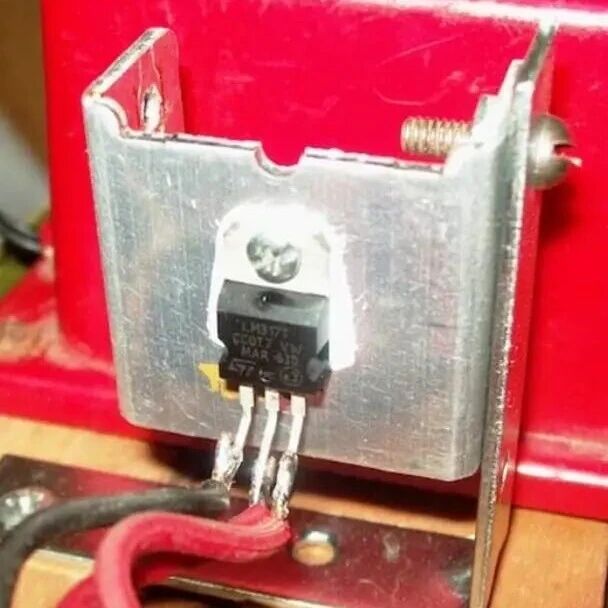
LM317

Search documents
这颗芯片,打开了线性放大器时代
半导体行业观察· 2026-02-15 01:37
Core Viewpoint - The LM317, introduced by National Semiconductor in the mid-1970s, revolutionized linear voltage regulation by integrating adjustable voltage functionality into a three-terminal module, allowing for a wide range of output voltages with minimal components [2][3]. Group 1: Product Features and Design - The LM317 is an adjustable positive voltage regulator capable of delivering over 1.5A of current, with output voltage adjustable between approximately 1.25V and 37V using two resistors [2]. - Unlike traditional regulators that compare output voltage to ground, the LM317 maintains a reference voltage of about 1.25V between its output and adjustment pins, allowing for a wide voltage range without internal recalibration for each voltage value [4][7]. - The device features built-in current limiting, thermal shutdown, and safe operating area protection, ensuring reliability even if the adjustment pin is accidentally disconnected [7]. Group 2: Performance and Practical Applications - The LM317 exhibits excellent performance as a linear regulator, with a typical line regulation of about 0.01% per volt and load regulation of approximately 0.1%, with ripple rejection rates nearing 80 dB when using appropriate capacitors [8]. - It has found extensive applications in laboratory power supplies, battery chargers, and audio equipment, providing clean power without the noise associated with earlier DC-DC converters [12]. - The LM317 has influenced the design of later adjustable regulators and modern switching controllers, establishing a standard where voltage selection is determined by circuit design rather than product catalogs [12]. Group 3: Longevity and Market Presence - Despite its age and relatively low efficiency by modern standards, the LM317 continues to be produced by multiple manufacturers, demonstrating its durability and reliability in various applications [12][13]. - The success of the LM317 is attributed to its straightforward solution to practical problems, establishing a trusted model for engineers and maintaining performance close to ideal conditions [13].