LR2021

Search documents
Semtech Broadens LoRa Gen 4 Lineup to Capture IoT Market Demand
ZACKS· 2025-10-01 15:05
Core Insights - Semtech Corporation (SMTC) has introduced two new transceivers, the LR2022 and LR2012, expanding its LoRa Gen 4 family to enhance its offerings for Internet of Things (IoT) applications [1][10] - The LoRa Gen 4 technology achieves data rates of up to 2.6 Mbps while maintaining high power efficiency and coverage, enabling new use cases such as AI-driven cameras and drone systems [2] - The LR2022 supports both sub-GHz and 2.4GHz bands, while the LR2012 focuses on sub-GHz performance with a sensitivity of -142 dBm, catering to various IoT system needs [3] - All LoRa Gen 4 devices are backward compatible with over 450 million existing LoRa units, ensuring a smooth transition for enterprises and protecting prior investments [4] Product Rollout Timeline - The LR2021 will enter production in October 2025, followed by the LR2022 in early 2026 and the LR2012 in mid-2026 [5] Competitive Landscape - Semtech operates in a competitive semiconductor market with rivals such as Texas Instruments (TXN), Silicon Laboratories (SLAB), and Analog Devices (ADI) targeting growth in IoT and wireless connectivity [6] - Texas Instruments offers a wide range of wireless connectivity chips and is a direct competitor in low power and cost-efficient markets [7] - Silicon Laboratories specializes in microcontrollers and wireless SoCs, emphasizing protocol diversity and easy integration, making it a strong rival in consumer and smart home IoT applications [8] - Analog Devices competes in analog and mixed-signal solutions, with capabilities in power management and connectivity, while Semtech differentiates itself with its focus on LoRa technology for long-range, low-power IoT applications [9]



Semtech LR2021 芯片重磅发布:以 LoRa Plus™技术重新定义物联网连接边界
Ju Chao Zi Xun· 2025-08-29 02:34
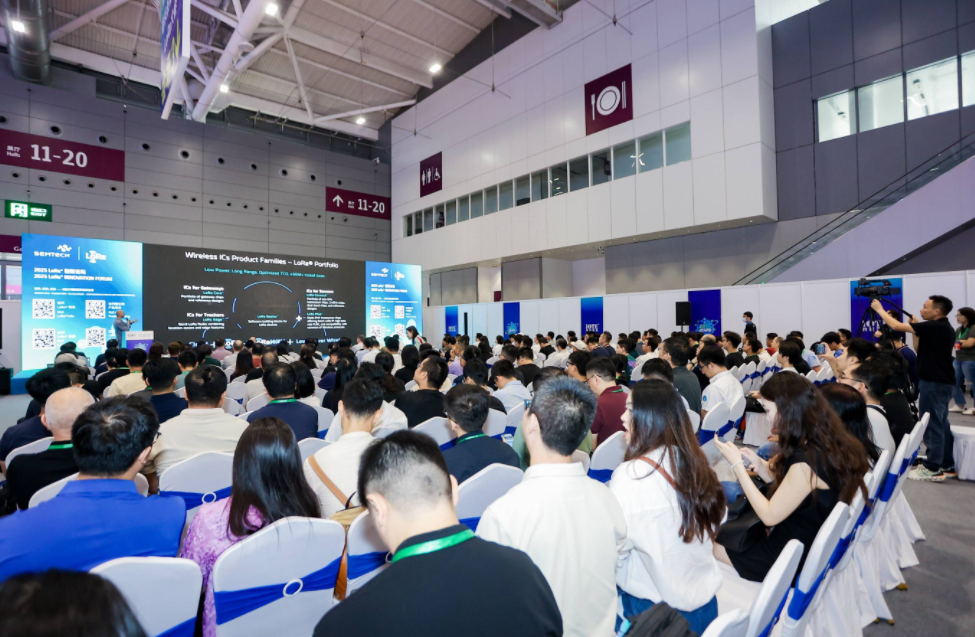
Core Viewpoint - Semtech has launched the new LoRa Plus™ series chip LR2021 at the IOTE 2025 International IoT Exhibition, marking the entry of LoRa technology into its fourth generation, which enhances low-power long-range transmission, multi-protocol compatibility, high-speed data transmission, and AI edge applications, redefining the boundaries of IoT connectivity [2][16]. Technical Features - The LR2021 chip integrates Semtech's fourth-generation LoRa technology, achieving multi-dimensional breakthroughs and providing robust support for IoT connectivity across various scenarios, including ground and non-ground networks [3]. - It supports multiple physical layer compatibilities and can integrate third-party protocol stacks, allowing it to adapt to various low-power wireless protocols, significantly simplifying the development process for IoT devices [7]. - The chip supports high-speed communication modes up to 2.6 Mbps and various modulation methods, catering to different data transmission needs from low-speed sensor data to high-speed audio and image transmission [7][8]. Performance Advantages - The LR2021 balances power consumption and data rate, making it suitable for AI-driven edge devices that require long-term stable operation and fast data transmission [9]. - Its low power consumption allows devices to operate for years on small batteries, reducing maintenance costs, while maintaining efficiency even during high-speed data transmission [9][10]. - The chip maintains backward compatibility with previous LoRa devices, allowing for seamless integration into existing systems without incurring high replacement costs [10]. Application Scenarios - Semtech has developed scenario-based solutions around the LR2021, focusing on key areas such as industrial IoT, supply chain, satellite IoT communication, agriculture, environmental monitoring, healthcare, and smart buildings [13]. - In industrial IoT, the chip's multi-protocol support and high-speed transmission capabilities enhance data interoperability among devices using different protocols [13]. - The LR2021 supports satellite communication, enabling real-time data transmission in remote areas, ensuring data continuity even without ground network coverage [14]. Redefining Connectivity - The introduction of the LR2021 chip signifies a shift from traditional LPWAN technology to a more integrated IoT connectivity solution, breaking down barriers between different protocols and enabling cross-industry innovation [16][17]. - It achieves full spatial coverage from ground to satellite, eliminating connectivity blind spots and supporting both low-speed and high-speed data transmission [16]. - The chip's capabilities foster an integrated IoT ecosystem, reducing application costs for enterprises and promoting data sharing across different industries [17].