Llama2

Search documents
中文大模型基准测评2025年年度报告:2026开年特别版:含1月底重磅模型动态评测
SuperCLUE团队· 2026-02-05 02:00
Investment Rating - The report does not explicitly provide an investment rating for the industry or companies involved. Core Insights - The report highlights significant advancements in Chinese large models and AI agents, marking a transition from "following" to "keeping pace" with global leaders in AI technology [14][24]. - The competitive landscape shows a clear distinction between domestic and international models, with domestic open-source models gaining substantial ground [23][47]. - The report emphasizes the importance of multi-modal capabilities and the emergence of AI agents in practical applications, particularly in programming and task planning [16][14]. Summary by Sections 1. Key Developments in 2025 - The report outlines three major phases of AI model evolution: the initial competition among models, the explosion of multi-modal capabilities, and the rise of AI agents [14][16]. - Notable models such as Kimi-K2.5-Thinking and Qwen3-Max-Thinking have emerged as leaders in specific tasks like code generation and mathematical reasoning [18][24]. 2. Annual Evaluation Results and Analysis - The 2025 annual evaluation ranks Claude-Opus-4.5-Reasoning as the top model globally, followed by Gemini-3-Pro-Preview and GPT-5.2(high) [23][45]. - Domestic models like Kimi-K2.5-Thinking and Qwen3-Max-Thinking are positioned fourth and sixth, indicating a strong competitive stance [23][45]. - The report notes that domestic models are rapidly closing the gap with international counterparts, particularly in code generation and reasoning tasks [24][48]. 3. SuperCLUE Model Quadrant and Capability Landscape - The report presents a model quadrant that categorizes models based on their capabilities in reasoning and application, highlighting the emergence of "technical leaders" and "practical leaders" in the domestic market [38][39]. - The capability landscape indicates that while domestic models excel in certain areas, they still face challenges in hallucination control and precise instruction adherence [42][48]. 4. Comparative Analysis of Domestic and International Models - The analysis reveals that closed-source models dominate the top rankings, with significant advantages in reasoning and instruction-following tasks [74][80]. - Domestic open-source models are noted for their rapid advancements, particularly in coding tasks, where they have begun to outperform some international models [56][84]. - The report emphasizes the structural differences between domestic and international models, with domestic models showing a strong trend towards open-source development [24][47].



不再依赖美国!新加坡国家AI计划“换心”阿里千问
Guan Cha Zhe Wang· 2025-11-25 10:49
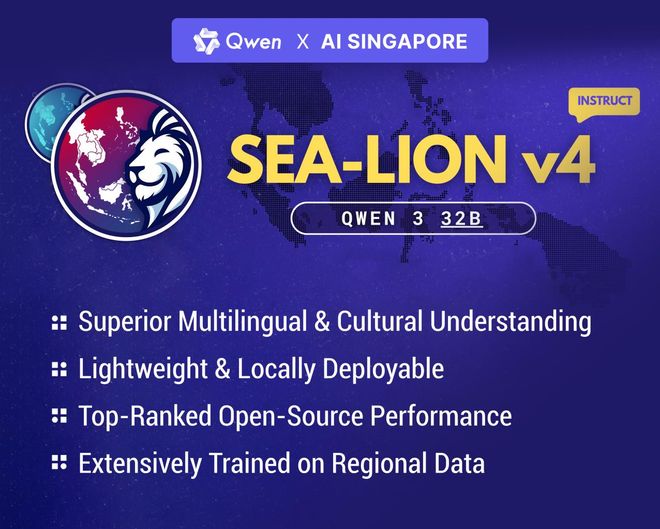
Core Insights - Alibaba Cloud and Singapore's National AI Program (AISG) have announced the development of a new national-level large language model, Sea-Lion v4, which will be based entirely on Alibaba's Qwen3-32B open-source model instead of previous American technology [1][3]. Group 1: Model Development and Features - The Sea-Lion v4 model aims to address the lack of representation of Southeast Asian languages in existing AI models, which previously had only 0.5% content in these languages [3][4]. - The Qwen3-32B model has been trained on 36 trillion tokens, covering 119 languages and dialects, providing a strong foundation for understanding Southeast Asian languages [5][6]. - The new model utilizes Byte Pair Encoding (BPE) for tokenization, which is more effective for non-Latin scripts, improving translation accuracy and inference speed [6]. Group 2: Market Context and Strategic Importance - Southeast Asia, with a population of 600 million and a rapidly growing digital economy, has been a "blind spot" for Western AI models, which struggle with local language nuances and cultural context [3][4]. - The collaboration between Alibaba and AISG is characterized by a two-way integration, where Alibaba provides a robust AI foundation while AISG contributes a cleaned dataset of 100 billion Southeast Asian language tokens [6][7]. - This partnership reflects a shift in the global AI landscape, with Chinese companies emerging as preferred partners for developing sovereign AI solutions in the Global South, challenging the historical dominance of American technology [7].

“训练成本才这么点?美国同行陷入自我怀疑”
Guan Cha Zhe Wang· 2025-09-19 11:28
Core Insights - DeepSeek has achieved a significant breakthrough in AI model training costs, with the DeepSeek-R1 model's training cost reported at only $294,000, which is substantially lower than the costs disclosed by American competitors [1][2][4] - The model utilizes 512 NVIDIA H800 chips and has been recognized as the first mainstream large language model to undergo peer review, marking a notable advancement in the field [2][4] - The cost efficiency of DeepSeek's model challenges the notion that only countries with the most advanced chips can dominate the AI race, as highlighted by various media outlets [1][2][6] Cost and Performance - The training cost of DeepSeek-R1 is significantly lower than that of OpenAI's models, which have been reported to exceed $100 million [2][4] - DeepSeek's approach emphasizes the use of open-source data and efficient training methods, allowing for high performance at a fraction of the cost compared to traditional models [5][6] Industry Impact - The success of DeepSeek-R1 is seen as a potential game-changer in the AI landscape, suggesting that AI competition is shifting from resource quantity to resource efficiency [6][7] - The model's development has sparked discussions regarding China's position in the global AI sector, particularly in light of U.S. export restrictions on advanced chips [1][4] Technical Details - The latest research paper provides more detailed insights into the training process and acknowledges the use of A100 chips in earlier stages, although the final model was trained exclusively on H800 chips [4][5] - DeepSeek has defended its use of "distillation" techniques, which are common in the industry, to enhance model performance while reducing costs [5][6]