M5 Ultra芯片

Search documents
苹果新一代Mac Studio细节曝光:搭载M5系列芯片,2026上半年发布
Huan Qiu Wang Zi Xun· 2026-02-13 03:52
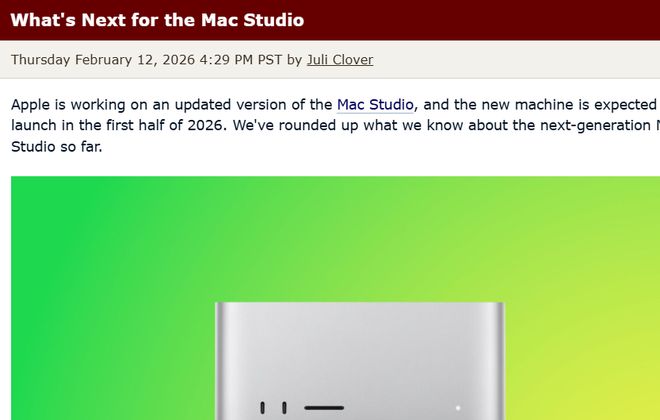
Core Insights - The new generation Mac Studio is currently in development and is expected to be officially launched in the first half of 2026 [1] - The upgrade will include significant enhancements in core configurations such as chips and storage, alongside the potential release of the new Studio Display 2 monitor [1] Design - The design of the new Mac Studio is expected to remain largely unchanged, maintaining a compact form factor similar to the current model, with dimensions of 3.7 inches in height and 7.7 inches in width [4] - The Mac Studio is positioned as the future core development direction for Apple's desktop computing, as the Mac Pro development has been put on hold [4] Performance - The new Mac Studio will feature the M5 Max and M5 Ultra chips, with the M5 Max offering significantly improved CPU and GPU performance compared to the M5 chip released in October last year [4] - The M5 Ultra chip is expected to double the performance of the M5 Max, with indications of these chips found in the latest iOS 26.3 candidate version [4] - The new Mac Studio is likely to be equipped with a faster SSD, similar to the upgraded M5 MacBook Pro, enhancing storage read and write speeds [4] Release Timing - The new Mac Studio is anticipated to be launched shortly after the spring update of Mac products, with the new MacBook Pro potentially being released in the week of March 2 [4]


摩根士丹利:2026年全球科技行业展望
欧米伽未来研究所2025· 2026-01-16 02:03
Core Insights - The report by Morgan Stanley highlights that the global tech industry is in a strong upward cycle driven by AI computing power demand, but the distribution of benefits is uneven [3] - The focus is shifting from mere "concept hype" to a rigorous examination of capacity bottlenecks, pricing power, and cyclical sequences in the semiconductor "super cycle" [3] Group 1: AI Infrastructure and Demand - AI server demand is expected to remain strong, with Nvidia GPU server shipments predicted to double from approximately 28,000 units in 2025 to a higher level in 2026 [4] - The report emphasizes that this growth is not just about quantity but also a qualitative shift in computing power density, with data center-related revenue projected to account for 40% of Nvidia's total revenue in 2025 and at least 50% in 2026 [4] Group 2: Energy Management and Semiconductor Supply Chain - The expansion of data centers is reshaping energy architectures, with power management semiconductors becoming a new growth point as power density per rack increases from 250kW to potentially 1MW [5] - Companies like Wiwynn and Hon Hai/Foxconn are favored for benefiting directly from AI server demand, while traditional hardware manufacturers lacking deep AI supply chain integration are viewed unfavorably [5] Group 3: Storage Chips and Market Dynamics - The storage chip sector is experiencing a rare "seller's market," particularly for high bandwidth memory (HBM), with supply shortages expected to persist despite efforts from major players like Samsung and SK Hynix to increase production [6] - DRAM contract prices are anticipated to rise in the first half of 2026, driven by limited capacity growth in traditional DRAM due to a focus on more profitable HBM production [6][7] Group 4: Semiconductor Equipment and Manufacturing - The report indicates that equipment manufacturers and foundries are benefiting from the shift to advanced process nodes, with TSMC expected to maintain a 20% compound annual growth rate (CAGR) over the next five years due to AI demand [8] - Apple has increased orders for TSMC's N3P wafers, which could significantly boost iPhone processor production, reflecting optimism for future sales [9] Group 5: European Tech Stocks and Investment Preferences - ASML is highlighted as a top pick in the European semiconductor sector, with an increased target price of €1000, driven by rising demand for lithography machines [10] - Companies focusing on advanced packaging and new materials, such as ASM International and Besi, are also recommended due to their unique positioning [10] Group 6: Automotive Semiconductor Sector - The automotive semiconductor industry is undergoing a painful inventory correction, with significant declines in inventory turnover days, but this may set the stage for future recovery [11] - Investors are advised to adopt a "cyclical trading" strategy, as the worst may be over for companies like Infineon, which have long-term growth drivers [11] Group 7: Investment Strategy and Market Outlook - The report suggests that 2026 tech stock investments should focus on structural opportunities with pricing power, particularly in storage chip manufacturers and AI infrastructure providers [12] - Companies facing competitive pressures and cost increases, such as PC assemblers and some traditional analog chip manufacturers, are at risk of profit erosion [12] Group 8: Cyclical Nature of the Tech Industry - While AI is a long-term driver, the tech industry remains cyclical, with PC and smartphone semiconductors potentially past their peak, while general servers and AI hardware are in a recovery phase [13] - Understanding these cyclical shifts is crucial for avoiding investments in assets under cost pressure and for succeeding in the market in 2026 [13]



苹果Mac Pro更新计划搁置,生态位被Mac Studio取代
Huan Qiu Wang Zi Xun· 2026-01-01 04:10
Core Insights - Apple has deprioritized the Mac Pro, indicating that there will be no significant updates planned for 2026, effectively replacing it with the more compact Mac Studio [1] - The performance gap between Mac Studio and Mac Pro is widening, with the upcoming M5 Ultra chip exclusively for Mac Studio, leaving Mac Pro behind [4] Group 1 - Apple has internally "basically given up" on the Mac Pro product line, with no major updates expected in 2026 [1] - The Mac Studio, equipped with the M3 Ultra chip, has already surpassed the Mac Pro in performance, supporting more CPU and GPU cores, and offering a maximum storage capacity of 16TB compared to Mac Pro's 8TB [4] - Mac Studio's unified memory limit is 512GB, which is more than double that of Mac Pro's 192GB, and it can support four 8K displays versus Mac Pro's three [4] Group 2 - The Mac Pro has faced challenges in meeting professional desktop user needs, with its initial 2013 design criticized for sacrificing cooling performance, leading to its market failure [5] - The 2019 modular Mac Pro regained some trust among professional users but has since struggled with its positioning in the Apple Silicon era [5]