
MDNA113

Search documents
Medicenna to Present Preclinical Data from its First-in-Class Tumor Anchored and Conditionally Activated Anti-PD-1-IL-2 Bifunctional Superkine at the AACR Annual Meeting 2026
Globenewswire· 2026-03-18 11:30
Core Insights - MDNA113 is a novel IL-13Rα2 tumor-targeted and "masked" anti-PD-1-IL-2 Superkine designed to deliver anti-PD1 and IL-2 specifically to the tumor microenvironment, addressing high unmet needs in various cancers affecting over 2 million patients annually worldwide [1][3] - The drug is positioned as a first-in-class PD-1-IL-2 bifunctional immunotherapy, aiming to expand the therapeutic window and overcome challenges faced by competing programs [1] - Pre-clinical data demonstrating the selectivity, localization, and potency of MDNA113 will be presented at the AACR Annual Meeting 2026, with an IND submission anticipated in H2 2026 [1][2] Company Overview - Medicenna Therapeutics is a clinical-stage immunotherapy company focused on developing Superkines targeting cancer and autoimmune diseases, including MDNA11, a long-acting IL-2 Superkine [4] - The company utilizes proprietary platforms such as BiSKITs™ and T-MASK™ for the development of its bifunctional immunotherapies [4] - Medicenna's IL-4 Empowered Superkine, bizaxofusp, has been involved in multiple clinical trials and has received FastTrack and Orphan Drug status from the FDA and EMA [4]


Medicenna Therapeutics Reports Third Quarter Fiscal 2026 Financial Results and Provides a Corporate Update
Globenewswire· 2026-02-13 13:09
Core Insights - Medicenna Therapeutics is advancing its clinical pipeline with promising data for MDNA11 and MDNA113, targeting various cancers and autoimmune diseases [2][3][21] Clinical Data and Trials - Updated clinical data from the ABILITY-1 trial shows MDNA11 achieving an objective response rate (ORR) of 36% in monotherapy and 43% when combined with pembrolizumab in patients treated as second or third-line therapy [4][5] - The ABILITY-1 study has expanded to include patients with non-small cell lung cancer (NSCLC) and secondary resistance to checkpoint therapy, addressing a significant unmet need in cancer treatment [4][6] - The NEO-CYT trial will evaluate MDNA11 in combination with nivolumab for high-risk melanoma, with patient enrollment expected to start in H1 2026 and interim data anticipated in H2 2026 [8][10] Product Development - MDNA113, a bifunctional anti-PD-1–IL-2 superkine, is progressing through IND-enabling studies, with plans to submit an IND in H2 2026 after demonstrating a favorable safety profile in non-human primates [3][14] - Bizaxofusp (formerly MDNA55) has shown a significant increase in median overall survival for recurrent glioblastoma patients, with a median overall survival of 13.6 months compared to the standard of care of 7 months [14] Financial Overview - As of December 31, 2025, Medicenna reported cash and cash equivalents of $10.6 million, expected to fund operations into Q3 2026 [16] - The company reported total operating costs of $5.6 million for the quarter, an increase from $5.1 million in the same period the previous year, primarily due to higher R&D expenditures [17][19] - The net loss for the quarter was $4.4 million, a decrease from $5.2 million in the prior year, attributed to an increase in the gain on the fair value of derivative warrant liability [18]

Medicenna Therapeutics Reports Third Quarter Fiscal 2026 Financial Results and Provides a Corporate Update
Globenewswire· 2026-02-13 13:09
Core Insights - Medicenna Therapeutics is advancing its clinical pipeline with promising data for MDNA11 and MDNA113, aiming for significant milestones in 2026 [2][3] Clinical Data and Trials - The ABILITY-1 trial for MDNA11 shows an objective response rate (ORR) of 36% in monotherapy and 43% when combined with pembrolizumab, with a disease control rate (DCR) of 86% and 72% respectively [3][4] - A new expansion cohort in the ABILITY-1 study will treat patients with non-small cell lung cancer (NSCLC) and secondary resistance to checkpoint therapy [3][5] - The NEO-CYT trial will evaluate MDNA11 in combination with nivolumab for melanoma, with patient enrollment expected to start in H1 2026 and interim data anticipated in H2 2026 [7][9] Product Development - MDNA113, a bifunctional anti-PD-1–IL-2 superkine, is progressing through IND-enabling studies, with plans to submit an IND in H2 2026 [2][12] - Bizaxofusp (formerly MDNA55) has shown a median overall survival (mOS) of 13.6 months in a Phase 2b trial for recurrent glioblastoma, compared to the standard mOS of 7 months [12] Financial Overview - As of December 31, 2025, Medicenna reported cash and cash equivalents of $10.6 million, expected to fund operations into Q3 2026 [14] - The company reported total operating costs of $5.6 million for the quarter, an increase from $5.1 million in the same period the previous year, primarily due to higher R&D expenditures [15][17] - The net loss for the quarter was $4.4 million, a decrease from $5.2 million in the prior year, attributed to a gain on the fair value of derivative warrant liability [16]
Medicenna Announces Changes to Board Composition
Globenewswire· 2026-02-13 12:00
Core Viewpoint - Medicenna Therapeutics Corp. has appointed Mr. Richard Sutin and Mr. Angelos Georgakis to its board of directors, effective February 12, 2026, following the retirement of Ms. Karen Dawes [1][2][3]. Group 1: Board Appointments - Mr. Richard Sutin brings extensive knowledge in capital markets and mergers and acquisitions, while Mr. Angelos Georgakis has experience advising biotech leadership through critical inflection points [2]. - The appointments are expected to enhance the company's growth and stewardship, creating long-term value for stakeholders [2]. - Ms. Karen Dawes, who served on the board since 2019, has retired, and the board expressed gratitude for her contributions [3][4]. Group 2: Background of New Directors - Angelos Georgakis is a strategic advisor to biotech leaders and has a history of helping executives navigate financing and acquisitions [5]. - Richard Sutin has a background in corporate legal services and has been recognized as a leading lawyer in corporate mid-market transactions [6]. Group 3: Company Overview - Medicenna is a clinical-stage immunotherapy company focused on developing novel Superkines, including long-acting IL-2 Superkine MDNA11 and targeted PD-1 x IL-2 bispecific MDNA113 [7]. - The company’s IL-4 Empowered Superkine, bizaxofusp, has been studied in multiple clinical trials and has received FastTrack and Orphan Drug status from the FDA [7].
Medicenna Therapeutics Announces Key Program Updates and 2026 Outlook
Globenewswire· 2026-01-15 12:30
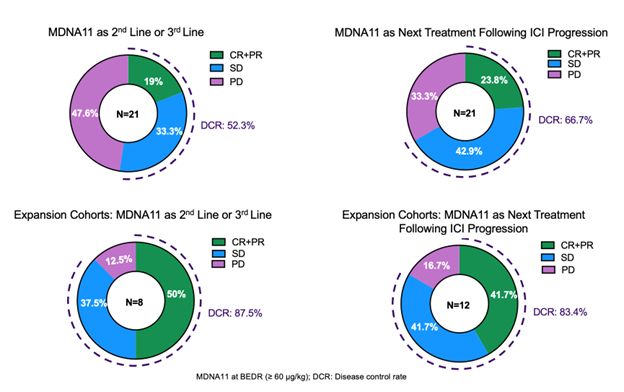
Core Insights - Medicenna Therapeutics is advancing its clinical programs, particularly focusing on MDNA11 and MDNA113, with promising data indicating their potential as best-in-class therapies for cancer treatment [2][3] MDNA11 Developments - In monotherapy expansion cohorts (n=21), the overall response rate (ORR) was 50% for patients treated with MDNA11 in the 2L/3L setting and 42% when MDNA11 was the next treatment post-ICI failure, indicating its best-in-class potential [5][10] - Among all efficacy-evaluable monotherapy patients (n=55) across 18 different cancers, the ORR was 19% for MDNA11 as a 2L/3L treatment and 24% when used post-ICI failure [10] - The ABILITY-1 Phase 1/2 trial has enrolled over 110 safety-evaluable patients, establishing a biologically effective dose range (BEDR) of 60-120 g/kg without dose-limiting toxicities [4][5] MDNA113 Insights - MDNA113, a bifunctional anti-PD1-IL2 superkine, has shown a favorable safety profile in non-human primates at doses up to 30 mg/kg, supporting its potential for human trials [9][16] - The IND submission and initiation of the first-in-human trial for MDNA113 are expected in H2 2026 [9][17] NEO-CYT Study - The NEO-CYT study, in collaboration with Fondazione Melanoma Onlus, will evaluate MDNA11 in front-line therapy for resectable advanced cutaneous melanoma, with patient enrollment planned for H1 2026 and interim data expected in H2 2026 [8][17] Strategic Priorities for 2026 - Medicenna aims to maximize the potential of MDNA11 in earlier-line and neoadjuvant settings, advance MDNA113 as a targeted bifunctional therapy, and progress bizaxofusp through partnerships for recurrent GBM and other brain cancers [14][17] - Key milestones include completing patient enrollment in the ABILITY-1 study, reporting updated clinical data, and securing FDA guidance for registrational trials [17][18]
Medicenna Updates MDNA11 Clinical Trial Results at the ESMO-IO Congress 2025, Further Bolstering its Anti-Tumor Activity in Advanced Solid Tumors
Globenewswire· 2025-12-10 12:30
Core Insights - MDNA11 demonstrates durable anti-tumor activity in difficult-to-treat populations, exceeding objective response rate (ORR) benchmarks in immune checkpoint resistant melanoma, MSS endometrial cancer, MSI-H, and TMB-H cancers [1] - The monotherapy expansion cohorts show an ORR of 42% and a disease control rate (DCR) of 83% for patients treated with MDNA11 after progression on immune checkpoint inhibitors [1] - Combination therapy with KEYTRUDA shows an ORR of 50% and a DCR of 75% in MSS endometrial cancer, while MSS TMB-H tumors show an ORR of 25% and a DCR of 88% [1] Clinical Data - In monotherapy cohorts, ORR is 38% in melanoma and 22% in MSI-H tumors, with corresponding DCRs of 75% and 78% respectively [1] - Patients with disease control in monotherapy cohorts had a median overall survival (mOS) of 120.2 weeks compared to 28.6 weeks for those without disease control [7] - In combination cohorts, patients with disease control had a median OS that was not yet reached, compared to 26 weeks for those without disease control [10] Safety Profile - MDNA11 shows a manageable safety profile, with over 90% of treatment-related adverse events being Grade 1-2 and transient, resolving typically within 48 hours [4] - No dose-limiting toxicities were observed at doses up to 120 µg/kg in monotherapy or in combination with KEYTRUDA [4] Recommended Dose - The preliminary recommended dose for expansion for both monotherapy and combination arms is established at 90 µg/kg Q2W, with a biological effective dose range set at 60 to 120 µg/kg [5] Future Developments - Medicenna plans to share new and mature data from the ABILITY-1 study and additional studies in the coming weeks and months [3]

Medicenna Therapeutics to Host a Live Webinar with Q&A to Discuss Updated MDNA11 Clinical Data
Globenewswire· 2025-12-09 22:04
Core Insights - Medicenna Therapeutics Corp. is hosting a live webinar on December 10, 2025, at 08:30 AM Eastern Time to discuss updated clinical data from the ABILITY-1 Phase 1/2 Study evaluating MDNA11 [1][2] Company Overview - Medicenna is a clinical-stage immunotherapy company focused on developing Superkines for cancer and autoimmune diseases, with a particular emphasis on long-acting IL-2 Superkine, MDNA11, which has superior affinity toward CD122 and preferentially stimulates cancer-killing T cells and NK cells [5] - The company is also developing MDNA113, a bispecific targeting PD-1 and IL-2 for solid tumors, utilizing proprietary BiSKITs™ and T-MASK™ platforms [5] - Bizaxofusp, an IL-4 Empowered Superkine, has been studied in five clinical trials with over 130 patients and has received FastTrack and Orphan Drug status from the FDA and EMA [5] Webinar Details - The webinar will feature presentations from Medicenna's executive and scientific advisory team, including Dr. Fahar Merchant, Dr. Arash Yavari, and Dr. André Mansinho, along with commentary from key opinion leaders and a live Q&A session [4][9]
Medicenna Therapeutics Reports Second Quarter Fiscal 2026 Financial Results and Provides a Corporate Update
Globenewswire· 2025-11-13 12:00
Core Insights - Medicenna Therapeutics is advancing its clinical programs, particularly focusing on MDNA11 and MDNA113, with significant updates expected at the ESMO Immuno-Oncology Congress in December 2025 [1][5][2] MDNA11: IL-2 Superkine Program - The updated clinical data from the Phase 1/2 ABILITY-1 Study for MDNA11 will be presented, showcasing its potential as a leading IL-2 therapy [5] - A new clinical trial, NEO-CYT, will evaluate MDNA11 in combination with checkpoint inhibitors for high-risk melanoma patients prior to surgery [1][5] - The primary endpoint of the NEO-CYT trial is Major Pathologic Response (MPR), which is predictive of long-term survival outcomes [5] MDNA113: First-in-Class Anti-PD-1-IL-2 Bispecific Superkine - MDNA113 is being evaluated in non-human primate studies, with plans for a first-in-human clinical trial to start in 2026 [1][12] - The bispecific therapy is designed to enhance safety and efficacy through proprietary technologies [12] - Preclinical data presented at AACR 2025 supports its development potential in cancers affecting over 2 million patients annually [5][12] Intellectual Property Update - Six new patents have been issued or allowed across multiple jurisdictions, protecting various superkine assets, including the anti-PD1 x IL-2 program [1][7] Financial Overview - As of September 30, 2025, the company reported cash and cash equivalents of $15.7 million, providing a runway into at least mid-2026 [8] - Total operating costs for the quarter were $5.5 million, consistent with the previous year, with a noted increase in R&D expenses to $4.1 million due to expanded clinical activities [9][11] - The net loss for the quarter was $4.9 million, compared to a loss of $4.2 million in the same period last year [10]
Updated MDNA11 Clinical Data from the ABILITY-1 Study to be Presented at the European Society for Medical Oncology (ESMO) Immuno-Oncology Congress 2025
Globenewswire· 2025-10-23 21:12
Core Insights - Medicenna Therapeutics Corp. is set to present updated clinical data for MDNA11 at the ESMO Immuno-Oncology Congress 2025 in London from December 10-12, 2025 [1][2] - The presentation will focus on the Phase 1/2 ABILITY-1 Study, evaluating MDNA11 as a monotherapy and in combination with pembrolizumab for advanced solid tumors [2] Company Overview - Medicenna is a clinical-stage immunotherapy company specializing in the development of Superkines targeting cancer and autoimmune diseases [1][3] - The company’s lead product, MDNA11, is a long-acting IL-2 Superkine designed to preferentially stimulate cancer-killing effector T cells and NK cells [3] - Medicenna is also developing MDNA113, a bispecific targeting PD-1 and IL-2 for solid tumors, utilizing proprietary platforms BiSKITs™ and T-MASK™ [3] - Bizaxofusp, an IL-4 Empowered Superkine, has been studied in five clinical trials with over 130 patients and has received FastTrack and Orphan Drug status from the FDA and EMA [3]
Medicenna Therapeutics (OTCPK:MDNA.F) 2025 Conference Transcript
2025-10-22 18:32
Summary of Medicenna Therapeutics Conference Call Company Overview - Medicenna Therapeutics is a publicly listed company on the TSX main board and OTCQX under the symbol MDNA, focused on developing immunotherapies for late-stage diseases, particularly cancer [1][2] - The company specializes in a class of molecules known as cytokines, aiming to develop enhanced versions called Superkines [1][2] Core Points and Arguments Development and Collaborations - Medicenna licensed the Superkines platform from Stanford University in 2016 and has exclusive worldwide rights [2] - The company has a clinical collaboration with Merck, utilizing Keytruda, the world's best-selling drug, in combination with its own therapies [2][3] Clinical Trials and Data - Medicenna is preparing to provide updates on its Superkine MDNA11, with over 100 patient data points collected [3][6] - The company has received FDA agreement on a phase 3 design for its brain cancer drug, indicating significant progress in its development pipeline [3][5] - MDNA11 has shown promising results, with tumor shrinkage observed in 30% to 50% of patients who have previously failed other therapies [12][14] Market Opportunity - Keytruda, which is set to go off patent in 2028, currently generates nearly $30 billion in annual sales, highlighting a significant market opportunity for alternatives like MDNA11 [11][12] - Medicenna's valuation is approximately $60 million USD, with potential for substantial growth given the response rates observed in clinical trials compared to competitors [18][19] Competitive Landscape - The company is positioned against competitors like Replimune and Iovance, which have higher valuations despite similar response rates [19][20] - Recent multibillion-dollar transactions in the bispecific molecule space, such as the $11.2 billion deal between Takeda and Innovent, indicate a growing interest in this area [21][22] Pipeline and Future Developments - Medicenna is advancing multiple drugs, including MDNA113, a bispecific molecule combining anti-PD-1 and IL-2, with data expected soon [21][23] - The brain cancer program shows potential for significant market impact, with an estimated $4 billion opportunity across various brain cancer types [25][26] Important but Overlooked Content - The company has a strong advisory team, including leading experts in brain cancer and skin cancer, which enhances its credibility and potential for success [4] - Medicenna's approach to IL-2 therapy addresses previous challenges with safety and efficacy, aiming to provide a safer treatment option that effectively shrinks tumors [10][11][13] - The company has a cash runway into Q3 of the following year, allowing it to continue its development efforts without immediate financial pressure [26][40] Upcoming Milestones - Key data readouts are expected by the end of the year, particularly at a major cancer conference in the UK [27][40] - The company plans to meet with regulators to discuss pathways for accelerated approval based on upcoming clinical trial results [28][40]

