Manus Agent

Search documents
硅谷全面“龙虾化”!Anthropic微软Meta和Notion等集体交卷自己的Claw
量子位· 2026-03-01 02:01
Core Viewpoint - The article discusses the recent surge in AI companies developing their own "Claw" systems, which are advanced AI agents capable of executing tasks and automating workflows, marking a significant shift in the AI landscape [2][12][48]. Group 1: Company Actions - Meta has accelerated its efforts by integrating the Manus Agent into Telegram, focusing on long-term memory to enhance user interaction [5][17][18]. - Anthropic has rapidly released new features for Claude Cowork, including mobile remote control and automated task management, to maintain its competitive edge [6][22][23]. - Microsoft introduced Microsoft Copilot Tasks, which autonomously plans schedules, operates across applications, and manages timed tasks, enhancing productivity within its ecosystem [29][30][31][33]. - Notion's Custom Agents represent a significant transformation, allowing for 24/7 operation without manual input, marking its shift from a document tool to a collaborative platform [37][39][42]. - Perplexity launched Perplexity Computer, aiming to unify various AI functions, from research to deployment, under one system [44][46]. Group 2: Industry Trends - The shift towards "Claw" systems is driven by AI models reaching a trust threshold, allowing companies to delegate more complex tasks to AI agents [49][51]. - There is a growing consensus that the next wave of AI growth will focus on the practical capabilities of AI rather than just knowledge accumulation [54][56]. - The commercialization of AI is evolving from selling tokens to selling labor hours, indicating a shift in how AI services are monetized [58][60].




比Manus更懂融资的Agent公司,也被硅谷大厂盯上了
雷峰网· 2026-01-26 11:17
Core Viewpoint - The article discusses the competitive landscape between Manus and Genspark, two leading AI agent companies founded by Chinese entrepreneurs, highlighting their different trajectories and market strategies in the AI sector [2][4][5]. Group 1: Company Background - Genspark was founded by Eric Jing, a former Baidu executive, in June 2024, focusing on the hot AI search market, while Manus, acquired by Meta, has a more grassroots origin with its founder lacking major corporate experience [4][5]. - Genspark quickly secured $60 million in seed funding from Singapore's BlueRun Ventures, achieving a valuation of $260 million, while Manus's parent company, Butterfly Effect, had a valuation of only $60 million after two funding rounds [4][6][7]. Group 2: Market Positioning - Genspark's rapid growth in the AI search sector was marked by its pivot to the agent market following Manus's successful launch of its agent product, which became a phenomenon in the industry [9][13]. - Manus achieved over 20 million monthly active users shortly after its launch, while Genspark's Super Agent was released less than a month later, but it struggled to match Manus's initial popularity [14][15]. Group 3: Financial Performance - Genspark's valuation reached $1.25 billion by November 2025 after a successful B-round funding, showcasing its strong market position compared to Manus, which had a valuation of less than $100 million during its B-round [17][7]. - Genspark's user retention rate is notably high, between 88% and 92%, attributed to its focus on essential business needs and rapid product iterations [24]. Group 4: Competitive Strategies - Genspark effectively utilizes marketing strategies that create buzz and engage with the AI community, contrasting with Manus's approach [22]. - The company maintains a fast product iteration cycle, releasing updates and new tools weekly, which enhances user engagement and satisfaction [23][24]. - Genspark's team composition, blending talent from both Chinese tech giants and Silicon Valley, allows it to leverage both engineering efficiency and product development speed [25]. Group 5: Future Outlook - The article suggests that the future of AI agents may lead to acquisitions by larger tech companies, as the operational demands of developing a competitive agent product require substantial resources that startups may not sustain independently [27].

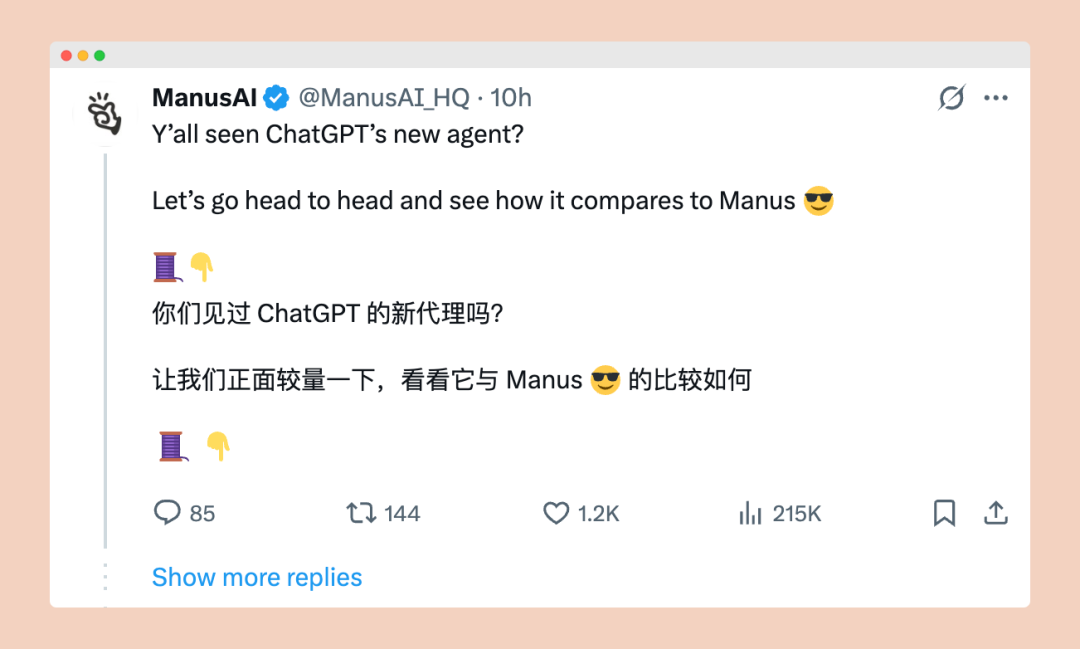
ChatGPT Agent遭暴击,国产AI轮番“公开处刑”
Hu Xiu· 2025-07-19 04:00
Core Insights - The excitement surrounding the release of OpenAI's ChatGPT agent is primarily felt by competing companies rather than end users, indicating a competitive landscape in the agent market [5][6]. - Companies like Manus and Genspark are actively comparing their products with ChatGPT, suggesting a fierce competition and positioning themselves as superior alternatives [1][4][50]. Product Comparisons - Manus has released multiple tweets highlighting its agent's capabilities compared to OpenAI's, claiming to be faster and more efficient [1]. - Genspark showcased a demo that emphasizes its agent's ability to complete tasks more smoothly than ChatGPT, indicating a focus on user experience [4]. - The ChatGPT agent has been rolled out to Pro users, with demand exceeding expectations, leading to a phased rollout for Plus and Team users [6]. User Experience and Performance - A user tested the ChatGPT agent by generating a comprehensive retirement plan presentation, which took about 20 minutes to complete, but the final product was deemed simplistic [12][14]. - The agent's process involved automatic information gathering without user intervention, showcasing its efficiency [13]. - Comparisons with Manus and Genspark revealed that while ChatGPT can generate presentations, the quality and aesthetics of the outputs from competitors were often superior [50][105]. Market Dynamics - The launch of the ChatGPT agent is perceived as a significant event in the agent market, akin to a "competitive bomb" being dropped, which has prompted other companies to enhance their offerings [5]. - The competitive landscape is characterized by rapid responses from companies like Manus and Genspark, who are eager to demonstrate their products' advantages over ChatGPT [1][4][50]. Financial Independence and Retirement Planning - The article discusses a financial independence model (FIRE) for a high-income individual aiming to retire at 30 with $5 million, highlighting the challenges of achieving such goals in a high-cost city like Vancouver [156][160]. - The analysis indicates that even with high savings rates (80-90%), the target of $5 million may not be feasible without extraordinary investment returns or additional income sources [157][159].