Notebook面板

Search documents
电子行业周报:AI&半导体:英特尔2026年Q1指引不及预期
Huajin Securities· 2026-01-25 00:24
Investment Rating - The industry investment rating is "Outperform the Market" (maintained) [4][40]. Core Insights - Intel's Q4 2025 revenue was $13.7 billion, a year-on-year decrease of 4.1% but a quarter-on-quarter increase of 3%. The revenue from the Client Computing Group (CCG) was $8.19 billion, down 6.6% year-on-year, while the Data Center and AI (DCAI) segment saw revenue of $4.74 billion, up 8.9% year-on-year. The Foundry business generated $4.51 billion, an increase of 3.8% year-on-year. Despite a recovery in core DCAI business, Intel's Q1 2026 guidance was significantly below market expectations, forecasting revenue between $11.7 billion and $12.7 billion [4][7][8]. - TE Connectivity reported Q1 2026 net sales of $4.7 billion, a 22% year-on-year increase, driven by growth in industrial and transportation sectors. Earnings per share rose to $2.53, up 45% year-on-year, with adjusted EPS at $2.72, a 33% increase. The company expects Q2 2026 sales of approximately $4.7 billion, a 13% year-on-year increase [4][7][8]. - Resonac, a major semiconductor materials manufacturer, announced a 30% price increase for all series of copper-clad laminates and adhesive films starting March 1, 2026, due to tight supply and rising costs of raw materials [4][8]. - The semiconductor industry is expected to benefit from AI advancements, with a projected 10,000-fold increase in total computing power by 2035. Key investment targets include companies across the semiconductor supply chain, such as SMIC, Hua Hong Semiconductor, and others [4][36]. Summary by Sections Industry Dynamics - Intel's Q4 2025 revenue was $13.7 billion, with a decline in CCG but growth in DCAI. Q1 2026 revenue guidance is significantly lower than expected [4][7]. - TE Connectivity's Q1 2026 net sales were $4.7 billion, with strong performance in industrial and transportation sectors [4][8]. - Price increases announced by Resonac and other companies in the semiconductor materials sector due to rising costs [4][8]. Market Review - The electronic industry saw a weekly increase of 1.39% from January 19 to January 23, 2026, with the construction materials sector leading the gains [9][10]. Industry High-Frequency Data Tracking - TV panel prices are expected to see mild increases in January 2026, while monitor panel prices are predicted to remain stable [16][18]. - Memory prices for various DRAM types have shown an upward trend from January 19 to January 23, 2026 [21].

群智咨询:预计1月份Monitor LCM面板价格将整体保持稳定
智通财经网· 2026-01-07 10:31
Group 1: IT Panel Market Overview - The overall price of IT panels is expected to remain stable in January, with entry-level FHD IPS OC panels likely to see a slight increase [1] - The global display panel market is projected to show a pattern of "overall stability with localized increases" in January [1] - Despite January being a traditional off-season, demand varies significantly among brands due to differences in inventory levels and cost sensitivity [1] Group 2: Demand and Supply Dynamics - Some brands have reduced their display panel inventory to a safe lower range, creating a motivation for restocking, which supports demand [1] - The supply side is facing structural tightness due to overseas capacity contraction and competition from TV and mobile applications for display panel capacity [1] - The concentration of supply among mainstream panel manufacturers is increasing, enhancing their bargaining power amid long-term low profitability and rising upstream material costs [1] Group 3: Specific Panel Price Movements - For 21.5" FHD, the January Open cell & LCM mainstream panel prices are expected to remain flat [1] - For 23.8" FHD, the January IPS Open cell mainstream panel price is projected to increase by $0.2, while the LCM mainstream panel price remains flat [1] - For 27" FHD, the January IPS Open cell mainstream panel price is also expected to rise by $0.2, with the LCM mainstream panel price remaining unchanged [1] Group 4: Notebook Panel Market Trends - The global notebook panel market continues to experience a downward price trend in January [2] - Demand for notebook panels remains weak, with most mainstream brands maintaining inventory levels above the safe range, focusing on inventory management [2] - The supply side remains loose, with notebook panels becoming a key target application for panel manufacturers, leading to increased price competition [2] Group 5: Price Forecasts for Notebook Panels - For low-end HD TN panels, the January mainstream TN LCM average price is expected to remain flat [2] - For IPS FHD & FHD+ products, the January prices for 16:9 and 16:10 mainstream specifications are projected to decrease slightly by $0.2 [2] - Mid-to-high-end specification panel prices continue to show a diverging trend [2]
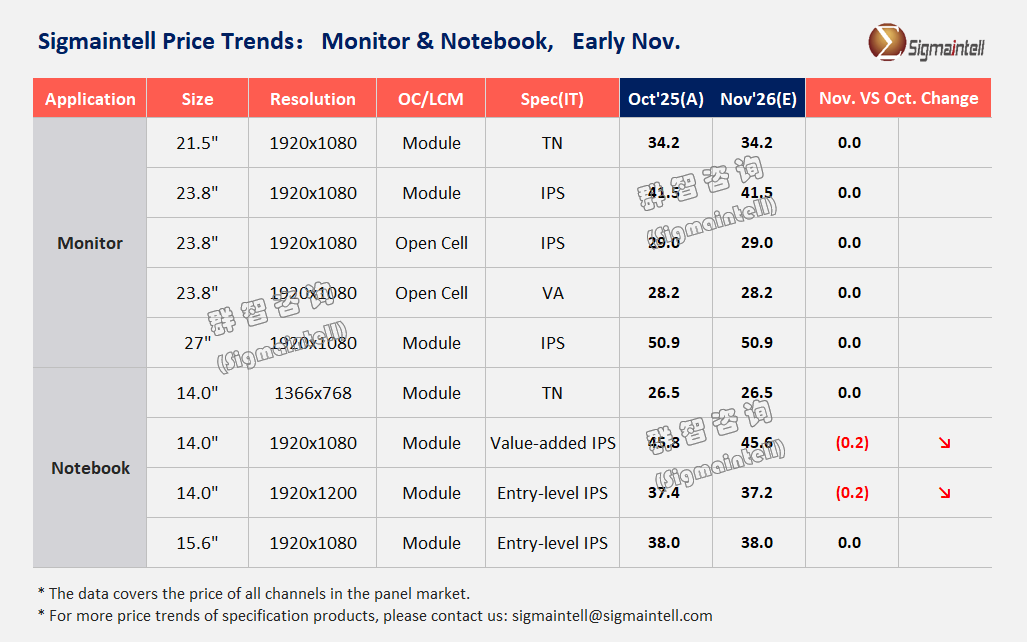
群智咨询:11月份中高端面板面临下跌压力 笔电主流细分市场价格竞争将进一步加剧
Zhi Tong Cai Jing· 2025-11-08 08:13
Core Insights - The global display panel market is expected to maintain price stability in November, with mainstream specifications likely to remain steady while high-end panels face downward pressure due to weak demand and supply adjustments [1][2]. Monitor Panels - In November, the global monitor panel market continues to show price stability, driven by weak demand characterized by high inventory levels among brand manufacturers and reduced procurement activity [2]. - The end of government subsidy policies has led to diminishing market stimulation, further contracting consumer demand [2]. - Panel manufacturers are adopting a "production on demand" strategy to maintain a dynamic balance in supply and demand, with some reducing supply to enhance bargaining power [2]. - Specific price performance for mainstream specifications in November includes: - 21.5" FHD: Prices expected to remain flat - 23.8" FHD: Prices expected to remain flat - 27" FHD: Prices expected to remain flat [2]. Notebook Panels - The notebook panel market continues to experience weak demand in November, leading to sustained price pressure [3]. - High inventory levels among brand manufacturers are prompting cautious procurement orders as the peak stocking season has concluded [3]. - Despite tariff adjustments alleviating some cost pressures, the overall cost burden from rising core component prices remains significant, with brands strongly transmitting cost pressures to panel suppliers [3]. - Price performance for notebook panels in November includes: - Low-end HD TN: Prices expected to remain flat - IPS FHD & FHD+: Prices for 16:9 and 16:10 mainstream specifications expected to decrease slightly by $0.2; high-end specifications continue to show price differentiation [3].