面板制造

Search documents
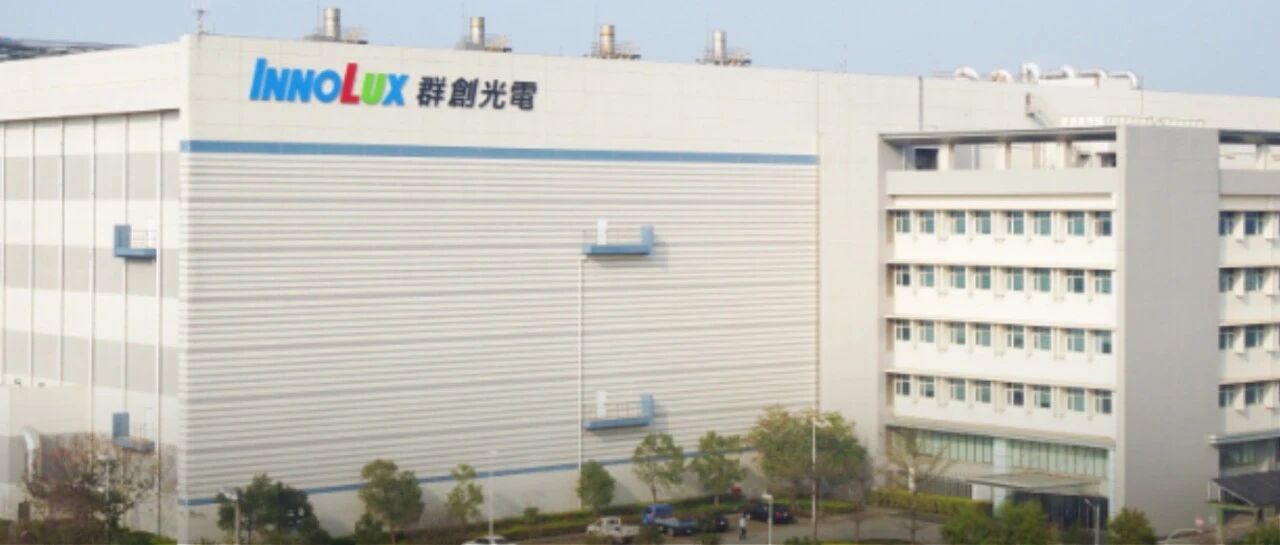
1.9亿元,群创出售南科二厂
WitsView睿智显示· 2026-03-10 09:51
Core Viewpoint - The article discusses the decision by Innolux Corporation to sell its second factory in the Southern Taiwan Science Park to a packaging and testing company, with the transaction amounting to approximately NT$880 million (around RMB 190 million) and expected gains of about NT$659 million (around RMB 143 million) [2]. Group 1: Factory Sale Details - Innolux's second factory primarily produced small to medium-sized panels and has recently been utilized by its subsidiary RayShine for manufacturing digital X-ray flat panel sensors and related medical X-ray sensing panels [2]. - The sale is part of a strategy to phase out inefficient production lines and reduce fixed costs, while also freeing up capital for new business ventures [2]. - The factory being sold is located at No. 6, Section 2, Huandong Road, Xinshi District, Tainan City, covering an area of 34,316.15 square meters (approximately 10,380.64 ping) [2]. Group 2: Board Decisions and Pricing - The board of directors authorized the chairman to proceed with the sale of the second factory, stipulating that the transaction price should not be lower than 90% of the average value from two appraisal reports [3]. - For the fifth factory, a similar pricing condition was established, requiring the sale price to be at least 90% of the amount from the currently issued appraisal report [3]. - If there is a discrepancy of 10% or more between the two appraisal amounts, the board will consult with accountants before deciding on any adjustments to the authorization [3]. Group 3: Financial Implications - The expected gain from the sale of the second factory is projected to be approximately NT$659 million, although the actual amount will be confirmed after the transaction is completed and related expenses are deducted [2].

集邦咨询:2月电视面板价格全面上涨 涨幅最高达3美元
Mei Ri Jing Ji Xin Wen· 2026-02-24 04:47
Core Viewpoint - TrendForce reports indicate that television panel prices are expected to rise, while monitor panel prices show slight fluctuations and laptop panel prices are declining [1] Group 1: Television Panel Market - In February, the demand for television panels remains stable, with manufacturers adjusting production capacity during the Lunar New Year holiday for 5 to 7 days [1] - After the holiday, it is anticipated that the price negotiations between buyers and sellers will not change significantly, maintaining an upward trend in television panel prices [1] - Price increases for February are projected as follows: 32-inch and 43-inch panels up by $1, 50-inch panels up by $1, 55-inch panels up by $2, 65-inch panels up by $3 due to strong demand, and 75-inch panels up by $2 [1] Group 2: Monitor and Laptop Panel Market - Monitor panel prices show slight changes, while laptop panel prices are experiencing a decline [1]
面板大厂推出五重串联QD-OLED屏
Xin Lang Cai Jing· 2026-02-12 12:12
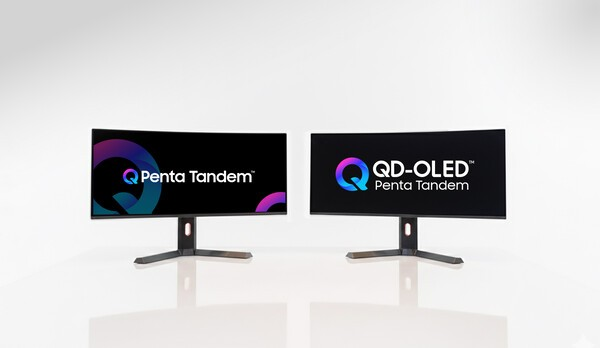
Core Viewpoint - Samsung Display has officially registered its QD-OLED five-layer organic light-emitting structure as the QD-OLED Penta Tandem trademark, aiming to market it as a high-end technology brand [1][5]. Group 1: Technology and Performance - QD-OLED technology utilizes blue OLED as a light source, achieving color reproduction through quantum dots, where the efficiency and durability of blue OLED directly impact panel quality [3][7]. - Starting in 2025, Samsung Display will upgrade the blue OLED stacking structure from four layers to five layers, incorporating the latest organic materials for technological iteration [3][7]. - The increase in the number of organic material layers is directly related to achieving higher resolutions, which leads to increased pixel density and smaller individual pixel light-emitting areas [9]. - Samsung Display has achieved a pixel density of 160 PPI on a 27-inch ultra-high-definition (3840×2160) display, setting an industry benchmark for self-emissive displays [4][9]. - The five-layer structure enhances panel luminous efficiency by 1.3 times and extends lifespan to twice that of the four-layer structure, with peak brightness reaching 4500 nits for TV panels and 1300 nits for monitor panels, both being industry-leading levels [4][9]. Group 2: Certification and Future Plans - Panels equipped with the five-layer tandem technology can help end products achieve VESA's DisplayHDR True Black 500 certification, which requires a pure black display brightness of less than 0.0005 nits and a brightness of no less than 500 nits at 10% pixel activation [10]. - Samsung Display plans to fully apply the five-layer tandem technology across its flagship panel product line by 2026, following the launch of the 27-inch ultra-high-definition panel in 2025 [5][10]. - The technology will also be extended to 31.5-inch ultra-high-definition, 34-inch wide ultra-high-definition (WQHD) panels, and 49-inch dual ultra-high-definition (5120×1440) panels in the second half of 2026 [5][10]. - The five-layer tandem technology is already being utilized in high-end OLED TV product lines for core customers [10].
夏普龟山K2工厂预计8月停工,或将冲击苹果IT面板
WitsView睿智显示· 2026-02-12 09:53
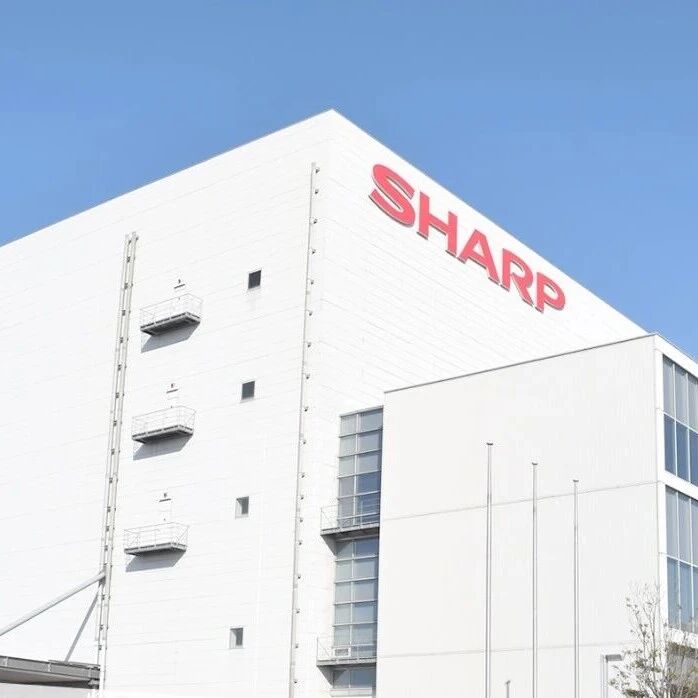
Core Viewpoint - Sharp announced the plan to cease operations at its K2 factory in Japan, which has been a key supplier of IT panels for Apple, potentially impacting the supply of MacBook, iPad, and electronic paper products [2][5]. Group 1: Factory Operations and Impact - The K2 factory, known for its Oxide backplane technology, has been crucial for Sharp's role as the third-largest supplier of IT panels to Apple [2][5]. - The decision to shut down the K2 factory is influenced by the diminishing competitive edge of Sharp's Oxide backplane technology due to investments from Korean and Chinese panel manufacturers [5]. - Currently, Apple products account for only 16-17% of the K2 factory's utilization, and the upcoming release of MacBook OLED versions is expected to further reduce orders for high-end LCD panels [5][6]. Group 2: Competitive Landscape - The K2 factory faces declining order volumes due to intense competition from Chinese panel manufacturers, which have expanded capacity and possess cost advantages [6]. - The shortage and rising prices of memory components have led customers to request cost-sharing from panel suppliers, exacerbating the challenges for the K2 factory [6]. - The factory's average unit cost has worsened due to insufficient demand from applications outside of Apple, prompting Sharp to exit the large-generation LCD panel business [6]. Group 3: Electronic Paper Market - The K2 factory has been a key supplier of Oxide backplanes for electronic paper, which are essential for reducing ghosting effects and extending battery life [6]. - The shutdown of the K2 factory may lead to a temporary negative impact on the upgrade progress of electronic paper products, although orders may be taken over by Chinese manufacturers that are actively expanding their Oxide capacity [6]. Group 4: Future Considerations - It remains to be seen whether Sharp can fully cease operations at the K2 factory by August or retain some capacity for key customers to maintain operational flexibility [6].

研报 | 夏普龟山K2工厂计划八月停工,或将冲击苹果IT面板与电子纸供应
TrendForce集邦· 2026-02-11 09:01
Core Viewpoint - Sharp announced the plan to cease operations at its K2 factory in Japan, which has been a key supplier of IT panels for Apple and electronic paper, due to declining competitiveness and uncertain order prospects from Apple [2][3]. Group 1: Factory Closure and Impact - The K2 factory primarily produced panels for laptops, tablets, electronic paper, and smartphones, supporting Sharp's role as the third-largest supplier of IT panels for Apple [2]. - The decision to close the K2 factory was influenced by the failure to transfer it to Foxconn and the need for business reform, with the closure planned for August [2]. - Sharp's technology in oxide backplanes, once a leading edge, has diminished due to investments from Korean and Chinese panel manufacturers, leading to a loss of competitive advantage [2][3]. Group 2: Apple Orders and Market Dynamics - Currently, Apple products account for only about 16-17% of the K2 factory's capacity, and the upcoming release of OLED versions of MacBook is expected to further reduce orders for high-end LCD panels [3]. - The uncertainty surrounding Apple’s order prospects was a key factor in Sharp's decision to cease operations at the K2 factory [3]. - The K2 factory's other panel business is facing declining order volumes due to fierce competition from Chinese manufacturers, exacerbated by rising costs and supply chain issues [3][4]. Group 3: Electronic Paper and Future Prospects - The oxide backplane technology is crucial for reducing ghosting and input lag in electronic paper, making the K2 factory a key supplier in this field [4]. - The closure of the K2 factory may lead to orders being taken over by Chinese manufacturers that are actively expanding their oxide capacity, although it could negatively impact the upgrade progress of electronic paper products in the short term [4]. - It remains to be seen whether Sharp can fully cease operations at the K2 factory by August or retain some capacity for key customers [4].

群智咨询:2月份Monitor主流IPS OC面板将迎来全面上涨
智通财经网· 2026-02-06 11:27
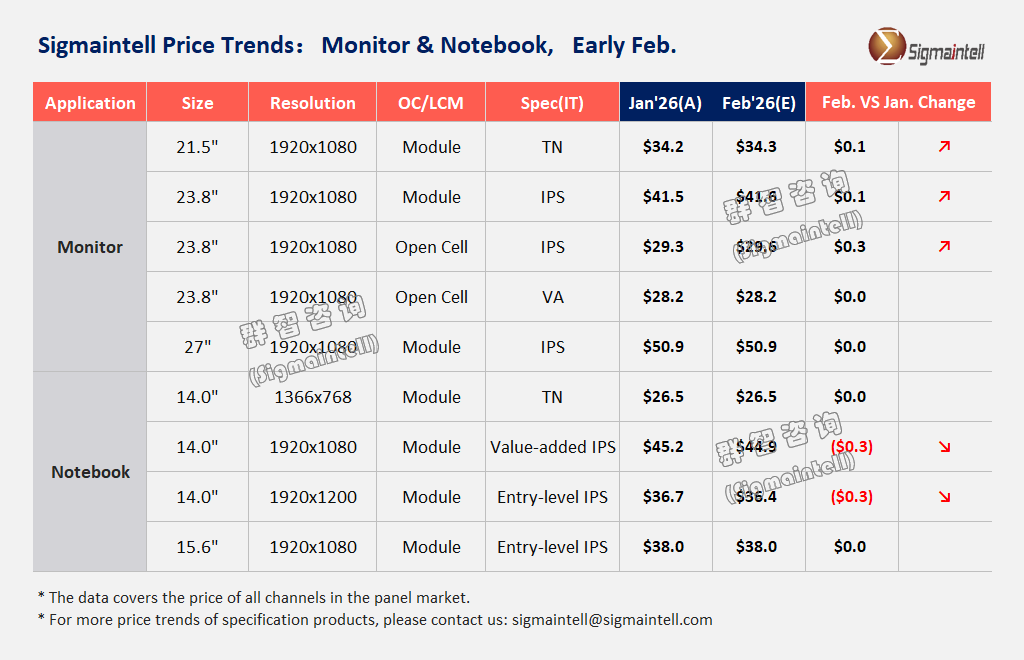
Core Insights - The global display panel market is expected to see price increases in February 2026, driven by stable demand and tightening supply conditions [1] - Monitor panel prices, particularly for mainstream IPS OC panels, are projected to rise, while small-sized LCM panel prices may also see slight increases [1] - The notebook panel market is experiencing an expanding downward price trend due to increased cost pressures and a surplus in supply [2] Group 1: Monitor Panels - In February, the prices for 21.5" FHD IPS Open Cell panels are expected to rise by $0.3, while LCM mainstream panel prices will increase by $0.1 [2] - The overall demand for monitor panels remains robust, supported by overseas commercial replacement demand and domestic demand for innovative technologies [1] - Supply constraints are anticipated due to reduced production capacity from mainland manufacturers and ongoing tightening from overseas suppliers [1] Group 2: Notebook Panels - The global notebook panel market is facing intensified price competition, with expectations of further price declines due to cost pressures from storage chip shortages and increased overall machine costs [2] - Despite some preemptive stocking by brands, the primary focus remains on reducing panel procurement costs, leading to downward pricing pressure [2] - The supply side for notebook panels remains relatively ample, contributing to a loose market supply-demand balance [2]
TrendForce预计2月电视及显示器面板延续上涨态势,笔电面板价格承压
Jin Rong Jie· 2026-02-06 07:55
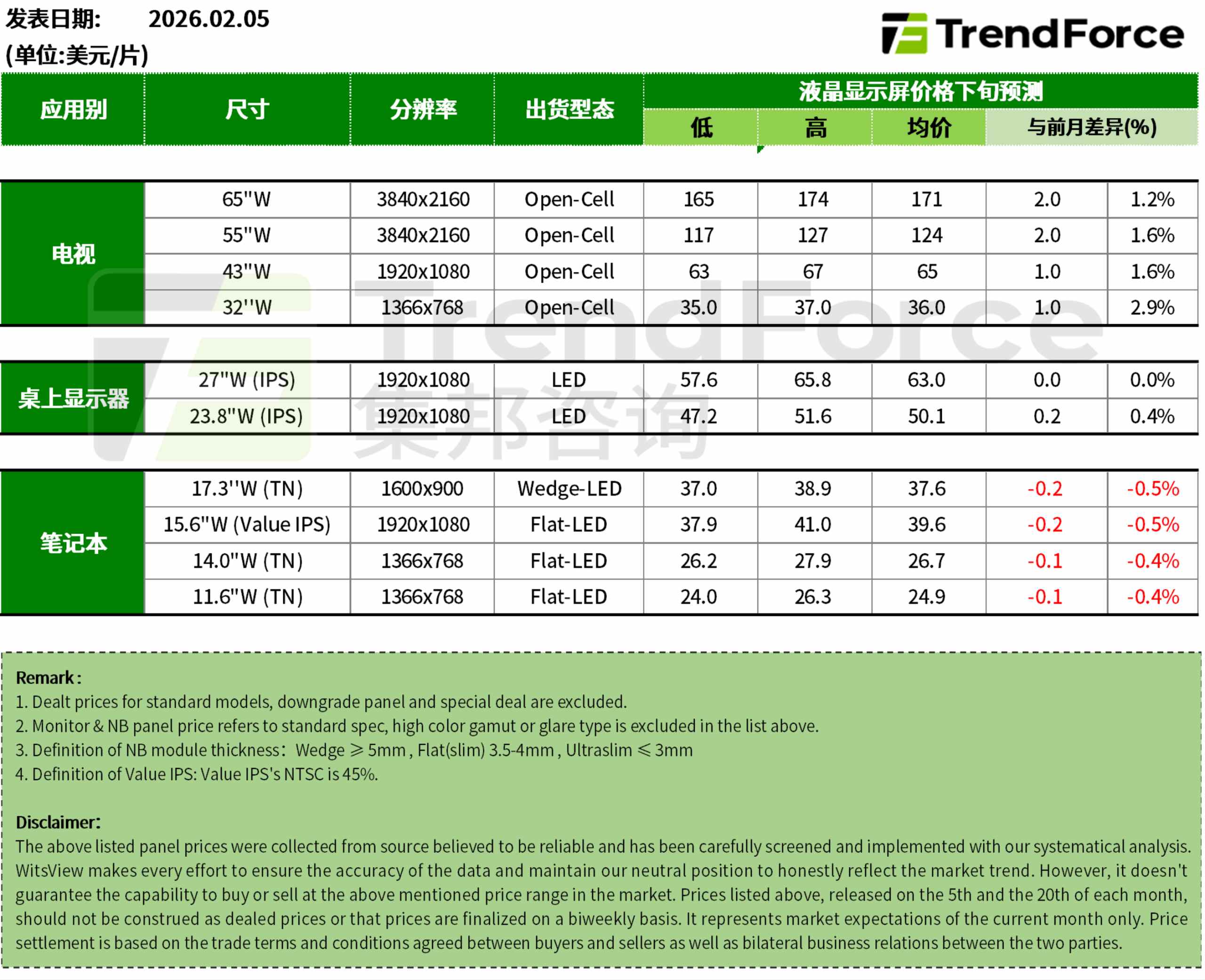
Group 1: TV Panels - In February, the demand for TV panels remains relatively stable, with manufacturers planning capacity adjustments during the Lunar New Year, leading to an expected average utilization rate decrease of about 10% compared to January, which supports a balanced supply-demand situation and contributes to rising prices [1] - It is estimated that TV panel prices will show a comprehensive upward trend in February, with 32-inch, 43-inch, and 50-inch panels expected to increase by $1, while 55-inch, 65-inch, and 75-inch panels are projected to rise by $2 [1] Group 2: Monitor Panels - The price of TV panels has established a comprehensive upward trend, and monitor panel demand is better than expected, with brand clients increasing urgent orders, prompting manufacturers to consider raising monitor panel prices [2] - For February, the 23.8-inch FHD Open Cell panel is expected to increase by $0.3, while the 27-inch FHD Open Cell panel is projected to rise by $0.1; additionally, the 23.8-inch FHD panel module is anticipated to increase by $0.2 [2] Group 3: Laptop Panels - In February, due to tight supply and rising prices of memory and other semiconductor components, laptop brand clients are preemptively stocking up on laptop panels, but the pressure to lower panel prices is increasing [3] - To maintain relationships with laptop brand clients and stabilize short-term orders, manufacturers are softening their pricing stance, leading to a downward price trend for laptop panels, with TN models expected to decrease by $0.1 and IPS models by $0.2 [3]
TrendForce:预计2月电视及显示器面板延续上涨态势 笔电面板价格承压
智通财经网· 2026-02-06 06:32
Group 1: TV Panels - In February, the demand for TV panels remains relatively stable, with manufacturers planning production adjustments during the Lunar New Year, leading to an expected average utilization rate decrease of about 10% compared to January, which supports a balanced supply-demand situation and aids in price increases [1] - The forecast for February indicates a potential overall price increase for TV panels, with 32-inch, 43-inch, and 50-inch panels expected to rise by $1, while 55-inch, 65-inch, and 75-inch panels are anticipated to increase by $2 [1] Group 2: Monitor Panels - As of February, the price trend for monitor panels is set to increase due to better-than-expected demand and urgent orders from brand clients, prompting manufacturers to consider raising prices [2] - Specifically, the 23.8-inch FHD Open Cell panel is expected to increase by $0.3, and the 27-inch FHD Open Cell panel is projected to rise by $0.1, with the 23.8-inch FHD panel module also likely to increase by $0.2 [2] Group 3: Laptop Panels - In February, the laptop panel market is experiencing downward price pressure due to tight supply and rising costs of memory and other semiconductor components, leading laptop brand clients to stock up while demanding lower prices [3] - Manufacturers are softening their pricing stance to maintain relationships with laptop brand clients, resulting in a forecasted price decline across all sizes of laptop panels, with TN models expected to drop by $0.1 and IPS models by $0.2 [3]
集邦咨询:2月份电视面板价格预计将延续上涨态势
Mei Ri Jing Ji Xin Wen· 2026-02-06 06:06
Group 1 - The core viewpoint of the article indicates that television panel prices are expected to continue rising in February, while some monitor panel sizes will see price increases, and laptop panel prices are anticipated to decline [1] Group 2 - In February, the demand for television panels remains relatively stable, and panel manufacturers plan to adjust production capacity during the Lunar New Year for 5-7 days, which is expected to lead to a 10% reduction in average utilization rates compared to January [1] - This production adjustment is likely to support a balanced supply-demand situation, contributing to the increase in television panel prices [1] - The forecast for February suggests that television panel prices may see a comprehensive upward trend, with 32-inch, 43-inch, and 50-inch panels expected to rise by $1, while 55-inch, 65-inch, and 75-inch panels are projected to increase by $2 [1]
东方证券:供需格局向好 大尺寸面板涨价有望持续
Zhi Tong Cai Jing· 2026-02-05 02:07
Core Viewpoint - The electronic industry panel manufacturers are continuing their production control strategies, leading to price increases for large-sized panels, which are expected to persist due to demand from events like the World Cup [1][2]. Group 1: Panel Price Trends - Large-sized panel prices are expected to continue rising as manufacturers maintain production control, with demand remaining stable [2]. - AVC data indicates that all sizes of TV panels saw price increases in late January, with some monitor panels also experiencing price hikes [1][2]. - The tight supply-demand situation for TV panels is extending to monitor panels, with expectations of price increases in February [2]. Group 2: Capital Expenditure Trends - The large-scale capital expenditure cycle in the panel industry is nearing its end, with leading manufacturers expected to significantly reduce future spending [3]. - According to BOE's announcement, 2025 will be the peak year for capital expenditure, with a significant decline anticipated starting in 2027 [3]. - TCL Technology is focusing on investments aligned with the accelerated penetration of OLED in the mid-size market, with no major new production line investments planned beyond the T8 line [3]. Group 3: Mobile OLED Panel Market - Mobile OLED panel prices are under short-term pressure, but the impact is expected to be manageable [4]. - The penetration rate of mobile OLED panels is anticipated to continue increasing, which may offset the decline in overall smartphone shipments [4]. - Omdia forecasts that global smartphone AMOLED panel shipments will decrease slightly to 810 million units in 2026, a minor decline from 817 million in 2025 [4]. Group 4: Investment Recommendations - The favorable supply-demand relationship and the expected continuation of price increases for large-sized panels suggest potential investment opportunities in panel manufacturers such as TCL Technology, BOE A, and others [5]. - Related material manufacturers and display driver chip manufacturers are also highlighted as potential investment targets [5].