
PC内存

Search documents
PC内存价格预计再涨50% 但市场依然保持健康
Zhong Guo Jing Ying Bao· 2026-01-14 06:39
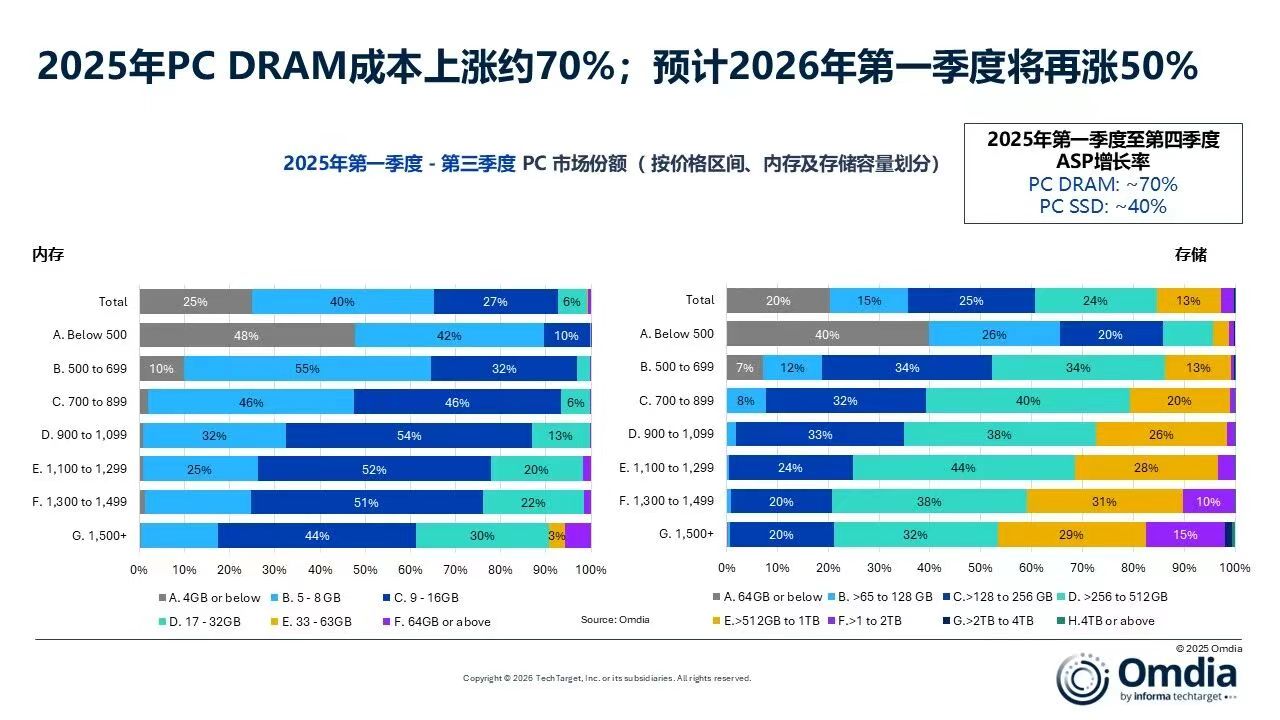
Core Insights - The global PC market is expected to see a significant recovery in 2025, with total shipments reaching 279.5 million units, marking a 9.2% year-on-year growth, ending two years of decline [1] - The fourth quarter of 2025 will be particularly strong, with total shipments of desktops, laptops, and workstations rising to 75 million units, a year-on-year increase of 10.1% [1] - The desktop market is projected to grow at a rate of 14.4%, while laptops (including mobile workstations) will maintain a dominant position with annual shipments of 220.4 million units [1] Market Dynamics - Despite the recovery, there are underlying concerns as memory and storage supply is tightening, leading to a rapid increase in prices, with expectations of a 50% rise in the short term [4] - The tightening supply is attributed to global supply chain issues, rising raw material costs, and surging market demand [4] - Major manufacturers are adjusting production strategies to prioritize high-end product lines, exacerbating supply-demand imbalances in the mid-to-low-end market [4] Competitive Landscape - The fourth quarter of 2025 will showcase a competitive landscape characterized by "top players solidifying their positions while mid-tier players gain traction" [5] - Lenovo will maintain its global leadership with shipments of 19.3 million units and a market share of 25.8%, reflecting a 14.4% increase from the previous year [5] - Dell will emerge as a significant player with a 26.0% year-on-year growth rate, increasing shipments from 9.9 million to 12.5 million units, raising its market share by 2.1 percentage points to 16.7% [5] - HP will follow with 15.4 million units shipped and a market share of 20.6%, showing a stable growth of 12.1% [5] - Smaller manufacturers are struggling, with a collective shipment decline of 1.5%, as they lose market share to larger players due to supply constraints [5] Strategic Recommendations for Smaller Players - Experts suggest that smaller PC manufacturers should focus on niche application scenarios to differentiate themselves and avoid direct competition with larger firms [6] - By developing high-performance, specialized PC products for specific fields like design and gaming, smaller firms can enhance product value and user loyalty [6] - Collaborating with software developers in niche markets can further optimize product performance and improve user experience [6] Impact of Rising Memory Prices - The overall PC market is performing well, but tightening memory supply and rising prices are expected to suppress shipment forecasts for 2026 [7] - Memory and storage costs have increased by 40% to 70% from Q1 to Q4 of 2025, leading to cost pressures that will be passed on to customers [7] - The rising memory prices are a structural adjustment in the global semiconductor industry, affecting product strategies and market dynamics [7] Future Outlook - The cost of memory is becoming a significant portion of PC hardware costs, with high-end laptops seeing memory costs rise to 23% [8] - Major manufacturers like Lenovo and Acer are planning price increases for 2026 due to these cost pressures [8] - The memory price increase cycle is expected to extend, further concentrating the market towards larger firms with better supply chain management and cost absorption capabilities [9] - Domestic memory manufacturers like Changxin Storage and Yangtze Memory are expected to play a crucial role in alleviating global memory supply shortages in the long term [10]


联想集团疯狂囤积PC内存:足以支撑至2026年底!
Ge Long Hui· 2025-11-25 05:59
Core Viewpoint - Lenovo Group has accumulated memory and other critical components to address supply shortages driven by the AI boom, with current inventory levels approximately 50% higher than usual [1] Group 1: Supply Chain Management - The global AI data center construction surge is increasing procurement costs for consumer electronics manufacturers, but Lenovo sees an opportunity to profit from its inventory advantage [1] - Lenovo has signed long-term contracts with key component suppliers, allowing the company to take a more proactive position in supply chain negotiations [1] Group 2: Pricing Strategy - Lenovo aims to avoid passing rising costs onto customers to maintain strong sales momentum this year, with a goal to balance pricing and supply capabilities by 2026 [1] - The company is experiencing unprecedented price increases for related products due to AI demand, as stated by CFO Winston Cheng [1] Group 3: Competitive Advantage - As a major buyer of core components, Lenovo's large procurement volume enables it to secure better pricing and establish deeper strategic ties with suppliers, creating a competitive "scale moat" that smaller players cannot match [1]