
Public offering funds

Search documents
公募基金信披标准将迎来重要修订 更加突出“以投资者为本”
Jin Rong Shi Bao· 2026-02-03 01:56
Core Viewpoint - The public fund industry in China is set to undergo significant institutional changes aimed at promoting high-quality development through revised information disclosure standards [1][2][7] Group 1: Key Revisions in Disclosure Standards - The China Securities Regulatory Commission (CSRC) has released a draft for public consultation regarding the revised "Guidelines for Information Disclosure of Publicly Offered Securities Investment Funds" [1][2] - The new guidelines consolidate existing disclosure requirements for annual, semi-annual, and quarterly reports into a single normative document, enhancing clarity and reducing redundancy [2][3] - The revisions aim to simplify and adjust certain disclosure requirements based on higher regulations and industry practices, drawing from experiences in mature foreign markets [1][2][3] Group 2: Focus on Investor-Centric Disclosure - The revised standards emphasize an "investor-centric" approach, requiring funds to disclose long-term performance metrics over 7 and 10 years, while eliminating short-term performance data from the past month [4][5] - This shift encourages a focus on long-term investment and value investment principles, aiming to cultivate a more rational investment culture among investors [5][6] Group 3: Enhancing Stability in Investment Behavior - The new guidelines mandate the disclosure of stock turnover rates in annual reports, addressing concerns over high turnover rates that contradict long-term investment principles [6][7] - This requirement is intended to promote more prudent investment practices among fund managers and enhance the stability of investment behaviors within the industry [6][7] Group 4: Overall Impact on the Industry - The integration and revision of disclosure rules are seen as a crucial step towards high-quality development in the public fund sector, reducing the complexity and execution friction associated with fragmented regulations [7] - By establishing targeted and tiered disclosure requirements based on the different functions of various reports, the revisions aim to improve the relevance and readability of disclosed information [7]

基金业重要新规3月起实施
2 1 Shi Ji Jing Ji Bao Dao· 2026-01-23 12:19
Core Viewpoint - The new regulations on public fund performance benchmarks aim to address long-standing issues in the industry, enhancing the representation, constraint, and assessment roles of performance benchmarks while strengthening external supervision [1][8]. Group 1: Key Highlights of the New Regulations - The guidelines and operational details emphasize the need for performance benchmarks to accurately reflect product positioning, investment strategies, styles, and risk-return characteristics, ensuring alignment between benchmarks and actual fund performance [3][4]. - The regulations require fund managers to establish comprehensive control mechanisms covering the selection, disclosure, monitoring, correction, and accountability related to performance benchmarks, thereby enhancing their functional role [4][6]. - The new rules integrate performance benchmarks into the assessment and evaluation systems, mandating that fund managers create a performance evaluation framework linked to fund investment returns, which will influence the compensation of fund managers based on their performance relative to benchmarks [5][9]. Group 2: Implementation and Transition - A one-year transition period is set for existing funds to adjust their performance benchmarks smoothly, with a principle of "adjusting benchmarks without changing portfolios" to prevent market disruptions [7][8]. - The regulations also outline responsibilities for custodians, sales, and evaluation institutions to ensure effective supervision and use of performance benchmarks, enhancing transparency and accountability in the fund management process [6][8].

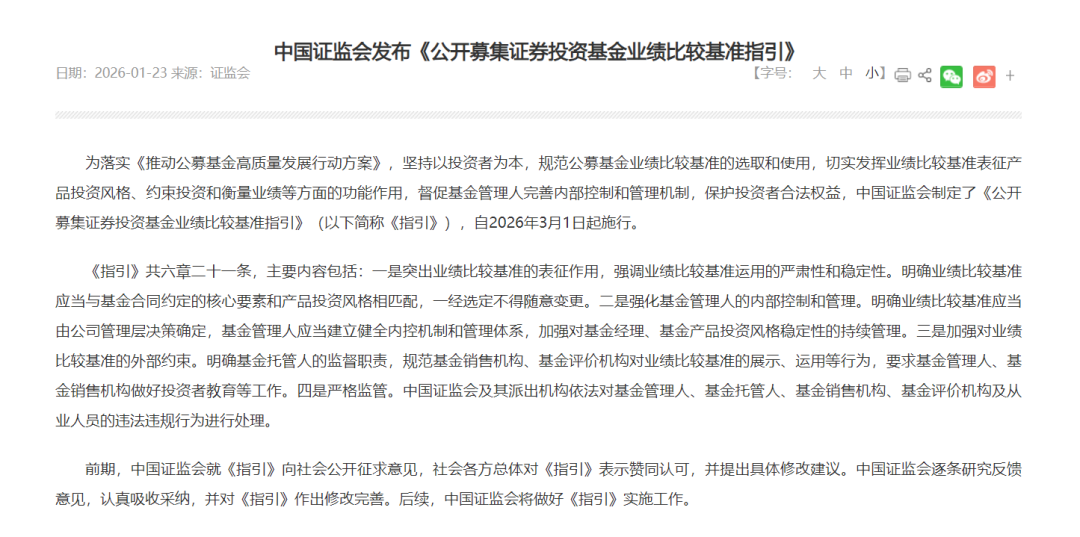
公募基金业绩比较基准新规亮相
Jin Rong Shi Bao· 2025-11-05 00:57
Core Viewpoint - The new regulations on performance benchmarks for public funds aim to enhance the stability and clarity of investment styles, improve investor returns, and fill regulatory gaps in the public fund industry [1][2][7]. Group 1: Regulatory Framework - The China Securities Regulatory Commission (CSRC) has released a draft guideline for public fund performance benchmarks, which includes operational details for selecting, disclosing, and managing these benchmarks [1][3]. - The guideline emphasizes the importance of performance benchmarks in reflecting the core elements of fund contracts and investment styles, which should not be changed arbitrarily once established [3][4]. Group 2: Internal Control and Management - Fund managers are required to establish a comprehensive internal control mechanism covering the selection, disclosure, monitoring, evaluation, and accountability of performance benchmarks [5][6]. - The decision-making process for selecting benchmarks must involve higher management levels, ensuring accountability for the representativeness and continuity of the benchmarks [5][6]. Group 3: Performance Evaluation and Incentives - The guidelines mandate that fund managers create a performance evaluation system centered on investment returns, linking compensation to fund performance relative to benchmarks [6][8]. - Fund evaluation agencies are encouraged to use performance benchmarks as a key criterion for assessing fund management, moving away from short-term market rankings [6][8]. Group 4: Industry Transition and Support - The CSRC plans to guide industry institutions through a transitional period to optimize existing benchmarks, ensuring they align with fund contracts and actual investment styles [7][8]. - An expert group will be formed to establish a benchmark element library to encourage standardized selection of benchmarks that represent equity assets [7].
基金“盲盒”时代要结束了
Sou Hu Cai Jing· 2025-11-01 23:06
Core Viewpoint - The new regulations from the China Securities Regulatory Commission (CSRC) aim to enhance transparency and reliability in public funds, moving from "vague benchmarks" to "precise anchoring" [1] Group 1: Regulatory Changes - On October 31, the CSRC released the "Guidelines for Performance Comparison Benchmarks of Publicly Offered Securities Investment Funds (Draft for Comments)" along with supporting operational details [1] - The new rules require that performance benchmarks must align with investment strategies and cannot be modified arbitrarily once set [1] - A dual regulatory mechanism involving internal control and custody has been introduced to prevent fund managers from deviating from established benchmarks [1] Group 2: Impact on Fund Management - Performance compensation for fund managers will now be linked to the benchmarks, ensuring that only those who outperform the benchmarks are rewarded [1] - This shift is expected to provide investors with clearer insights into a fund's actual performance, reducing the risk of being misled by inflated performance claims [1] Group 3: Industry Implications - The upgrade of benchmarks is not merely a change in calculation methods but represents a fundamental restructuring of trust within the industry [1] - The overall goal is to foster a more transparent, stable, and professional environment for the high-quality development of China's fund industry [1]

财经深一度丨公募基金改革再“落子”,业绩“参照系”全面升级
Xin Hua Wang· 2025-10-31 16:36
Core Viewpoint - The China Securities Regulatory Commission (CSRC) has released a draft for public consultation regarding performance benchmarks for public funds, indicating a shift towards a clearer and more objective evaluation system for fund performance [1] Group 1: Reform Overview - The new guidelines signify a critical step in the ongoing reform of public funds, transitioning from "incremental reform" to "stock reform" by addressing the performance evaluation of existing public funds [1] - The performance benchmark will serve as a "reference" for public funds, helping investors understand the fund's investment focus and risk-return characteristics [2] Group 2: Benchmark Selection and Management - Fund managers can select benchmark elements from an established industry benchmark element library, ensuring that the benchmarks accurately reflect the fund's investment direction, strategy, and style [3][5] - The benchmarks must be objectively transparent, with clear calculation methods and data sources, and funds are required to disclose the basis for benchmark selection in contracts and reports [6] Group 3: Accountability and Oversight - The new regulations mandate that public fund companies establish a comprehensive management system for the selection, disclosure, monitoring, evaluation, and accountability of performance benchmarks [7] - The decision-making authority for benchmark selection will be elevated to the company management level, ensuring accountability and appropriate matching of fund managers to their respective funds [7] Group 4: Performance Evaluation and Transition - The new rules will incorporate performance benchmarks into the evaluation of fund managers' compensation, discouraging aggressive investment strategies and style drift [8] - A one-year transition period will be provided for optimizing performance benchmarks for existing products, allowing fund managers to adjust benchmarks to better align with actual portfolio styles without causing significant market disruption [9]
每年让利投资者300亿元!公募基金迎来销售费率改革重磅文件
2 1 Shi Ji Jing Ji Bao Dao· 2025-09-05 14:28
Core Viewpoint - The public fund fee reform has officially entered its final stage with the release of the "Regulations on the Management of Sales Fees for Publicly Raised Securities Investment Funds" by the China Securities Regulatory Commission (CSRC), aiming to enhance investor benefits and promote high-quality development in the public fund industry [1][7]. Summary by Sections Fee Reduction - The new regulations are expected to reduce costs for investors by approximately 300 billion yuan annually, with previous phases already yielding reductions of about 140 billion yuan and 68 billion yuan [2][7]. - The maximum subscription and redemption fees for stock funds have been lowered from 1.2% and 1.5% to 0.8%, while mixed funds have seen reductions from 1.2% and 1.5% to 0.5%. Bond funds' fees have been cut from 0.6% and 0.8% to 0.3% [2]. Investor Protection - All redemption fees will now be allocated to fund assets, ensuring that they belong to investors, and the redemption fee for holding periods of 7 to 30 days has been increased to 1% [3][4]. - This change aims to encourage fund sales institutions to shift from earning "flow" income to "retention" income, while also discouraging short-term speculative trading [3]. Tail Commission Adjustments - The regulations introduce differentiated arrangements for tail commission ratios, focusing on servicing individual investors and promoting equity funds [4][5]. - For personal investor sales, the tail commission will remain capped at 50% of management fees, while for institutional investors, the cap for non-equity funds will be reduced from 30% to 15% [5]. New Direct Sales Platform - The CSRC has approved the launch of the Fund Industry Service Platform (FISP) to enhance direct sales services for institutional investors, addressing the challenges faced by traditional direct sales operations [6]. Long-term Investment Development - The updated regulations are seen as a significant step towards fostering a long-term, value-oriented investment culture in the public fund industry, aligning with national policies aimed at high-quality development [7][8]. - Industry leaders believe that the fee reductions will enhance investor experience and encourage a focus on improving service capabilities [9].