ResAD框架

Search documents
地平线ResAD:残差学习让自动驾驶决策更接近人类逻辑
自动驾驶之心· 2025-11-07 16:04
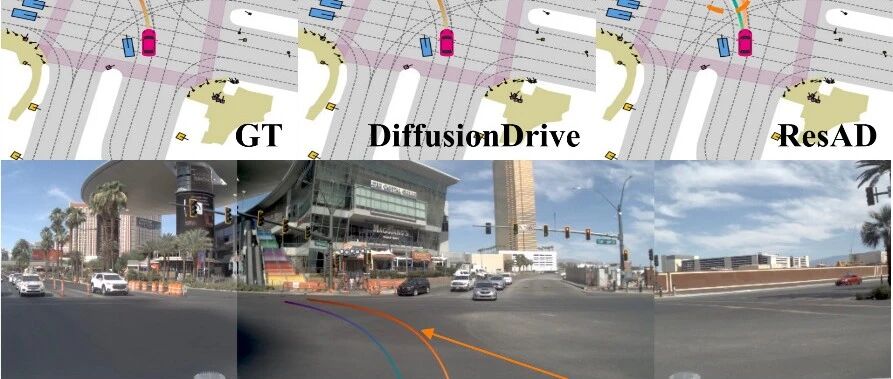
Core Insights - The article discusses the limitations of traditional modular approaches in autonomous driving and introduces the ResAD framework, which aims to improve efficiency and safety by using an end-to-end model that focuses on learning necessary adjustments from a baseline trajectory [2][50]. Group 1: Framework Overview - ResAD framework proposes a shift from directly predicting future trajectories to learning the necessary adjustments from a physical baseline trajectory, termed "inertial reference line" [2][50]. - The model focuses on understanding the reasons for trajectory adjustments, such as obstacles and traffic rules, rather than memorizing data correlations [50]. Group 2: Methodology - The ResAD framework incorporates a "normalized residual trajectory modeling" approach, which simplifies the learning problem by defining trajectory predictions as adjustments to a reference line [11][50]. - The framework employs a "point-wise residual normalization" technique to balance the optimization weights of near and far trajectory points, ensuring that critical adjustments are not overlooked [20][50]. Group 3: Testing and Results - Real-world testing demonstrated the effectiveness of the ResAD framework, showcasing its ability to handle complex driving scenarios and respond intelligently to dynamic obstacles [6]. - In benchmark evaluations, ResAD achieved state-of-the-art performance on NAVSIM v1 and v2, with a PDMS score of 88.6 and an EPDMS score of 85.5, indicating high safety and efficiency in route completion [38][39]. Group 4: Comparative Analysis - ResAD outperformed existing models like DiffusionDrive in various metrics, including lane adherence and route completion efficiency, highlighting its superior trajectory generation capabilities [41][39]. - The article emphasizes the importance of the unique trajectory modeling strategy in ResAD, which allows for the generation of contextually relevant and diverse trajectories without relying on a static trajectory library [10][41].

地平线残差端到端是如何实现的?ResAD:残差学习让自动驾驶决策更接近人类逻辑
自动驾驶之心· 2025-10-13 23:33
点击下方 卡片 ,关注" 自动驾驶之心 "公众号 戳我-> 领取 自动驾驶近30个 方向 学习 路线 >>自动驾驶前沿信息获取 → 自动驾驶之心知识星球 论文作者 | Zhiyu Zheng等 编辑 | 自动驾驶之心 想让车子自己开,传统方法得像搭积木:先"看"(感知),再"猜"(预测),最后"做决定"(规划)。这套流程环环相扣,一个环节出错,后面全跟着错, 既不高效,也不安全。 于是, 端到端自动驾驶 成了一条新路。它想让AI像老司机一样,直接把看到的(传感器数据)变成要走的路线(未来轨迹)。想法很美好,但现实很骨 感:现有的端到端模型,大多在死磕一个问题—— "未来的轨迹长啥样?" 为了解决这些问题,地平线、华科和武大的团队提出了 ResAD 框架。核心思想很简单: 不直接预测整条轨迹,而是先给一个"惯性参考线"——就是车子如 果不动方向盘会走的路线。然后,让模型只学习一个"调整量"(残差),即为了安全行驶,需要偏离这根参考线多少。 这样一来,学习目标就从 "轨迹是什么?" 变成了 "为什么要调整方向?" 。模型被迫去关注那些导致调整的真实原因,比如障碍物、交通规则等,而不是死 记硬背数据里的巧合。 我们 ...