SURPRISE3D

Search documents
SURPRISE3D:首创复杂3D场景空间推理数据集,突破语义捷径依赖瓶颈
具身智能之心· 2025-07-13 09:48
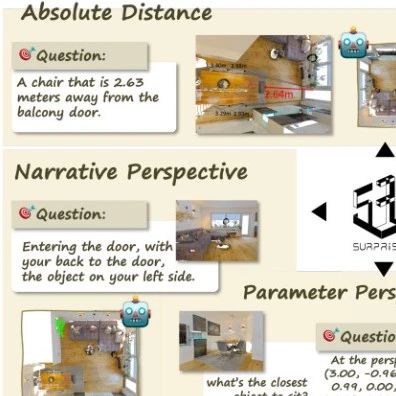
Core Viewpoint - The article emphasizes the importance of spatial reasoning in embodied AI and robotics, highlighting the limitations of existing 3D vision-language benchmarks and the need for a new standard that effectively evaluates spatial reasoning capabilities [3][4][5]. Group 1: Background and Limitations - Spatial reasoning is essential for intelligent agents to navigate and interact in real environments, requiring an understanding of 3D spatial layouts and context [3]. - Current 3D vision-language benchmarks fail to capture and assess spatial reasoning effectively, leading to models relying on semantic shortcuts rather than true spatial understanding [4]. - Three main limitations of existing benchmarks are identified: over-reliance on explicit queries, limited and shallow reasoning coverage, and template-driven or simplistic spatial queries [4]. Group 2: SURPRISE3D Dataset - SURPRISE3D is introduced as a new benchmark that combines linguistic intricacy with geometric complexity, featuring over 900 richly annotated indoor environments and more than 200,000 query-object mask pairs [5][6]. - The dataset's queries are designed to be implicit, ambiguous, and semantically lightweight, compelling models to rely on reasoning rather than recognition [5]. - Empirical evaluations show that even the most advanced existing 3D foundational models struggle on this dataset, indicating a significant innovation space for improving spatial reasoning capabilities [5][6]. Group 3: Query Types and Annotation Process - The dataset includes complex spatial queries that require various types of reasoning, such as narrative perspective, parametric perspective, relative position, and absolute distance [11][12]. - The annotation process involves dual workflows focusing on spatial reasoning and common-sense/human intention reasoning, ensuring a rich and complementary set of queries [16][18]. - Quality control measures include human verification and a multi-stage review process to ensure high-quality annotations [21][22]. Group 4: Experimental Results and Insights - Baseline models were evaluated for their effectiveness in spatial reasoning tasks, revealing that overall spatial reasoning capabilities are weaker than knowledge reasoning capabilities [26]. - After fine-tuning on the SURPRISE3D dataset, all models showed significant improvements in reasoning abilities, particularly in spatial reasoning, with average performance enhancements of approximately three times [28]. - The findings suggest that current methods have substantial room for improvement in spatial reasoning, highlighting important directions for future research [29].