Suno V3

Search documents
从冷门歌手到热门金曲,AI音乐成了?
Tai Mei Ti A P P· 2025-12-11 06:37
Core Insights - The rise of AI-generated music has transitioned from novelty to mainstream, with significant engagement on platforms like Bilibili and Douyin, where related content has garnered millions of views [1][2] - AI music has evolved from simple imitation to a more sophisticated creation process, utilizing deep learning models to generate original compositions across various genres [2][4] - The commercial potential of AI music is being realized, with notable success stories such as the AI song "Walk My Walk," which has generated substantial revenue through streaming platforms [7][9] Group 1: AI Music Development - AI music has undergone a "full-stack upgrade," moving from basic imitation to complex creation involving composition, arrangement, and lyrics generation [2][5] - New AI music generation models, such as Suno V3 and Mureka, allow users to create high-quality music quickly and across different genres [4][5] - The emergence of various AI tools has transformed the music production landscape, enabling a one-stop creative platform for users [5][6] Group 2: Commercialization and Market Dynamics - The direct monetization of AI music is evident, with platforms like Spotify providing revenue opportunities for artists based on streaming numbers [7][9] - AI-generated artists are gaining attention from record labels, leading to increased valuations and contracts for AI music creators [9][11] - Despite the potential, the domestic market for AI music remains conservative, with challenges in monetization and platform policies limiting revenue generation for creators [11][13] Group 3: Challenges and Future Outlook - The AI music industry faces significant challenges, including copyright issues and a supply-demand imbalance, with an overwhelming number of songs generated but limited consumer willingness to pay [25][26] - Technical limitations in AI music generation, particularly in non-Latin languages like Chinese, hinder broader acceptance and usability [28][29] - Optimism remains among industry professionals regarding the future of AI music, with expectations that it will lower creative barriers and enhance musical diversity [29]


AI歌手Yuri火爆全网,周杰伦们慌不慌?
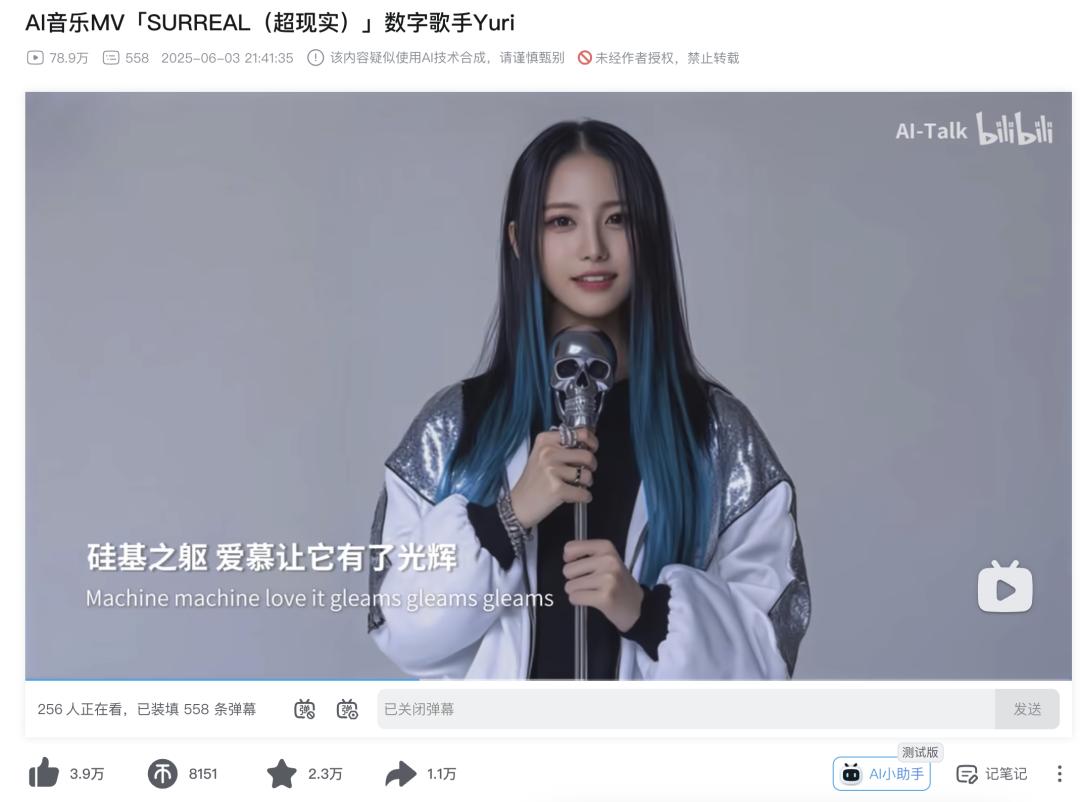
3 6 Ke· 2025-06-28 00:31
Core Viewpoint - The rise of AI singer Yuri, created by AI.TALK, marks a significant moment in the AI music industry, with her debut music video "SURREAL" achieving over 7 million views across platforms, indicating a growing acceptance and interest in AI-generated music [1][7]. Group 1: AI Singer Development - The success of Yuri is attributed to advancements in music and video generation models, allowing for high-quality production that blurs the line between AI and human-generated content [7][12]. - Unlike previous virtual idols, Yuri represents a new wave of AI singers that can create music autonomously, leveraging AI models for both music composition and video production [6][8]. Group 2: Market Dynamics - The AI digital human market in China is projected to reach approximately 4.12 billion yuan in 2024, with a year-on-year growth of 85.3%, highlighting the rapid expansion of this sector [12]. - The commercial potential of AI singers is compared to traditional virtual idols, suggesting that AI singers can replicate successful monetization strategies such as merchandise, concerts, and collaborations [8][11]. Group 3: Challenges and Opportunities - Despite the potential, AI singers face challenges in achieving widespread recognition and maintaining audience engagement, as seen with other AI singers like Qiyue, which struggled to gain traction despite significant backing [10][11]. - The ability to create high-quality music and videos is essential for the commercial success of AI singers, as the market becomes increasingly competitive with more entrants expected [12][13].