TRELLIS

Search documents
无需训练的3D生成加速新思路:西湖大学提出Fast3Dcache
量子位· 2025-12-04 05:57
Core Insights - The article discusses the rapid evolution of 3D generative models, particularly highlighting the challenges of computational intensity and the slow generation of high-quality 3D assets due to complex denoising processes [1] - Fast3Dcache, developed by the AGI Lab at Westlake University, offers a training-free, plug-and-play geometric acceleration framework that significantly enhances speed while maintaining or even improving geometric quality [2] 3D Shape Evolution - The research team identified a "three-stage stability pattern" in the voxel changes during the 3D generation process, which includes: 1. A turbulent phase where the object's outline is forming and requires full computation [4] 2. A logarithmic linear decay phase where more voxels stabilize, following a logarithmic pattern [4] 3. A fine-tuning phase where most voxels are defined, allowing for aggressive acceleration methods [4] Fast3Dcache Mechanisms - Fast3Dcache incorporates two key mechanisms: 1. PCSC (Predictive Caching Scheduler Constraint) predicts the stability of voxels and allocates computational resources dynamically based on the stability curve [6] 2. SSC (Spatiotemporal Stability Criterion) selects which tokens to reuse based on their velocity and acceleration in latent space, effectively addressing structural integrity issues [7][8] Performance Metrics - Fast3Dcache demonstrates significant performance improvements, achieving a 27.12% speed increase and a 54.83% reduction in computational load (FLOPs) while maintaining geometric quality when parameters are set to τ=8 [10] - The framework shows orthogonality, allowing seamless integration with existing acceleration algorithms, resulting in up to 3.41 times faster inference when combined with TeaCache and 10.33 times faster with EasyCache [11][14] Implications for 3D Content Creation - Fast3Dcache challenges the traditional belief that accelerating 3D generation compromises quality, providing a solution that does not require retraining models or complex parameter tuning [19] - This innovation is particularly beneficial for 3D content creators and developers seeking to reduce computational costs and enhance generation efficiency, paving the way for future advancements in 3D geometry generation [19]


标准化3D生成质量榜单来了!首创层次化评价体系,告别“谁的demo更吸睛”主观评估
量子位· 2025-08-16 03:58
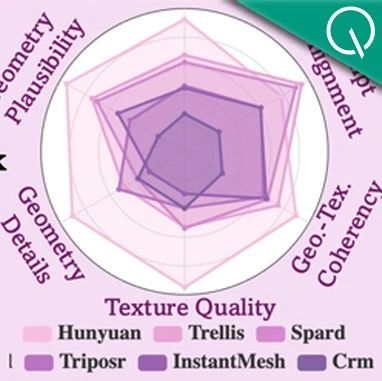
Core Viewpoint - The article discusses the advancements in AI 3D generation technology, highlighting the introduction of a new evaluation system called Hi3DEval, which aims to provide a comprehensive assessment of 3D content generation quality through a multi-layered approach [3][8][28]. Group 1: Hi3DEval Evaluation System - Hi3DEval is a new hierarchical automatic evaluation system for 3D content generation, developed in collaboration with several universities, addressing the limitations of traditional evaluation methods [3][8]. - The evaluation framework consists of three levels: object-level, part-level, and material-subject, allowing for a detailed analysis of 3D generation quality [5][8][9][15][17]. - The first 3D generation leaderboard has been published on HuggingFace, featuring 30 mainstream and cutting-edge models, covering both Text-to-3D and Image-to-3D tasks [6][21]. Group 2: Evaluation Dimensions - Object-level evaluation focuses on five dimensions: geometric plausibility, geometric detail, texture quality, geometric-texture coherence, and prompt-3D consistency [9][10][12][14]. - Part-level evaluation allows for a more granular assessment of specific components, such as chair legs or armrests, identifying defects in local structures [15][16]. - Material-subject evaluation assesses surface visual and physical properties across four dimensions: detail and complexity, color and saturation, consistency and artifacts, and material plausibility [17]. Group 3: Leaderboard and Industry Impact - The leaderboard provides a standardized assessment of models under uniform conditions, ensuring fairness and referenceability in the evaluation results [21][28]. - The introduction of Hi3DEval aims to establish a systematic and transparent quality evaluation standard for 3D content, facilitating better comparisons and advancements in the industry [28].