The Monsters 1 a.m.系列

Search documents
多数海外门店的客流量减少和排队现象消失!华尔街质疑:泡泡玛特选择“走量模式”,对吗?
Hua Er Jie Jian Wen· 2025-12-17 03:34
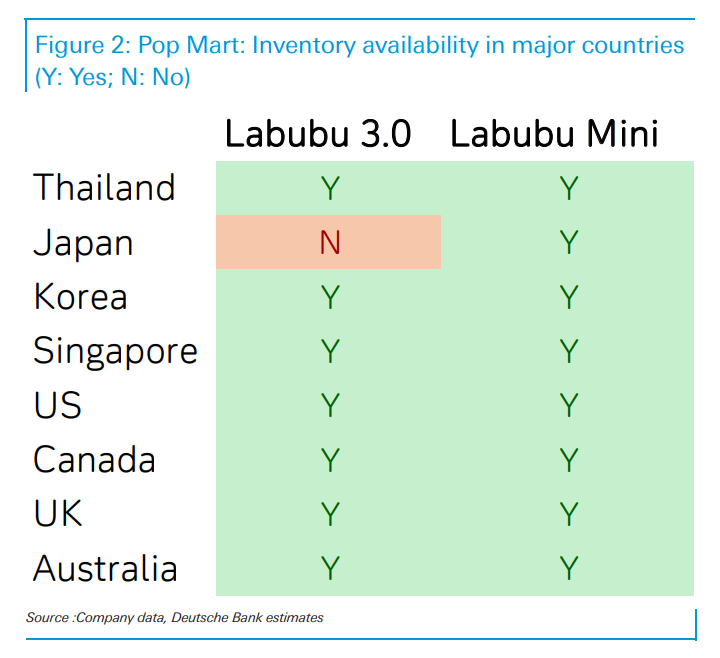
Core Viewpoint - The market sentiment is shifting dramatically, with Deutsche Bank downgrading Pop Mart's rating to "Hold" due to the loss of "scarcity" which is undermining the brand's premium pricing ability [1] Group 1: Business Model and Market Dynamics - Pop Mart's aggressive capacity expansion since mid-October 2025 has increased monthly production from 10 million to 50 million units, resolving supply shortages but significantly reducing product scarcity and collector enthusiasm [1][2] - The once high-demand Labubu series, with approximately 145 million units sold globally, is now widely available, leading to a decline in Google search interest and social media discussions [2] - The business model relies heavily on high transaction volumes with low average transaction values, necessitating frequent customer visits to maintain sales performance comparable to top fashion brands [4] Group 2: Customer Traffic and Profitability - Observations indicate that stores in major cities like Bangkok, Singapore, Seoul, and the U.S. no longer experience queueing, which could negatively impact the company's operating leverage [5] - Deutsche Bank projects an adjusted net profit margin (NPM) of 34.4% for 2025, up from 26.1% in 2024, but this is contingent on maintaining high customer traffic [5] Group 3: Historical Context and Future Risks - Historical analysis of Hello Kitty's IP cycles warns investors that the trajectory of IP popularity is not linear, with potential for significant downturns following periods of high demand [6][10] - Current market reactions to new products like "mini Labubu" and "The Monsters 1 a.m." series are lukewarm, raising concerns about the ability to sustain Labubu's popularity or quickly launch another hit IP [11] Group 4: Valuation and Catalysts - Pop Mart's forward P/E ratio is currently at 15 times, reflecting market concerns about the peak of its "fashion cycle" [12] - Future stock price movements will depend on short-term catalysts; if revenue growth is merely a result of increased production at the expense of IP popularity, long-term valuation logic may need to be reassessed [12]