Toyota Prius

Search documents
Nissan's new hybrid is a U.S.-first that mixes EV driving with a gas engine
CNBC· 2026-03-21 13:00
Core Viewpoint - Nissan Motor is set to introduce a new type of hybrid vehicle in the U.S. market, known as "e-Power," which operates like an all-electric vehicle but is powered by a traditional gas engine acting as a generator [1][2]. Group 1: Product Overview - The e-Power system is classified as a series hybrid, where the gas engine generates power for the electric motors that drive the vehicle, differing from traditional hybrids that use the gas engine for propulsion [2][3]. - The e-Power hybrid system is expected to debut in a new version of Nissan's popular Rogue compact SUV later this year [3]. Group 2: Market Context - The introduction of the e-Power hybrid comes at a time of rising gas prices and slower-than-expected adoption of electric vehicles (EVs), with a projected increase in hybrid vehicle sales [4]. - S&P Global Mobility forecasts that hybrids will account for 18.4% of new vehicle sales in the U.S. this year, a significant increase from 12.6% last year and 7.3% in 2023, while pure EV sales are expected to decrease to 7.1% [5]. Group 3: Unique Selling Proposition - The e-Power hybrid offers a unique powertrain for the U.S. market, functioning as an electrically driven vehicle without the need for a plug, allowing users to refuel it like a conventional car [6].



Toyota recalls 141,000 Prius vehicles over doors that have risk of opening while driving
New York Post· 2026-02-10 23:35
Core Viewpoint - Toyota is recalling approximately 141,000 Prius and Prius Prime vehicles due to a malfunctioning rear door lock system that can lead to unexpected door openings while the vehicle is in motion [1][3]. Group 1: Recall Details - The recall affects 2023–2026 Toyota Prius models, 2023–2024 Prius Prime vehicles, and 2025–2026 Prius Plug-In Hybrid models sold in the U.S. [1][4]. - The issue arises from an electric rear door lock system that may malfunction if water enters a door switch, potentially causing a short circuit [2][3]. Group 2: Safety Concerns - If the rear door unlatches while driving, it could open and increase the risk of injury to occupants, especially rear-seat passengers [3][5]. - A warning notification may appear on the dashboard, and a buzzer may sound to alert the driver if the switch activates while the vehicle is in motion [3]. Group 3: Remedial Actions - Toyota dealers will modify the left and right rear door switch circuits to prevent activation even if shorted, and the repair will be performed at no cost to the owners [4]. - Owners of affected vehicles will be notified in late March, and they can check their vehicle's status online using their VIN or license plate information [4].

Ugly Charts of US Auto Sales, 2025: Stellantis, Nissan Flirt with Catastrophe. GM, Ford, Honda Sales Rise but far below Peaks. Toyota & Hyundai-Kia Set Records
Wolfstreet· 2026-01-07 04:34
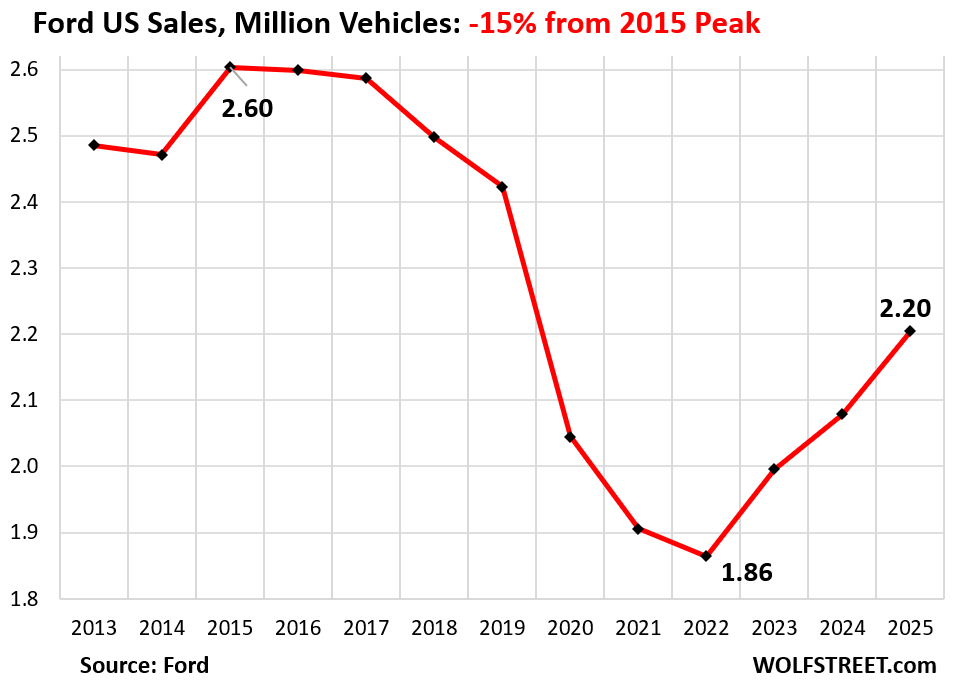
Core Insights - Total new-vehicle sales in 2025 rose by 2.4% to 16.2 million vehicles, marking the highest level since 2019 and just above 1986 levels, indicating four decades of stagnation and partial recoveries [1] - The automotive market has seen significant fluctuations, with some manufacturers experiencing steep declines while others have managed to increase sales [1][4] Sales Performance by Automakers - **General Motors (GM)**: Q4 sales fell by 6.9% year-over-year to 703,001 units, but full-year sales rose by 5.5% to 2.85 million vehicles, still down 7.5% from the 2015 peak [14] - **Toyota**: Combined sales for Toyota and Lexus jumped by 8.0% in 2025 to 2.52 million vehicles, slightly surpassing the 2015 peak [16] - **Ford**: Sales rose by 6.0% to 2.20 million vehicles for the year, but this was still down 15% from the 2015 peak [19] - **Hyundai-Kia**: Combined sales increased by 7.4% to a record 1.63 million vehicles, up 26% from the 2015 high [21] - **Honda**: Full-year sales inched up by 0.5% to 1.43 million vehicles, but still down 13% from the 2017 peak [25] - **Stellantis**: Sales dropped by 3% to 1.26 million vehicles, a 44% decline from the 2015 peak [28] - **Nissan**: Sales were roughly flat at 926,153 vehicles, down 42% from the 2017 peak [31] Pricing Trends - The average retail transaction price peaked at $47,329 at the end of 2022 and was $47,104 at the end of 2025, reflecting a 1.5% increase year-over-year but a 0.5% decrease from three years ago [8] - Automakers have raised prices across the board, with a 36% increase in average retail transaction prices from 2020 to 2022, leading to consumer pushback [6][7] Market Dynamics - The automotive industry has been characterized by a shift towards upscale models, with manufacturers focusing on larger and more expensive vehicles to boost revenues amid stagnating unit sales [7] - The market has seen a significant impact from federal incentives and tariffs, with Q3 sales surging due to frontrunning these changes, followed by a Q4 decline of 4.2% year-over-year [4]

Toyota Marketing Strategy
Business Strategy Hub· 2025-12-17 04:27
Core Insights - Toyota Motor Corporation is the world's largest automotive manufacturer, generating $305.26 billion in annual revenue in 2024 and achieving a trailing twelve months (TTM) revenue of $326.24 billion as of October 2025 [1] Group 1: Target Market Overview - Toyota targets a diverse market, including individuals, families, companies, and governments, with Japan being its largest market, accounting for nearly 50% of revenue in FY 2025 [2][3] - The company offers a wide range of car models, such as the Toyota Highlander for families and the GR Supra for performance enthusiasts, and plans to produce an electric vehicle in the Czech Republic targeting eco-conscious consumers [2] - Toyota's sales from April 2024 to March 2025 reached 48 trillion Japanese yen, with North America being the largest market in terms of unit sales [2][3] Group 2: Positioning - Toyota's brand value increased by 23% to $64.7 billion in 2024, and it was recognized as the world's leading car brand for 2025 [3] - The company's vision emphasizes leading future mobility with a focus on quality, innovation, and environmental responsibility [3][6] Group 3: Value Proposition - Toyota's value proposition includes performance, technology, stylish design, and reliability, with the RAV4 being the best-selling model in the US in 2024 [4][7] - The company offers high-quality vehicles at affordable prices, with the RAV4 priced at $29,250, and emphasizes low maintenance costs and fuel efficiency [4][8] Group 4: Marketing Mix (4Ps) - **Product**: Toyota focuses on high-quality, reliable vehicles and invests in R&D, introducing innovative models like the new Land Cruiser series and plans for six new BEVs in Europe by 2026 [6][11] - **Pricing**: The company employs cost-based, market-oriented, and value-based pricing strategies, adjusting prices based on market conditions and customer segments [7][12] - **Place**: Toyota operates in over 170 countries with strategic manufacturing plants and a strong dealer network to enhance distribution and customer satisfaction [8][15] - **Promotion**: The company utilizes various promotional strategies, including cash-back offers and financing deals, to attract customers and enhance brand awareness [9][10] Group 5: Customer Acquisition & Retention - Toyota relies on its dealerships for customer acquisition and retention, with a strong focus on delivering exceptional customer experiences [11][20] - The company has a high customer loyalty rate of 62.0%, leading among mass-market car brands, and employs sponsorships to promote its vehicles [11][22] Group 6: Marketing Goals (KPIs) - Toyota's marketing goals include increasing revenue and market share, with a reported revenue of $298.3 billion between April 2023 and March 2024 [12][23] - The company sold 10.8 million vehicles in 2024, making it the world's best-selling automaker, and reported a 7.4% increase in sales in the first half of 2025 [12][24] - Toyota raised its full-year operating profit forecast by 9% to 4.7 trillion yen ($30.7 billion), reflecting confidence in its marketing efforts [12][25]