
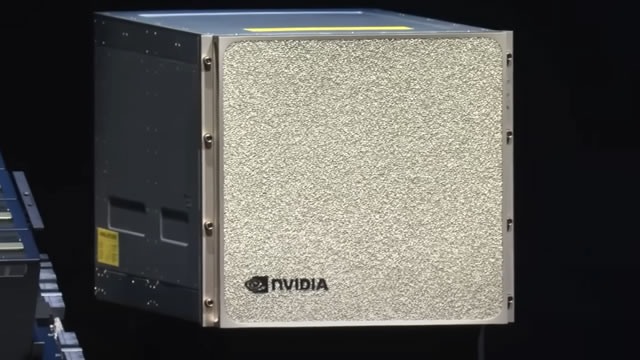
Vera Rubin superchip

Search documents
The Best Trillion-Dollar Stock to Buy in January 2026, According to Wall Street (Hint: Not Tesla)
The Motley Fool· 2026-01-16 08:06
Core Viewpoint - Nvidia is expected to maintain its position as the leading provider of AI infrastructure for the foreseeable future, driven by its dominant market share and robust product offerings [3][8]. Group 1: Market Position and Performance - Nvidia holds nearly 90% market share in the data center accelerator market, which is crucial for AI workloads [3]. - The company reported a 62% increase in revenue to $57 billion, with non-GAAP net income rising 60% to $1.30 per diluted share [10]. - Nvidia's stock has surged 1,150% since January 2023, yet analysts suggest the current valuation remains attractive at 45 times earnings [10][13]. Group 2: Product Offerings and Innovations - Nvidia's GPUs are complemented by CPUs and networking gear, along with a comprehensive ecosystem of software development tools, enhancing its competitive edge [4]. - The upcoming Vera Rubin superchip, set to launch in the second half of 2026, will significantly enhance performance, with Vera CPUs offering double the performance of previous models and Rubin GPUs running AI workloads much faster [11]. Group 3: Growth Opportunities - The demand for generative AI is a key growth driver, with Nvidia providing essential hardware and software for AI model development [5]. - Data center GPU sales are projected to grow at 36% annually through 2033, while robotaxi chip sales are expected to increase at 74% annually through 2030 [8][9]. - Nvidia is also positioned to benefit from the easing of export restrictions to China, potentially unlocking a significant market for its products [12].


Nvidia CEO Jensen Huang Says Rubin Architecture Is Now in Full Production. Here's Why That Matters.
Yahoo Finance· 2026-01-10 08:22
Core Insights - The demand for artificial intelligence (AI) is significantly outpacing supply, particularly in cloud infrastructure, leading to capacity constraints among major cloud operators [1][7] - A critical bottleneck in AI development is the shortage of AI-capable chips, especially graphics processing units (GPUs) [2] - Nvidia has announced that its new Rubin Architecture is in full production, six months ahead of schedule, which is expected to alleviate some of the chip shortages [5][7] Company Developments - Nvidia's Rubin Architecture includes six chips designed to enhance AI training and inference, promising a 10x reduction in inference token costs and a 4x reduction in the number of GPUs needed for training mixture of experts models compared to the previous Blackwell platform [4] - The Vera Rubin superchip, which combines a Vera CPU and Rubin GPU, is specifically designed to meet the increasing computational demands of AI [5] - Nvidia's early rollout of these next-generation AI chips is anticipated to benefit cloud and data center operators, potentially leading to significant revenue growth for the company [5] Industry Trends - Major cloud operators, such as Microsoft, are experiencing rapid data center buildouts, with Azure cloud growth accelerating to 40% year over year, yet still unable to meet demand [6] - Microsoft has indicated that it expects to remain capacity constrained through at least the end of its fiscal year, resulting in lost revenue opportunities for Azure due to the mismatch between demand and infrastructure buildout [6][7]
5 ETFs to Buy for January
ZACKS· 2026-01-08 18:00
Core Insights - The S&P 500 has experienced three consecutive years of returns significantly exceeding its long-term average of approximately 10% as it enters 2026, despite investor concerns regarding a "K-shaped" recovery in the U.S. economy and geopolitical tensions following U.S. actions against Venezuela [1][2]. Market Performance - The SPDR S&P 500 ETF Trust (SPY) has gained 1.2% from the start of 2026 until January 6, while the SPDR Dow Jones Industrial Average ETF Trust (DIA) and Invesco QQQ Trust, Series 1 (QQQ) have increased by 2.5% and 1.2%, respectively [3]. - Value stocks have outperformed growth stocks, with the State Street SPDR Portfolio S&P 500 Value ETF (SPYV) rising by 1.5% compared to the State Street SPDR Portfolio S&P 500 Growth ETF (SPYG), which increased by 1% [4]. ETFs in Focus - The iShares Russell 2000 ETF (IWM) is expected to benefit from the "January Effect," a seasonal increase in stock prices due to year-end tax strategies, with small-cap stocks typically performing well in January [5]. - The iShares MSCI USA Momentum Factor ETF (MTUM) is likely to see inflows from retirement contributions and fund rebalancing, which often favor high-momentum stocks at the beginning of the year [6]. - The VanEck Semiconductor ETF (SMH) has seen strong performance due to sustained demand for AI, cloud computing, and advanced data centers, with chipmakers benefiting from high-performance processor orders [7][8]. Sector Highlights - Defense stocks have rallied due to increased military spending expectations following U.S. actions against Venezuela, with global defense spending projected to exceed $3.6 trillion by 2030, marking a 33% increase from 2024 levels [11][12]. - The healthcare sector is gaining traction as a defensive investment, with biotech stocks strengthening due to innovations and mergers, and major drugmakers expected to invest approximately $370 billion in U.S. projects over the next five years [14].

How long will Jensen Huang be Nvidia's CEO?
Yahoo Finance· 2026-01-07 13:29
Core Insights - Jensen Huang has been the CEO of Nvidia since 1993, significantly increasing the company's stock price from mere pennies to over $187, making it the most valuable company globally [1] - Huang's tenure as CEO exceeds that of other prominent tech leaders, raising concerns among shareholders regarding succession planning as he approaches 63 years of age [2] Group 1 - Huang has no immediate plans to step down, emphasizing his commitment to the company and addressing shareholder concerns during a Q&A session at CES [2] - He attributes his long tenure to not getting fired and maintaining interest in his role, highlighting the responsibility that comes with leading Nvidia [3] - Nvidia's influence extends beyond the tech sector, affecting the broader market, as Huang acknowledges the company's role as a leader in the industry [3][4] Group 2 - Nvidia announced the launch of its next-generation Vera Rubin superchip, set to begin shipping later this year, indicating ongoing innovation [4] - The company has also formed a partnership with Mercedes-Benz to develop self-driving technology, positioning itself to compete with Tesla's autopilot [4]
光物质通道:AI 用 3D 光子互连板 --- Lightmatter Passage _ A 3D Photonic Interposer for AI
2025-09-22 00:59
Summary of Lightmatter Passage Conference Call Industry and Company Overview - **Industry**: AI and Photonic Computing - **Company**: Lightmatter, known for its Passage M1000 "superchip" platform utilizing photonic technology to enhance AI training capabilities [1][3][13] Core Points and Arguments 1. **Exponential Growth of AI Models**: The scale of AI models has increased dramatically, with models now reaching hundreds of billions or even trillions of parameters, necessitating thousands of GPUs for training [3][4] 2. **Challenges in AI Training**: The industry faces significant challenges in scaling AI training, particularly due to the slowdown of Moore's Law and the limitations of traditional electrical interconnects, which create bottlenecks in data communication and synchronization [7][10][11] 3. **Lightmatter's Solution**: The Passage M1000 platform addresses the interconnect bottleneck by employing a 3D photonic stacking architecture, integrating up to 34 chiplets on a single photonic interposer, achieving a total die area of 4,000 mm² [13][14] 4. **Unprecedented Bandwidth**: The Passage platform delivers a total bidirectional bandwidth of 114 Tbps and 1,024 high-speed SerDes lanes, allowing each chiplet to access multi-terabit-per-second I/O bandwidth, effectively overcoming traditional I/O limitations [17][21] 5. **Comparison with Competitors**: Lightmatter's approach contrasts with other industry players like NVIDIA and Cerebras, who focus on maximizing single-chip performance or building ultra-large chips. Lightmatter emphasizes optical interconnects to achieve high bandwidth communication across chiplets [30][42][44][52] Additional Important Insights 1. **Nature Paper Validation**: A study published in *Nature* demonstrated the feasibility of photonic processors for executing advanced AI models, achieving near-electronic precision, which complements Lightmatter's focus on interconnect solutions [22][23][82] 2. **Future of AI Acceleration**: The combination of Lightmatter's optical interconnects and the advancements in photonic computing suggests a paradigm shift towards hybrid electronic-photonic architectures, breaking through performance ceilings in AI acceleration [82][83] 3. **Scalability and Efficiency**: Lightmatter's Passage aims to simplify AI deployments and improve efficiency by collapsing datacenter-level communication into a single "superchip," potentially offering better cost efficiency and flexibility compared to traditional methods [42][52][78] Conclusion - The emergence of Lightmatter's Passage platform represents a significant advancement in addressing the challenges of modern AI training, providing a breakthrough pathway through innovative photonic interconnect technology [84]