Vibe coding

Search documents
“手写代码已不再必要!”Redis之父罕见表态:AI将永远改变编程,网友质疑:我怎么没遇到这么好用的AI!
猿大侠· 2026-01-19 04:11
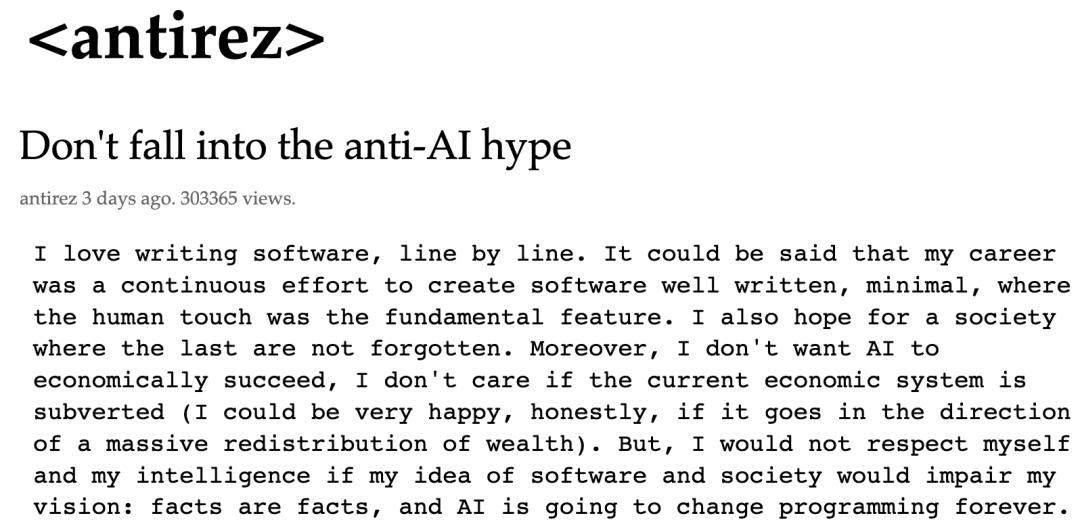
Core Viewpoint - The article discusses the transformative impact of AI on programming, highlighting differing opinions among industry leaders regarding the necessity of traditional coding practices and the potential for AI to enhance creativity and efficiency in software development [1][2][4][5]. Group 1: Perspectives on AI in Coding - Google engineer Jaana Dogan emphasizes the efficiency of AI, noting that a task taking a year for a team was completed by AI in just one hour [1]. - Linus Torvalds expresses skepticism about AI writing code, preferring AI to assist in code maintenance rather than creation [1]. - Salvatore Sanfilippo (antirez) provocatively claims that writing code is often no longer a necessary task, urging developers to embrace the ongoing industry transformation [2][4]. Group 2: Embracing Change - Antirez questions the resistance to AI, suggesting that developers risk missing out on significant industry changes if they do not adapt [4]. - He argues that the true passion in programming lies in creation, and AI can expedite reaching creative goals [5]. - Antirez's article has gained significant traction, with over 300,000 views, indicating a strong interest in the topic [5]. Group 3: AI's Practical Applications - Antirez shares personal experiences where AI significantly reduced the time required for coding tasks, such as improving the linenoise library and fixing Redis test failures [12][13]. - He notes that AI can effectively handle independent tasks with clear descriptions, making it a valuable tool for developers [10][15]. - The ability of AI to replicate complex coding tasks in a fraction of the time previously required marks a significant shift in programming practices [16]. Group 4: Concerns and Critiques - Some developers express skepticism about AI's capabilities, particularly in complex system design and long-term maintenance, highlighting ongoing challenges in AI-generated code quality [20][22][27]. - Concerns arise regarding the potential for over-reliance on AI to diminish engineers' understanding of systems, suggesting that AI may be more suited for prototyping than production environments [27][28]. - The debate continues on the balance between AI's benefits and its limitations, indicating that the role of AI in engineering is still evolving [28]. Group 5: Future Outlook - Antirez acknowledges the inevitability of AI's impact on programming, urging developers to adapt rather than resist [29]. - He emphasizes the importance of understanding how to effectively use AI tools to enhance creativity and productivity in software development [30]. - The article concludes with a call for developers to engage with AI technologies thoughtfully, suggesting that the future of programming will increasingly involve collaboration with AI [31].


“手写代码已不再必要,”Redis之父罕见表态:AI将永远改变编程,网友质疑:我怎么没遇到这么好用的AI
3 6 Ke· 2026-01-15 13:21
Core Viewpoint - The emergence of AI in coding raises questions about the future role of programmers, with contrasting opinions from industry leaders on whether AI will enhance or replace traditional coding practices [1][2]. Group 1: Perspectives on AI in Coding - Google engineer Jaana Dogan highlights the efficiency of AI, noting that a task taking a year for a team was completed by AI in just one hour [1]. - Linus Torvalds expresses skepticism about AI writing code, emphasizing the importance of code maintenance over code generation [1]. - Salvatore Sanfilippo (antirez) argues that writing code is no longer a necessary task in most cases, suggesting that developers who resist AI may miss out on significant industry changes [2][4]. Group 2: Antirez's Insights and Experiences - Antirez shares his journey from writing code to collaborating with AI, stating that his career has focused on creating well-structured and readable software [4][5]. - He acknowledges the potential for AI to disrupt economic structures and wealth distribution, expressing indifference to the consequences as long as it promotes fairness [4]. - Antirez emphasizes that AI will permanently change programming, making it irrational to write all code manually unless for personal enjoyment [8][10]. Group 3: Practical Applications of AI - Antirez describes his recent experiences where he completed tasks in hours that would have taken weeks, such as improving the linenoise library and fixing Redis test failures [10][11]. - He successfully built a pure C implementation of a BERT inference library in just five minutes using AI, demonstrating the efficiency of AI in coding tasks [12]. - Antirez notes that AI can replicate complex implementations quickly, allowing developers to focus on understanding project requirements rather than writing code [13]. Group 4: Concerns and Critiques from the Developer Community - Some developers express skepticism about AI's ability to handle complex system designs and long-term maintenance, citing issues with code quality and architectural problems [17][18]. - Concerns are raised about over-reliance on AI potentially diminishing engineers' understanding of systems, with some suggesting AI is better suited for prototyping rather than production environments [21][22]. - The debate continues on whether AI will replace programmers or simply change their roles, with some predicting a shift towards AI as a team replacement solution [24].
工作场景AI化,一个月花100美元订阅AI工具值吗?
AI前线· 2025-11-25 05:03
Core Insights - The rise of large models and intelligent agents is reshaping the underlying logic of productivity, enhancing individual work efficiency and reconstructing organizational collaboration and operational models, leading to the emergence of "10x teams" and "10x individuals" [2][3] Group 1: Characteristics of "10x Individuals" - "10x individuals" are not defined by coding speed but by their proactive thinking and ability to utilize various methods to solve problems, transcending traditional role boundaries [4][6] - They are adept at using a variety of tools without being limited to a specific technology stack, maintaining a clear understanding from product conception to implementation and validation [5][6] - The most prominent ability of "10x individuals" is their capacity to quickly grasp the core issues that need to be addressed [4][5] Group 2: Organizational Transformation - Organizations need to transition from a "solid" to a "liquid" structure, becoming more fluid, inclusive, and adaptable, with constantly expanding capability boundaries [6][9] - The introduction of AI tools has reduced execution barriers, allowing team members to engage in tasks outside their traditional roles, thus enhancing collaboration and efficiency [7][8] - The concept of "AI rate" is introduced as a metric to evaluate teams based on their engagement with AI-related activities, promoting a culture of AI integration across various roles [11][12] Group 3: Efficiency Gains from AI - AI has led to significant efficiency improvements, with examples showing that tasks that previously took a month can now be completed in just three days, demonstrating a 10x increase in productivity [9][10] - In risk control scenarios, AI has enabled the processing of millions of short videos daily, showcasing productivity enhancements that far exceed the 10x benchmark [10] - The use of AI tools has allowed for a reallocation of human resources, enabling teams to handle more complex tasks while maintaining operational capacity [37] Group 4: AI Tools and Applications - Various AI tools are being utilized, including coding assistants like Cursor and NoCode products, which are tailored for specific applications and enhance productivity [24][27] - The integration of AI into everyday work processes is becoming ubiquitous, with tools being adapted for various business needs, from document generation to operational efficiency [28][29] - The importance of selecting the right tools that fit the internal infrastructure and workflows is emphasized, as not all external tools are suitable for every organization [26][27] Group 5: Cultural and Management Shifts - Organizations are encouraged to foster a culture that promotes the active use of AI, recognizing that immediate benefits may not be apparent but are crucial for long-term growth [38] - Management practices need to evolve to ensure smooth information flow and clarity in business objectives, enabling teams to leverage AI effectively [39] - The need for continuous learning and adaptation to new AI tools is highlighted, with management encouraged to engage directly with emerging technologies to drive organizational change [38][39]

Wix.com Ltd. (WIX) Presents At Citi's 2025 Global Technology, Media And Telecommunications Conference Transcript
Seeking Alpha· 2025-09-03 22:49
Group 1 - The discussion focuses on the evolution of GenAI and Vibe coding in the web building space, particularly for small and medium-sized businesses (SMBs) [2][3] - There is a significant interest from investors regarding the impact of these technologies on the industry and how companies are adapting to these changes [3] - The conversation aims to explore the high-level trends and future directions in the web building sector influenced by GenAI and Vibe coding [3]