Video game consoles

Search documents
GameStop CEO Ryan Cohen Has $35 Billion Reasons to 10x the Stock. Should Investors Buy In?
Yahoo Finance· 2026-01-27 11:40
Core Viewpoint - Tesla shareholders have approved a substantial pay package for CEO Elon Musk, contingent on achieving specific financial goals, which GameStop is now emulating with a similar performance award for CEO Ryan Cohen [1] Group 1: Compensation Structure - Ryan Cohen's compensation plan does not guarantee salary, cash bonuses, or stock vesting, but he could earn tens of billions if he meets growth targets [2] - GameStop plans to grant Cohen stock options to purchase over 171.5 million shares at $20.66, potentially worth over $3.5 billion [3] - To receive the full award, GameStop must achieve $10 billion in EBITDA and a market cap of $100 billion, making Cohen's award worth over $35 billion at that level [3] Group 2: Financial Performance - GameStop generated approximately $136 million in EBITDA through the first ten months of 2025, with a current market cap of about $10.3 billion [4] - Portions of Cohen's incentive will vest upon reaching specific thresholds, such as a $20 billion market cap and $2 billion in EBITDA for the first tranche [4] - GameStop has improved its financial profile by reducing its physical store presence and expanding its collectibles business, which now accounts for nearly 28% of total revenue [5] Group 3: Business Challenges - The software business, which sells new and pre-owned video games, has experienced a significant decline, while hardware sales are also decreasing but at a slower rate [6] - Despite these challenges, GameStop has seen improvements in operating cash flow, EBITDA, and earnings this year [6] Group 4: Leadership Background - Ryan Cohen became involved with GameStop prior to its 2021 surge and was appointed CEO in 2023, implementing various operational improvements [7] - GameStop's board aims to incentivize Cohen to significantly increase the stock value [7]

CEO Ryan Cohen Just Bought $10 Million of GameStop Stock. Is it Time to Give This Meme Stock Another Look?
The Motley Fool· 2026-01-25 01:00
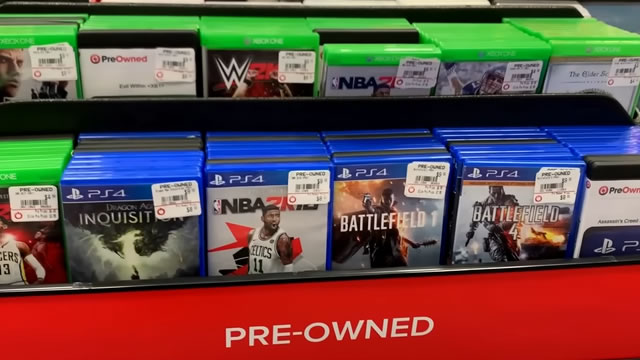
Core Insights - GameStop has seen significant insider buying from CEO Ryan Cohen, who purchased 500,000 shares at an average cost of approximately $21.12, totaling over $10.5 million, indicating bullish sentiment towards the company [3] - The company is attempting to pivot its strategy as its traditional brick-and-mortar video game business declines, while also exploring new avenues such as collectibles and cryptocurrency [2][4] Financial Performance - GameStop's hardware business has experienced a 5% decline, while its software revenue has plummeted by 27% year-over-year; however, the collectibles segment has seen a remarkable 55% revenue growth [4] - The company has improved its operating cash flow and reported diluted earnings per share of $0.67, a significant improvement from the previous year [5] - GameStop's current market capitalization stands at $10 billion, with a trading multiple of approximately 2.3 times revenue and close to 22 times forward earnings [7][8] Market Position and Analyst Outlook - Only one Wall Street analyst covers GameStop, projecting nearly $1 of EPS in 2026 and total revenue of $4.16 billion, indicating potential year-over-year growth [8] - Despite improvements, the earnings multiple appears high for a company still stabilizing its revenue, particularly in its largest business segment [9]

Sony Financial Soars in Spinoff Listing in Tokyo Trade Debut
Insurance Journal· 2025-09-29 09:08
Core Viewpoint - Sony Financial Group Inc. experienced a strong debut in Tokyo following its spinoff from Sony Group Corp, which is refocusing on its entertainment and image sensor sectors. The financial unit's market valuation reached ¥1.2 trillion ($8.1 billion) based on its closing price on the first trading day [1]. Group 1: Spinoff Listing and Market Impact - The listing marks the first direct listing in Japan in over two decades, serving as a test for how spinoffs can enhance company valuations. This aligns with government reforms and initiatives from the Tokyo stock exchange, including tax incentives for spinoffs [2]. - The spinoff allows for better management resource allocation and is seen as a legitimate move by a blue-chip company like Sony, addressing demands for improved capital efficiency in the Tokyo market [4]. Group 2: Business Structure and Future Prospects - The separation into two distinct businesses will facilitate clearer evaluations and potentially better pricing multiples for each unit. Major financial institutions, including Nomura Securities, Goldman Sachs, and JPMorgan, are advising on the transaction [5]. - Analysts suggest that the spinoff could be a step towards Sony transitioning from a conglomerate to multiple focused publicly listed companies, although there may be technical selling pressure due to index recalibrations [6]. Group 3: Financial Performance and Growth Potential - The financial group is projected to achieve ¥82 billion in net income for the fiscal year ending March 31, reflecting a 4.1% year-over-year increase [8]. - Analysts highlight strong growth potential in the insurance and banking sectors, which could lead to a premium on the shares. The market value of Sony Financial Group could rise to ¥1.9 trillion according to estimates [9].