West Texas Intermediate (WTI)

Search documents
Revisiting Energy Market Impacts From the Iran War
Etftrends· 2026-03-31 14:03
Core Insights - The ongoing war in Iran has led to significant increases in oil prices, with energy stocks outperforming other sectors, showing a year-to-date total return increase of over 40% compared to a 6.7% decline in the S&P 500 [3][4] Liquefied Natural Gas (LNG) Market - The closure of the Strait of Hormuz and Iranian attacks on Qatari export facilities are expected to hinder LNG exports for 3 to 5 years, affecting 12.8 million tons per annum or approximately 1.7 billion cubic feet per day [5] - North American LNG is becoming more attractive to global buyers due to these disruptions, benefiting companies like Cheniere and Venture Global, which have significant expansion potential [6] - Venture Global has secured five-year LNG purchase agreements totaling 2 MTPA and has initiated financing for a 9-MTPA expansion [7] - Cheniere's operational capacity is largely secured under long-term contracts, but it is exploring ways to increase cargo shipments [8] Oil Market Dynamics - Global oil supplies have decreased by over 10 million barrels per day since the war began, with Brent crude experiencing the most significant price impacts [11] - The U.S. has released 400 million barrels from emergency reserves to stabilize prices, with contributions from both Iranian and Russian oil expected to add significant volumes to the market [12] - Saudi Aramco has increased oil volumes through its East-West pipeline, providing some relief to supply constraints [13] - The Brent-WTI spread has widened significantly, benefiting U.S. refiners [14] Liquefied Petroleum Gas (LPG) Market - Qatar's LPG exports are expected to decline by 13% due to infrastructure damage, which may lead to increased interest in long-term contracts with U.S. suppliers [15] - U.S. companies like Energy Transfer, Enterprise Products Partners, and Targa Resources are positioned to benefit from these market shifts [15] Broader Energy Implications - The U.S. Energy Information Administration has raised its production forecasts for oil, natural gas, and NGLs for 2027, indicating a more favorable outlook for U.S. energy production [16] - The attractiveness of the U.S. and Canada as energy partners is expected to increase, particularly for LNG and LPG, due to their proximity to key markets [17] - Energy security and reliability remain critical topics, with countries that have diversified energy sources better positioned to handle market disruptions [18]



Crude Oil Drives Higher as Traders Brace for Longer Mideast War
Yahoo Finance· 2026-03-27 17:11
Core Insights - Oil prices are rising due to ongoing conflicts in the Middle East, particularly the Iran war, with Brent crude surpassing $111 per barrel and West Texas Intermediate near $99 [1] - The liquidity in the oil market has decreased as traders become fatigued by the rapid news cycle, leading to increased price volatility [2] - The extension of the deadline for US actions against Iran allows for more diplomatic discussions but also enables the US to increase military presence in the region [3] Oil Market Dynamics - Analysts suggest that oil prices may stabilize in the $85 to $90 per barrel range due to a lack of significant peace progress in the Middle East [4] - The price spread between Brent and WTI has widened to approximately $13 per barrel, compared to $5 a month ago, influenced by regional inventory levels and strategic reserve releases [5] - Brent crude is on track for a record monthly gain in March, driven by the near-complete closure of the Strait of Hormuz, which is critical for global energy flows [6] Geopolitical Developments - Ongoing military actions include Israel targeting Iranian missile production facilities and drone attacks on Kuwaiti ports, indicating escalating tensions in the region [7] - Analysts from Macquarie Group Ltd. estimate a 60% chance of the conflict concluding by the end of March, but a 40% chance of it extending into June, which could push oil prices to $200 per barrel [8]
Oil Prices Rise +80% Since December - When Will It End?
ZACKS· 2026-03-26 15:40
Group 1: Oil Prices and Geopolitical Tensions - The Iran War is developing on two fronts: a peace plan is being discussed by President Trump and Iranian officials, while Israel continues military actions against Iran's nuclear program [2][3] - The Strait of Hormuz, a critical passage for 20% of global oil supply, has been choked off by Iran, leading to a significant increase in gasoline prices in the U.S., which have risen approximately $1 per gallon [4] - Spot oil prices have surged, with West Texas Intermediate (WTI) up 76% from December lows to $94.30 per barrel, and Brent crude up 88% to $107.80 [5] Group 2: Employment Market Insights - Initial Jobless Claims for last week were reported at 210K, matching expectations and indicating a stable employment market [6] - Continuing Claims fell to 1.819 million, the lowest since May 2024, following a downward revision from the previous week [7]

Current price of oil as of March 25, 2026
Yahoo Finance· 2026-03-25 12:32
Core Insights - The current price of oil is $99.75 per barrel, reflecting a decrease of $2.72 from the previous day but an increase of $26.64 compared to the same time last year [1] - Oil prices have shown significant volatility, with a 2.65% decrease from yesterday and a 39.53% increase over the past month [2] Oil Price Trends - The price of oil yesterday was $102.47, and one month ago it was $71.49, indicating a substantial rise in prices over the past month [2] - Year-over-year, the price has increased from $73.11 to $99.75, marking a 36.43% rise [2] Factors Influencing Oil Prices - Oil prices are primarily driven by supply and demand, with external factors such as economic slowdowns and geopolitical conflicts also playing a significant role [3] - The relationship between oil and natural gas prices is notable, as fluctuations in oil prices can lead to changes in natural gas demand [7] Impact on Gas Prices - Crude oil constitutes over half of the cost at the gas pump, and spikes in oil prices typically lead to immediate increases in gas prices, while declines in oil prices result in a more gradual decrease in gas prices, a phenomenon referred to as "rockets and feathers" [5] Strategic Petroleum Reserve - The U.S. maintains a Strategic Petroleum Reserve to ensure energy security during emergencies, which can help mitigate sudden price increases due to supply disruptions [5][6]
Stagflation Scare? ETFs May Help Protect Your Portfolio
ZACKS· 2026-03-24 15:51
Core Insights - Oil prices are expected to remain high due to the ongoing Middle East conflict, increasing the risk of stagflation in the U.S. economy [1][3][7] - The U.S. economy is already facing stagflation risks characterized by high inflation and slow growth, exacerbated by President Trump's tariff policies [2][7] - The conflict has led to significant supply disruptions, with over 40 energy assets in the Middle East suffering severe damage, which may prolong supply chain issues [5][6] Oil Price Dynamics - Since the onset of the Middle East conflict, oil prices have surged approximately 26.6% in the past month, with a year-to-date increase of about 37.1% for U.S. crude benchmark West Texas Intermediate (WTI) [3] - The conflict has caused ongoing supply disruptions, including the closure of the Strait of Hormuz, which is expected to keep oil prices elevated even after the conflict subsides [4] Economic Implications - Current disruptions in oil supply are comparable to the combined effects of the 1970s oil crisis and the 2022 natural gas shock, raising concerns about a return to 1970s-style stagflation [6] - Historical data shows that during stagflation periods, such as from 1968 to 1983, inflation surged significantly, with the Consumer Price Index increasing by 186.4% [8] Investment Strategies - Investors are advised to increase exposure to defensive funds while maintaining a long-term investment perspective to navigate the current economic uncertainty [9][10] - Specific ETF strategies include focusing on dividend ETFs, consumer staple ETFs, utility ETFs, and healthcare ETFs to provide stability and income during volatile market conditions [13][15][16][17]

109-year-old energy giant paying $4 billion in dividends as oil spikes
Yahoo Finance· 2026-03-24 13:33
Core Viewpoint - Oil prices have risen above $100 a barrel, creating a favorable environment for ConocoPhillips, which has demonstrated strong performance and strategic growth potential [1] Group 1: Company Performance - ConocoPhillips reported a strong performance in 2025, increasing production, cutting costs, and returning $9 billion to investors [1] - The company has a low-cost drilling inventory across key regions such as the Permian Basin, Eagle Ford, and Bakken, positioning it well for future growth [4] - For 2026, ConocoPhillips plans to return approximately 45% of its cash from operations to shareholders, with expectations of around $4 billion in ordinary dividends and additional cash from buybacks [7] Group 2: Market Conditions - The Strait of Hormuz, a critical waterway for oil supply, has been largely closed to commercial shipping, contributing to rising oil prices [2] - Brent crude recently surpassed $113 per barrel, while West Texas Intermediate (WTI) crossed $101, with Goldman Sachs projecting Brent to average $110 in the near term, a 62% increase from the 2025 average [6] - The International Energy Agency has described the current oil supply situation as "very severe," worse than past oil shocks, leading to a record release of 400 million barrels from strategic reserves by member nations [6]

Will the S&P 500 Index and VOO stock rebound or crash further?
Invezz· 2026-03-23 13:43
Indices - The S&P 500 Index has dropped to $6,500, marking a ~7% decline from its year-to-date high due to the ongoing war in Iran [1][5] - JPMorgan has lowered its target for the S&P 500 Index from $7,500 to $7,200, citing geopolitical concerns and rising energy prices as factors that will negatively impact American equities [2] - The Fear and Greed Index has fallen to 14, indicating extreme fear in the stock market, which historically precedes market rebounds [6][7] Energy Prices - Brent crude oil prices have surged from $55 earlier this year to over $108, while West Texas Intermediate (WTI) has risen to $97, significantly impacting companies, particularly in the airline industry [3] - United Airlines announced a 5% reduction in its flight schedule due to soaring jet fuel prices, reflecting the broader impact of rising energy costs on operational decisions [3] Federal Reserve and Economic Concerns - The Federal Reserve is expected to maintain interest rates between 3.50% and 3.75%, with potential hikes later this year, influenced by rising public debt, which has reached a record high of $39 trillion [4] - The Pentagon's request for $200 billion to fund war efforts in Iran is further straining the economy, contributing to concerns about inflation and economic growth [4] Market Outlook - Analysts predict that the S&P 500 Index and key ETFs like SPY and VOO may remain under pressure in the near term but are likely to rebound later this year, especially if geopolitical tensions ease [5][9] - Corporate earnings are expected to grow by 12.5% in the first quarter, marking the sixth consecutive quarter of growth, which could serve as a catalyst for market recovery [9][8]
Morning Bid: Ticking time bomb
Yahoo Finance· 2026-03-23 10:41
Market Overview - President Trump's ultimatum to Iran has led to a global market selloff, with stocks and bonds declining as tensions in the Middle East escalate [1][2] - The conflict has now entered its fourth week, with no signs of de-escalation, further impacting investor sentiment [2] Oil and Gas Prices - Brent crude oil prices surpassed $113 per barrel, while West Texas Intermediate (WTI) reached $100 before a slight decrease [4] - Average U.S. gas prices are approaching $4 per gallon, indicating rising energy costs for consumers [4] Stock Market Performance - Major Asian stock indexes experienced significant declines, with Japan's Nikkei down 3.5% and South Korea's KOSPI dropping nearly 6% [4] - The MSCI global equities gauge has fallen to its lowest level since November 2025, and European shares also opened lower, with the STOXX 600 down more than 2% [5] Bond Market Dynamics - Government bonds have faced a selloff, with ten-year U.S. Treasury yields reaching their highest levels in nine months [6] - Market expectations indicate a 75% chance of a Federal Reserve rate increase by the end of the year, reflecting concerns over inflation [6] Currency and Gold Market - The dollar has strengthened against a basket of major currencies, while gold prices continue to decline, leading investors to favor cash as a safer option [7] - The Japanese government is prepared to intervene in foreign exchange markets as the yen approaches the $160 threshold, amidst ongoing volatility [8]
Goldman Boosts Oil Price Forecast by $8 for Brent and $7 for WTI
Yahoo Finance· 2026-03-23 09:10
Price Outlook - Brent crude is projected to average $85 per barrel and West Texas Intermediate (WTI) at $79 per barrel this year, an increase from previous estimates of $77 and $72 respectively [1] - Current trading prices are $112.69 per barrel for Brent and $99.60 per barrel for WTI, reflecting a rise as geopolitical tensions escalate [2] Geopolitical Tensions - President Trump issued an ultimatum to Iran, demanding the reopening of the Strait of Hormuz within 48 hours or face severe military consequences [3] - Iran has threatened to target the energy and water infrastructure of U.S. allies in the region in response to the ultimatum [3] Supply Disruption - Goldman Sachs anticipates that the disruption in tanker traffic through the Strait of Hormuz will last for six weeks, followed by a gradual recovery of crude shipments [4] - The closure of the Strait has resulted in a significant impact, cutting off 20% of global oil flows [4] Market Implications - The current oil supply shock is expected to highlight structural risks associated with the concentration of oil production and spare capacity in the Middle East [5] - Analysts express concerns that the disruption could extend for months, even if military actions cease [4]

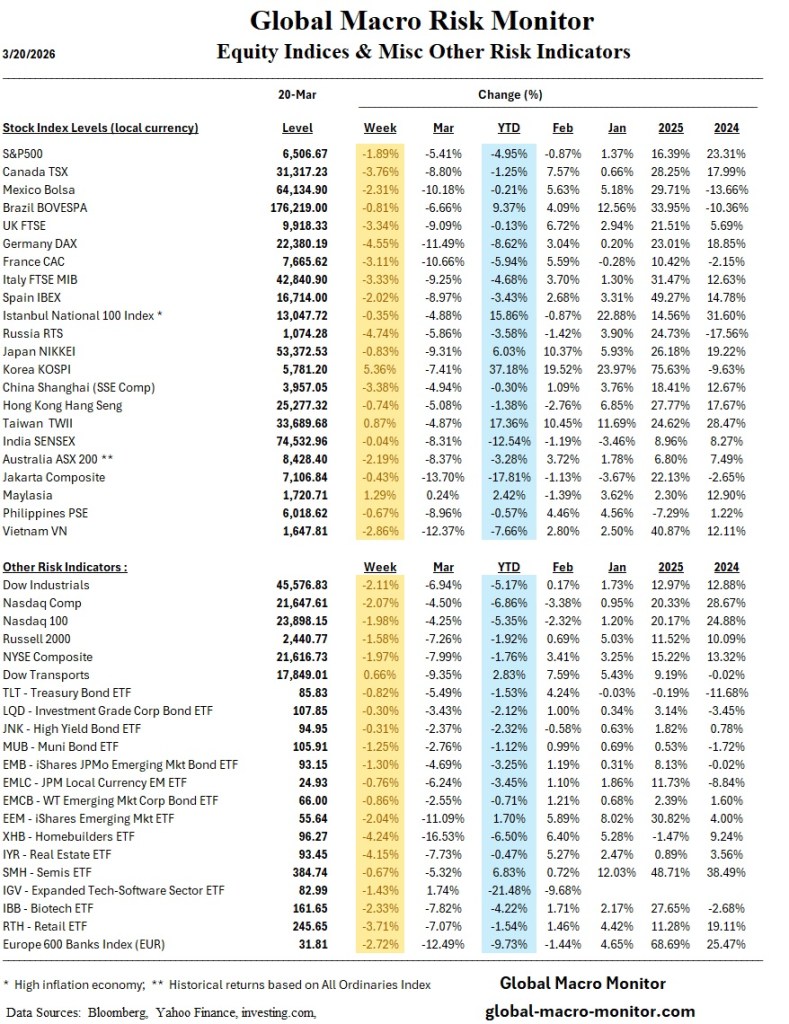
Global Risk Monitor: Week in Review – March 20
Global Macro Monitor· 2026-03-21 22:38
Core Insights - The recent geopolitical tensions, particularly regarding Iran and the Strait of Hormuz, have shifted market dynamics from a "disinflation + cuts" narrative to a "war premium + policy uncertainty" regime, leading to significant adjustments in asset prices [1][2]. Market Dynamics - The Federal Reserve's path has been repriced, with markets now assigning approximately 12% odds of a rate hike in April and over 30% probability by October, indicating a shift from expected rate cuts to potential hikes driven by geopolitical supply shocks impacting inflation expectations [2][9]. - The Brent-WTI spread has widened to around $14, reflecting global supply fragility due to the geopolitical situation, with Brent crude prices acting as a high-frequency signal of geopolitical stress [3][5]. Energy Sector Performance - Energy equities have surged, with the XLE index up 3% for the week and 30% year-to-date, serving as a hedge against geopolitical escalation, while other sectors, particularly rate-sensitive ones like homebuilders and real estate, have underperformed [6][7]. - The spike in Brent crude prices has led to a significant impact on equities, with the S&P 500 dropping nearly 2% and the Nasdaq approaching correction territory, indicating a broader market de-risking under macro stress [6][10]. Central Bank Responses - Central banks, including the Fed, have raised inflation expectations while maintaining a cautious stance on policy changes, indicating a focus on energy-driven inflation risks rather than labor market data [9][14]. - The ECB and BoE have echoed similar concerns, highlighting the tightening of global financial conditions due to the ongoing conflict without any rate hikes [9][14]. Regional Performance - In the U.S., major equity indices experienced broad declines, with the Nasdaq flirting with correction territory, while energy stocks outperformed significantly [12]. - Europe is facing a growth squeeze and inflation shock due to its structural vulnerability to Middle Eastern supply disruptions, leading to a weakening of growth expectations [14]. - The UK is experiencing a worsening trade-off between inflation control and growth stability, exacerbated by geopolitical risks [14]. Geopolitical Impact - The ongoing conflict with Iran has led to the largest supply disruption in global oil market history, with Brent crude prices hovering around $112, and the potential for further price increases if shipping lanes are compromised [15][16]. - The market is currently pricing in a prolonged and uncertain conflict, with persistent inflationary consequences, rather than a clean resolution [15][16].