X推荐算法系统

Search documents
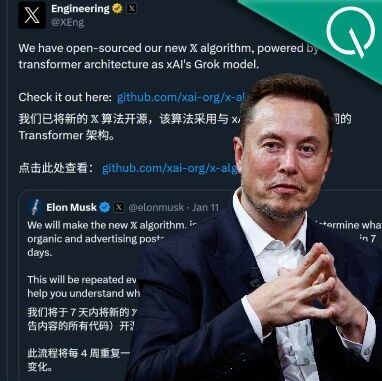
马斯克罕见低头:开源推荐算法,自嘲“很烂”不过未来月更
Sou Hu Cai Jing· 2026-01-21 04:30
Core Viewpoint - GitHub has made Elon Musk's open-source recommendation algorithm system fully visible, which is primarily driven by AI models, marking a significant step towards transparency in social media algorithms [1][2][4]. Group 1: Algorithm Transparency and Design - The open-source file indicates that the algorithm is almost entirely AI-driven, having removed most human-designed features and heuristic rules [2][3]. - The community has reacted positively, praising the transparency that no other platform has achieved [4]. - Musk acknowledged the algorithm's shortcomings, stating it is "dumb" and requires significant improvements, but emphasized the importance of transparency in the development process [5][6]. Group 2: Algorithm Functionality - The recommendation system is based on a Transformer architecture similar to Grok-1, which learns from users' historical interactions to recommend content [10]. - The system constructs a "real-time user profile" by collecting raw user behavior data without pre-set assumptions, allowing the model to learn directly from this data [14][15]. - The algorithm filters content through various modules, including a retrieval module that gathers potentially interesting tweets from both followed and unfollowed accounts [18][20]. Group 3: Key Features of the System - The system operates on five key principles: 1. Purely data-driven, rejecting manual rules [28]. 2. Candidate isolation mechanism for independent scoring [29]. 3. Hash embedding for efficient retrieval [30]. 4. Predicting multiple user behaviors rather than a single score [31]. 5. Modular pipeline design for rapid iteration [32]. Group 4: Criticism and Future Plans - Despite the praise for transparency, the algorithm has been criticized for lacking a time decay mechanism for historical blocking, which could unfairly impact account recommendations [33][35]. - Musk has committed to ongoing transparency, stating that updates will continue to be released every four weeks [39].

马斯克罕见低头:开源𝕏推荐算法,自嘲“很烂”不过未来月更
量子位· 2026-01-21 04:09
Core Viewpoint - GitHub has made Elon Musk's open-source recommendation algorithm system fully visible, which is primarily driven by AI models [1][2] Group 1: Algorithm Transparency and Community Reaction - The open-source announcement has generated significant excitement within the community, with many praising the transparency of the system [2] - Musk acknowledged the algorithm's shortcomings, stating it is "dumb" and requires substantial improvements, but emphasized the importance of transparency in the improvement process [4][5] - Musk has consistently criticized the previous platform's lack of openness and has followed through on his promise to publicly share Twitter's core recommendation algorithm since the acquisition [6][7] Group 2: Algorithm Mechanism - The recommendation system is built on a Transformer architecture similar to Grok-1, which learns from users' historical interactions (likes, replies, retweets) to recommend content [9] - The system begins by identifying the user and their recent activities, aiming to create a "real-time user profile" without pre-set assumptions [12][13] - Two types of user information are collected: Action Sequences (direct interest signals) and Features (long-term attributes) [14] Group 3: Content Filtering and Scoring - The algorithm filters through a vast amount of tweets to select a few thousand potentially relevant ones, using both familiar and external sources [16][17] - The system employs a Hydration module to complete candidate tweet information and a Filtering module to eliminate unwanted content [21][22] - The final scoring is done by a Phoenix ranking model, which predicts various user interactions and assigns scores based on weighted combinations of these predictions [25][26] Group 4: Key Features of the System - The system is purely data-driven, rejecting manual rules and allowing AI models to learn directly from raw user data [33] - It utilizes a candidate isolation mechanism to ensure independent scoring of each piece of content [34] - The algorithm predicts multiple user behaviors rather than providing a single recommendation score [36] - The modular design of the system supports rapid iteration and development [37] Group 5: Acknowledgment of Limitations - Despite the praise for transparency, the algorithm has been criticized for certain flaws, such as the lack of a time decay mechanism for "block" signals, which could negatively impact account recommendations [39][41] - Musk himself acknowledged the algorithm's deficiencies, indicating a commitment to ongoing improvements and updates every four weeks [42][44]