XLF

Search documents
The Big 3: XLF, RKLB, MSFT
Youtube· 2026-02-26 18:00
Group 1: Market Overview - The tech sector is experiencing a trend where stocks are selling off regardless of positive earnings or guidance, indicating a lack of investor enthusiasm for major tech stocks, including those in the AI sector [2][3]. - There is a rotation in market investments, with money not flowing back into AI at the moment, suggesting a shift in investor focus [4][6]. Group 2: Financial Sector Analysis - The financial sector ETF (XLF) is highlighted as a potential investment opportunity, particularly as many financial stocks have sold off due to rumors of a 10% cap on credit rates and tariff impacts [5][6]. - Many financial stocks are down 10-20% from their highs, presenting a low-risk, high-reward entry point for investors [7][8]. - The XLF ETF is trading near key support levels, making it an attractive option for diversification in a volatile market [8][17]. Group 3: Rocket Lab Insights - Rocket Lab has shown significant growth, with a 240% increase over the last 52 weeks, and is involved in launching small satellites and defense contracts [19][21]. - The company reported a 48% year-over-year revenue increase to $155 million, indicating strong financial performance [21][22]. - Technical analysis suggests that Rocket Lab's stock is in an uptrend, with potential resistance levels identified around $100 [23][25]. Group 4: Microsoft Evaluation - Microsoft has faced a decline of 30% from its highs, raising questions about how much further the stock could drop, especially given its strong revenue and earnings performance [34][36]. - The company is seen as a low-risk, high-reward investment opportunity, particularly due to its strong corporate client base and dividend payments [37][38]. - Technical indicators suggest potential support levels around $368 and resistance levels at $396 and $425, with a bullish outlook if these levels are broken [38][39].



Are Odds Improving for a Fed Rate Cut? ETFs to Consider
ZACKS· 2026-02-16 17:05
Core Insights - February has shown increased volatility compared to January, with investors adopting a "sell first, ask questions later" strategy due to AI-driven disruption fears [1] - The U.S. Consumer Price Index (CPI) release provided some relief by easing inflation concerns, leading to expectations that the Federal Reserve may start cutting rates around mid-year [1] Inflation Data - Consumer inflation rose 2.4% year-over-year in January, down from 2.7% in December, returning to its April 2025 level [2] - Core CPI increased 2.5% annually, marking its lowest reading since April 2021, while economists had anticipated both headline and core inflation to be at 2.5% [2] Federal Reserve Rate Expectations - Following the softer-than-expected January inflation data, U.S. interest rate futures increased the probability of a June rate cut to approximately 70%, up from 64% prior to the report [4] - The CME FedWatch tool indicates a 50.7% likelihood of interest rates being lowered to 3.25-3.5% in June 2026, an increase from 44.5% a month earlier, with expectations for July strengthening to an 80.4% likelihood of a rate cut [5] Investment Opportunities in ETFs - Small-cap stocks, which are heavily reliant on external borrowings, could significantly benefit from lower interest rates, enhancing capital availability and allowing for refinancing of existing debt [7] - Suggested small-cap ETFs include iShares Core S&P Small-Cap ETF (IJR), iShares Russell 2000 ETF (IWM), and Vanguard Small Cap ETF (VB), all rated Zacks ETF Rank 2 (Buy) [8] - Financial ETFs are expected to gain from anticipated Fed interest rate cuts, which could lower capital costs for banks and boost loan activity [9] - Recommended financial ETFs include State Street Financial Select Sector SPDR ETF (XLF), Vanguard Financials ETF (VFH), and iShares U.S. Financials ETF (IYF), with XLF and VFH rated Zacks ETF Rank 1 (Strong Buy) [12] - The utilities sector, being capital-intensive, will also benefit from reduced financing costs, making utility ETFs like Utilities Select Sector SPDR Fund (XLU), Vanguard Utilities ETF (VPU), and iShares U.S. Utilities ETF (IDU) attractive options [13][14]

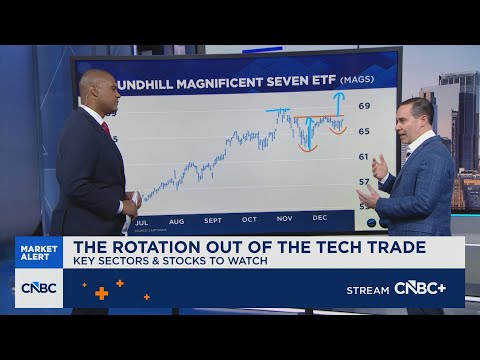
Healthcare and financials lead, says CappThesis’ Frank Cappelleri
CNBC Television· 2025-12-22 13:08
All right, we're gonna start with this MAG7 chart, right. So, take a look at this chart. I I want to get your take on it.Something I think is interesting is that this part right here, we haven't seen the MAG 7 hit a new high since all the way back in October. What are the charts telling us about the path forward. That's right.I think it's telling us that we're about to have that happen. This is what we call handle pattern. It's a bullish formation.What you do is have a breakout, you have a measure move, and ...
How investors can position for President Trump's Fed Chair pick
Youtube· 2025-12-16 20:27
Core Viewpoint - The selection of the next Federal Reserve chair could significantly impact investment strategies, with different approaches recommended depending on whether Kevin Hasset or Kevin Worsh is appointed [1][2]. Group 1: Investment Strategies Based on Fed Chair Candidates - If Kevin Hasset is chosen as the next Fed chair, the recommended investment strategy would focus on small-cap stocks, which typically benefit from economic growth and have a higher proportion of floating rate debt (60% for small caps vs. 30% for large caps) [3][4]. - In contrast, if Kevin Worsh is appointed, the financial sector stocks, particularly the financial sector ETF XLF, would be favored due to his experience and perceived market trust, which could lead to a steepening yield curve benefiting banks [5][6]. Group 2: Alternative Investment Options - For investors uncertain about which candidate will be selected, the Vanguard Dividend Appreciation ETF (VIG) is suggested as a stable option. This ETF includes companies with strong pricing power that can maintain dividends in a lower interest rate environment, providing diversification across sectors such as financials, healthcare, tech, and consumer staples [8]. - This strategy is characterized by lower volatility and expected rewards, but it is anticipated to perform well under both potential scenarios of Fed leadership [9].

Financial Sector Breaks Out as Capital Rotates and Leadership Shifts
Yahoo Finance· 2025-12-15 17:30
Core Viewpoint - The financial sector is experiencing a significant breakout, indicating renewed momentum and potential leadership as capital rotates into financials, with the XLF ETF serving as a key vehicle for investors to gain exposure [5][24]. Group 1: XLF ETF Overview - XLF currently manages approximately $54 billion in assets, has a dividend yield of 1.33%, and a net expense ratio of 0.08%, making it an efficient sector ETF [1]. - The ETF provides broad exposure to the financial sector, tracking the Financial Select Sector Index and including major companies like Berkshire Hathaway, JPMorgan Chase, Visa, Mastercard, and Bank of America [2]. - XLF has seen positive inflows of 2.38% over the past month and 3.76% over the past three months, with a total of $27.9 billion in inflows over the past year, indicating strong institutional confidence [9]. Group 2: Technical Developments - XLF rose 2.37% last week and decisively cleared the $54 resistance level, marking a potential inflection point after a prolonged consolidation [4][8]. - The financial sector has broken out of a multi-month consolidation, signaling improved sentiment and early signs of sector leadership [5][7]. Group 3: Individual Stock Performances - JPMorgan Chase, the second-largest holding in XLF, has a weighting of approximately 10.8% and recently posted Q3 EPS of $5.07, exceeding estimates, with revenue rising 8.8% YOY to $47.12 billion [11][12][13]. - Bank of America, with a weighting of roughly 4.8%, confirmed sector strength by breaking out to fresh 52-week highs, reporting Q3 EPS of $1.06, beating estimates, and a revenue increase of 10.8% YOY [14][16]. - Charles Schwab, with a market capitalization of $171 billion, is positioned for a potential breakout, currently trading less than 3% below its 52-week high, with a Moderate Buy rating from analysts [17][18][19]. - Robinhood has shown exceptional growth, with a YTD increase of 220% and a three-year surge of nearly 1,200%, reporting Q3 EPS of 61 cents and revenue doubling YOY to $1.27 billion [21][22]. Group 4: Market Sentiment and Future Outlook - The financial sector's breakout reflects shifting expectations around interest rates and improving sentiment, suggesting that financials may lead into year-end and beyond [24][25]. - Analysts maintain a favorable outlook on leading financial stocks, indicating that the sector is becoming increasingly relevant for investors [10][24].


Should You Buy Bank Stocks & ETFs for 2026?
Zacks Investment Research· 2025-12-09 20:40
Market Trends & Performance - Big bank stocks have performed strongly this year, with the six largest US banks reporting strong Q3 results exceeding expectations [2][5] - The sixth-largest bank in the US earned approximately $41 billion, a 19% year-over-year increase [3] - Regional banks have underperformed due to higher exposure to commercial real estate and pressured sectors, lacking the tailwinds from trading and investment banking that benefited big banks [6] - Anticipated Federal Reserve rate cuts could further benefit banks, particularly with a steeper yield curve and resilient economy, potentially widening net interest margins and strengthening loan demand [7] ETF Analysis - The Financial Sector SPDR Fund (XLF) is a popular and cheap bank ETF with $54 billion in assets and an expense ratio of 8 basis points, holding S&P 500 financial stocks [8] - Berkshire Hathaway, with a 12% weighting, is a top holding in XLF, but its underperformance has slightly impacted XLF's overall returns [9][10] - The Invesco KBW Bank ETF (KBWB) holds money center banks, regional banks, and thrift institutions, with a higher weighting towards bigger banks, managing $59 billion in assets with a 35 basis points expense ratio [11][12] - The SPDR S&P Regional Banking ETF (KRE) focuses on US regional banks, following an equal weighting scheme with approximately 140 holdings, $37 billion in assets, and a 35 basis points expense ratio [14] Investment Opportunities & Risks - Major banks are leading in AI adoption, reporting measurable cost savings and efficiency gains [5] - Banks are positioned to benefit from lighter regulatory scrutiny [4] - KBWB has shown the best performance, up about 28%, XLF is up about 12%, and KRE is up about 10% year to date [15]

$1.7 trillion-dollar ETF giant State Street says 401(k) market about to face new low-cost challenger
CNBC· 2025-11-07 15:05
Core Insights - The SEC's recent decision to allow fund companies to create ETF share classes of traditional mutual funds is expected to lead to a significant increase in new ETFs in the market, but State Street Investment Management plans to take a different approach by offering mutual fund share classes of its ETF strategies in the U.S. retirement plan market [1][2][11] Group 1: Market Opportunity - State Street identifies the retirement plan market, particularly 401(k) and 403(b) plans, as a $4 trillion opportunity where ETFs have not been traditionally represented as core index fund options [3] - The company aims to leverage its existing $1.7 trillion in ETF assets to create competitive offerings in this market [5][12] Group 2: Competitive Advantages - State Street's scale and low fees provide a competitive edge in offering portfolio options to investors and retirement plan sponsors [4][12] - The "in-kind flows" used in ETF management can lead to lower costs and better performance over time for retirement investors, as large institutions can redeem ETF shares without forcing the sale of investments [6][7] Group 3: Industry Context - The mutual fund industry is expected to rapidly adopt the SEC's new ETF provision, with over 70 fund providers having applications pending [9][10] - The current government shutdown has delayed State Street's plans to introduce ETFs as mutual funds in the retirement market [11] Group 4: Strategic Focus - State Street's strategy is not solely about marketing specific ETF strategies but about creating a structure that integrates the efficiency of ETFs into more markets [16] - The fragmentation in the retirement industry, with various legal wrappers for portfolio strategies, presents a challenge that State Street aims to address [17][18]


Strange SPX Finish
Investorideas.com· 2025-10-21 15:45
Core Insights - The S&P 500 showed a cautious close after a strong opening, indicating potential selling pressure from institutions [1][2] - Earnings reports, particularly from Netflix, are anticipated to influence market sentiment moving forward [2] Market Performance - The S&P 500 continued to rise initially but faced setbacks as market breadth varied across sectors like QQQ, XLF, and HYG [1] - The closing bell saw stocks losing traction, with the ES low of 6,780s acting as a significant resistance level [1] Earnings Impact - The upcoming earnings report from Netflix is viewed as a potential catalyst for market movement, especially after a lackluster performance in the previous session [2] Communication Channels - The company emphasizes the importance of staying updated through various platforms such as Twitter, Telegram, and YouTube for real-time analytics and trading signals [4][5][8]

Final Trades: The Mosaic, the IBIT, and the XLF
Youtube· 2025-10-06 18:01
Group 1 - Bitcoin has experienced a strong performance recently, reaching record highs alongside gold, indicating positive momentum in the cryptocurrency market [1] - The financial sector has seen a stellar quarter for M&A and IPO activity, suggesting that banks are likely to benefit from this trend [1] - Anticipated rate cuts are expected to support loan growth, further enhancing the financial industry's outlook [1] Group 2 - Mosaic is highlighted as a company to watch, with indications of a multi-month breakout in its performance [2]

Worldwide Exchange: ETF Flows Week of September 29
CNBC Television· 2025-10-03 17:34
ETF Market Overview - ETF market net inflows have topped $923 billion this year, on track for another trillion dollar year [1][2] - ETFs are popular due to transparency, tax efficiency, and surpassing other investment vehicles [2] Top ETF Inflows - Top ETF inflows included VGT (Vanguard Information Technology Index Fund), GLD (a gold ETF), and XLF [3] - Investors are interested in gold and technology [4] Crossmark Investments' ETFs - Crossmark launched two ETFs two months ago: large cap growth (CLCG) and large cap value (CLCV) [5] - Investors are moving money from SMAs and mutual funds into ETFs [6] CLCG (Crossmark Large Growth ETF) - CLCG invests in growth stocks with reasonable valuations (price to free cash flow) and high returns on equity profitability [8] - Holdings include some of the "mag seven" and financial stocks [9] CLCV (Crossmark Large Value ETF) - CLCV provides exposure to value stocks, particularly financials, banks, and financial service companies [10][11] - Banks are considered cheap relative to the market, benefiting from deregulation [11] Investment Strategy - A balanced portfolio is recommended, and investors should consider the value ETF to complement overweight growth positions [10][12] - Some investors are allocating 50% to each of the growth and value ETFs [13] - Value is cheap relative to growth, offering a risk-reward opportunity [13]