Workflow
Zinc
icon
Search documents
Riverside Resources and Questcorp Launch Phase 2 Exploration Program at La Union Project, Sonora, Mexico
TMX Newsfile· 2026-04-01 07:05
Core Viewpoint - Riverside Resources Inc. has initiated the Phase 2 exploration program at the La Union Project in Sonora, Mexico, building on the success of the previous Phase 1 drill program which discovered sediment-hosted gold [1][2]. Exploration Program Details - The Phase 2 program is fully funded by Questcorp and involves geological mapping, geochemistry, geophysics, and structural analysis across four main target areas [1][2]. - An expanded aeromagnetic drone survey will be conducted concurrently to enhance the Phase 1 geophysical dataset, aiding in drill targeting for a planned drilling program in early summer 2026 [3]. Target Areas and Mineralization Styles - The Union Project features multiple district-scale target areas, focusing on three distinct mineralization styles: carbonate replacement deposit (CRD), sediment-hosted gold in calcareous siltstones, and structurally controlled gold mineralization within quartzite [6]. - Follow-up work will include further investigation of sediment-hosted gold targets identified during Phase 1, particularly at the Union Mine and Famosa North area [7]. Recent Developments - The Famosa area mineral concessions have been consolidated into Riverside's land package, enhancing the foundation for the Phase 2 work program [5]. - The company has secured permits, site access, and selected both a drill contractor and geophysical service provider, ensuring logistics are in place for the summer 2026 drilling program [8]. Company Overview - Riverside Resources Inc. is a well-funded exploration company with over C$5,000,000 in cash, no debt, and a strong portfolio of gold-silver, copper, and REE assets in North America [11].
Questcorp Mining and Riverside Resources Commence Phase 2 Exploration Program at the La Union Project, Sonora, Mexico
TMX Newsfile· 2026-04-01 07:05
Core Viewpoint - Questcorp Mining Inc. and Riverside Resources Inc. have initiated the Phase 2 exploration program at the La Union Project in Sonora, Mexico, building on the success of the previous Phase 1 drill program [1][2]. Group 1: Phase 2 Exploration Program - The Phase 2 program aims to refine existing drill targets and generate new ones through geological mapping, geochemistry, geophysics, and structural analysis [3][8]. - An expanded aeromagnetic drone survey will run concurrently to enhance geological interpretation and refine drill targets ahead of the planned drilling in early summer 2026 [3]. Group 2: Results from Phase 1 - The Phase 1 drill program included a high-grade 30-meter chip-channel interval at the Union Mine grading 20.2 g/t gold and 226 g/t silver, and a new sediment-hosted gold discovery at Luis Hill returning 42 meters grading 0.3 g/t gold [7][8]. - The results from Phase 1 have established multiple well-defined targets for further exploration [4]. Group 3: Project Details and Partnerships - The La Union Project is a district-scale exploration project with historical mining areas and multiple targets associated with gold, silver, zinc, and lead mineralization [11]. - Questcorp holds an option to earn a 100% interest in the project, while Riverside holds approximately 9.9% equity interest in Questcorp, which may increase to 19.9% upon completion of the earn-in [11]. Group 4: Future Plans and Positioning - With permits secured, site access established, and contractors engaged, the company is well-positioned to advance to the next fully funded drilling phase [9]. - The combination of CRD-style mineralization and emerging sediment-hosted gold potential at Luis Hill indicates the project's scale and versatility [2].
First Majestic Announces 2025 Mineral Reserve and Mineral Resource Estimates
TMX Newsfile· 2026-03-31 21:15
Core Viewpoint - First Majestic Silver Corp. reported significant growth in its mineral reserves and resources for 2025, driven by successful exploration activities and favorable metal price assumptions, particularly at its Santa Elena and Jerritt Canyon mines [1][2][4]. Group 1: Mineral Resource and Reserve Growth - In 2025, First Majestic achieved a 4% year-over-year increase in silver-equivalent ounces, with a 16% increase in silver Proven and Probable Mineral Reserves [2][8]. - Measured and Indicated (M&I) Mineral Resources increased by 50%, totaling 652.8 million AgEq ounces, while Inferred Mineral Resources rose by 69% to 592.3 million AgEq ounces [6][12]. - The growth in contained AgEq ounces was largely attributed to successful exploration and updated metal price assumptions, particularly at Santa Elena and Jerritt Canyon [2][4]. Group 2: Key Discoveries and Exploration Success - The discovery of the Santo Niño silver-gold deposit at Santa Elena added 27.4 million silver-equivalent ounces, including 9.0 million ounces of silver and 210,000 ounces of gold [3][6]. - Continued exploration at the Navidad vein system expanded Inferred Resources to 63.4 million silver-equivalent ounces, comprising 18.4 million silver ounces and 460,000 gold ounces [3][6]. - Jerritt Canyon reported a substantial increase in gold resources, with a 116% year-over-year increase in gold ounces, driven by higher gold price assumptions and lower cut-off grades [6][9]. Group 3: Operational Highlights - A total of 264,364 meters of exploration drilling were completed in 2025, addressing life-of-mine opportunities across First Majestic's mines [8]. - Proven and Probable Mineral Reserves at the four operating mines in Mexico totaled 184.8 million AgEq ounces, reflecting a 4% year-over-year increase [11][12]. - The resource growth at Los Gatos was notable, with Inferred AgEq ounces increasing by 59% year-over-year, positioning the operation for potential life-of-mine extension [10][12].
Newmont Announces First Quarter 2026 Results Conference Call
Businesswire· 2026-03-31 20:15
Core Viewpoint - Newmont Corporation will release its first quarter 2026 results on April 23, 2026, followed by a conference call to discuss the results [1][2] Company Overview - Newmont is the world's leading gold company and also produces copper, zinc, lead, and silver, with operations in favorable mining jurisdictions across Africa, Australia, Latin America, North America, and Papua New Guinea [3] - The company is the only gold producer listed in the S&P 500 Index and is recognized for its strong environmental, social, and governance practices [3] - Founded in 1921, Newmont has been publicly traded since 1925 and is known for its value creation through robust safety standards and technical expertise [3] Upcoming Events - A conference call to discuss the first quarter 2026 results will take place at 5:30 PM Eastern Daylight Time on April 23, 2026, with a replay available on the company's website [1][2]
Drilling Resumes on Berrigan Zinc, Gold, Silver Property under Option from Chibougamau Independent Mines
Globenewswire· 2026-03-31 17:20
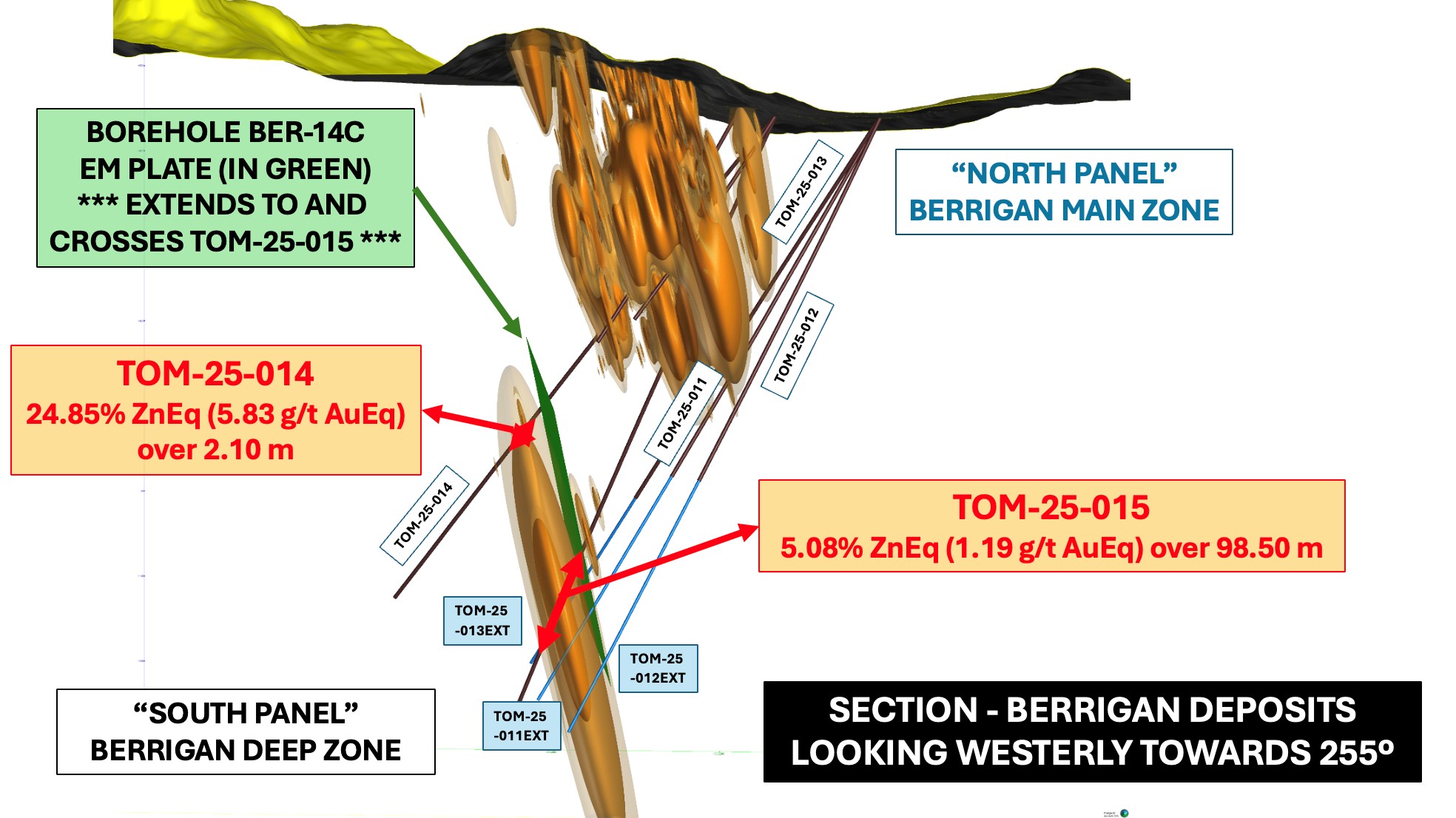
Core Insights - Chibougamau Independent Mines Inc. announces that TomaGold Corporation has initiated a drill program to extend five recent drill holes to explore a newly discovered zinc/gold/silver zone beneath the Berrigan mineralized zone [1][2] Drilling Program Details - The drill hole extensions aim to intersect the horizon where previous drill hole TOM-25-015 reported 5.08% Zn Eq (1.19 g/t Au Eq) over 98.50 meters, including 23.20% Zn Eq (5.44 g/t Au Eq) over 4.90 meters [2][4] - The Phase 2 drilling program is set to cover 1,500 meters targeting the newly discovered Berrigan Deep Zone [9][10] Previous Drilling Results - Significant mineralized intersections from previous drilling phases include: - Hole TOM-25-009: 5.82% Zn Eq over 48.05 meters, with notable intervals such as 33.97% Zn Eq over 2.90 meters [3] - Hole TOM-25-010: 8.03% Zn Eq over 4.35 meters, including 11.43% Zn Eq over 6.25 meters [3] - Hole TOM-25-011: 1.81% Zn Eq over 18.50 meters, with a peak of 16.12% Zn Eq over 2.00 meters [3] Summary of Mineralization - The Berrigan property is part of a larger land package under option from Chibougamau Independent Mines, with previous drill results indicating substantial mineralization potential [2][4]
Drilling Resumes on Berrigan Zinc, Gold, Silver Property under Option from Chibougamau Independent Mines
Globenewswire· 2026-03-31 17:20
Core Viewpoint - Chibougamau Independent Mines Inc. announces that TomaGold Corporation has initiated a drill program to extend five recent drill holes to explore a newly discovered zinc/gold/silver zone beneath the Berrigan mineralized zone [1][2]. Group 1: Drill Program Details - TomaGold's drill program aims to extend five drill holes to intersect the newly discovered mineralized zone, which was previously indicated by drill hole TOM-25-015 that intersected 5.08% Zn Eq over 98.50 meters, including 23.20% Zn Eq over 4.90 meters [3][5]. - The drilling program is part of a 1,500-meter Phase 2 initiative targeting the Berrigan Deep Zone [8]. Group 2: Previous Drilling Results - The Phase 1 drilling results at the Berrigan Mine project show significant mineralized intersections, with notable results including: - Hole TOM-25-009: 5.82% Zn Eq over 48.05 meters, with a peak of 33.97% Zn Eq over 2.90 meters [4]. - Hole TOM-25-010: 8.03% Zn Eq over 4.35 meters, with a peak of 11.43% Zn Eq over 6.25 meters [4]. - Hole TOM-25-014: 24.85% Zn Eq over 2.10 meters, with a peak of 36.34% Zn Eq over 1.40 meters [4]. - Hole TOM-25-015 reported 5.08% Zn Eq over 98.50 meters, with significant intervals including 23.20% Zn Eq over 4.90 meters [5]. Group 3: Technical Calculations - ZnEq and AuEq values are calculated using standard parameters, with AuEq based on prices of US$4,150/oz for gold, US$51.34/oz for silver, US$5.023/lb for copper, and US$1.392/lb for zinc [9]. - The calculations apply metallurgical recovery factors of 95% for zinc, 85% for gold and silver, and 90% for copper, based on a metallurgical report from February 2002 [9].
USAR vs. TECK: Which Mining Stock Deserves a Spot in Your Portfolio?
ZACKS· 2026-03-31 17:01
Core Insights - USA Rare Earth, Inc. (USAR) and Teck Resources Limited (TECK) are significant players in the mining industry, focusing on minerals essential for electrification and clean energy technologies [1][2] - Both companies are capital-intensive, facing long development cycles and regulatory challenges, but are positioned for growth due to rising demand for minerals used in electric vehicles and renewable energy [2] Summary of USA Rare Earth (USAR) - USAR is advancing its Stillwater magnet manufacturing facility in Oklahoma, which will produce Neodymium Iron Boron (NdFeB) magnets for various high-growth applications [3] - The Stillwater facility is expected to be one of the first large-scale magnet plants in the U.S., supporting the domestic rare earth supply chain [3] - Key equipment installation and preparations for commissioning are underway, with operations expected to begin in early 2026 [4] - The company completed a $1.5 billion PIPE financing in January 2026 to upgrade the Stillwater plant and expand production capacity to approximately 1,200 metric tons of NdFeB magnets [5] - USAR acquired Less Common Metals in November 2025 to secure critical metal and alloy feedstock for the Stillwater plant [6] - A non-binding Letter of Intent with the U.S. Department of Commerce includes $277 million in proposed federal funding and a $1.3 billion senior secured loan under the CHIPS Act, totaling $1.6 billion [7] - Despite advancements, USAR has not generated revenues and has faced rising operational expenses, leading to a loss of 19 cents per share in Q4 2025 [8][9] Summary of Teck Resources (TECK) - Teck Resources is undergoing a strategic transformation to focus on copper and critical minerals, planning a merger with Anglo American to enhance copper output [10][11] - The merger will create a leading copper producer with over 70% of its portfolio in copper, projecting annual copper production to rise from 1.2 million tons to 1.35 million tons by 2027 [11] - The merger is expected to generate approximately $800 million in annual pre-tax synergies within four years, with significant efficiencies achieved early on [12] - Teck's Highland Valley Mine Life Extension is projected to extend the mine's life to 2046, with expected average annual copper production of 132,000 tons [13] - However, production at Quebrada Blanca has decreased by 8.6% year-over-year due to ongoing development issues, and cash unit costs for zinc are expected to rise in 2026 [14] Financial Performance and Valuation - The Zacks Consensus Estimate for USAR's 2026 bottom line is a loss of 24 cents per share, with a projected loss of 66 cents per share for 2027 [15] - In contrast, TECK's 2026 bottom line is estimated at $2.19 per share, with a 2027 estimate of $2.31 per share [16] - Over the past six months, USAR's shares have declined by 22.7%, while TECK's stock has gained 9.5% [18] - USAR is trading at a forward price-to-earnings ratio of negative 41.57X, while TECK's forward earnings multiple is 21.82X [20] Final Assessment - USAR's Stillwater facility positions it well for long-term demand for NdFeB magnets, but the company continues to face challenges with rising costs and no revenue generation [22] - TECK's diversified asset base and strong earnings outlook make it a more attractive investment compared to USAR, with the merger expected to enhance its market position [23][24]
Americas Gold and Silver Reports Loss in 2025, Revenues Up Y/Y
ZACKS· 2026-03-31 15:50
Core Insights - Americas Gold and Silver (USAS) reported an adjusted net loss of $35.2 million in 2025, which is wider than the adjusted loss of $33.7 million in the previous year, primarily due to increased operational spending as part of a strategic investment to grow production at Galena [1][9] - The company experienced a net loss of $87.4 million in 2025, compared to a net loss of $48.9 million in 2024, influenced by higher costs in various areas despite increased revenue [2] - Revenue for 2025 reached approximately $118 million, marking an 18% increase from the prior year, driven by a 39% rise in realized silver prices [4][5] Financial Performance - The adjusted loss per share was 13 cents, consistent with the Zacks Consensus Estimate, compared to a loss of 32 cents in the prior year [1] - The company posted a loss per share of 33 cents in 2025, an improvement from the loss of 46 cents per share in 2024 [3] - Attributable cash costs rose to $25.69 per ounce of silver produced in 2025, up from $17.41 per ounce in 2024, while all-in sustaining costs increased to $32.95 per ounce from $28.13 [7] Production and Revenue Drivers - Consolidated silver production was approximately 2.65 million ounces in 2025, up from 1.7 million ounces the previous year, with the Galena Complex maintaining steady production and the Cosalá Operations seeing a 44% increase [6] - The revenue growth was partly attributed to pre-production revenues from the EC120 Project, totaling $45 million during the period [5] Strategic Initiatives and Outlook - The company has taken significant steps to enhance future performance, including acquiring the Crescent Mine and securing $132 million in financing [8] - Silver production is projected to be between 3.2 and 3.6 million ounces in 2026, with all-in sustaining costs expected to range from $30 to $35 per ounce sold [10] Cash Position and Market Performance - At the end of 2025, the company had cash and cash equivalents of $129.8 million and working capital of $67.5 million, having used $3.95 million in cash for operating activities during the year [11] - USAS shares have surged 273.6% over the past year, significantly outperforming the industry growth of 37.9% [12]
Nortec Completes $605,000 Non-Brokered Private Placement and Announces $57,500 Debt Settlement
TMX Newsfile· 2026-03-31 10:00
Group 1: Private Placement Offering - The company completed a non-brokered private placement offering, consisting of 11,100,000 non-flow-through units at a price of C$0.05 per unit, generating gross proceeds of C$555,000, and 769,231 flow-through units at a price of C$0.065 per unit, generating gross proceeds of C$50,000 [1][2] - The net proceeds from the offering will be used for working capital and general corporate purposes, while the net proceeds from the flow-through offering are intended for qualifying exploration activities in Ontario, Canada [2] Group 2: Debt Settlement - The company entered into a debt settlement agreement to settle an aggregate of CAD$57,500 in debt by issuing 1,150,000 common shares at a deemed price of CAD$0.05 per share [5][6] - All securities issued under the debt settlement will be subject to a four-month and one-day hold period from the date of issuance [6] Group 3: Acquisition of Barker Bay Gold Property - The company received conditional approval for the acquisition of the Barker Bay Gold Property from the TSX Venture Exchange and expects to close the transaction in April 2026 [7][9] - The acquisition is part of the company's strategy to enhance its portfolio in the gold sector [8] Group 4: Company Overview - Nortec Minerals Corp. is focused on identifying gold and copper properties with high discovery potential and advancing those projects to create shareholder value [8] - The company holds 100% interests in two exploration stage critical mineral projects in Ontario and a 16.4% interest in the Tammela Gold project in Finland [8]
紫金天风期货锌季报
1. Report Industry Investment Rating No relevant content provided. 2. Core Viewpoints of the Report - The industry operation often experiences a temporary deterioration before improvement. The short - term global zinc demand forecast is moderately lowered, but in the medium - to - long - term, the impact of high oil prices on the overseas zinc supply will be significantly greater than the suppression of domestic demand [3]. - The zinc price is approaching the domestic zinc smelting break - even point. Production cuts by major mines such as OZ may lead to a substantial risk of ore shortage, and there may be unexpected production cuts in the second quarter [3]. - The views in the annual report have been verified: the interference rate at the ore end has increased, some ore increments cannot smoothly enter the market, and the复产 progress of overseas smelters has been postponed [3]. - The annual report expectations have been adjusted: the Middle East geopolitical conflict may reshape the global zinc product trade flow, with ore sources concentrated in China and China's export advantage continuously expanding [3]. - The core contradiction in the current zinc market may have shifted from "demand recovery" to "supply transfer and export premium under the reconstruction of the supply chain" [3]. - Trading strategies: - Unilateral: The forecast for the annual high of the zinc price is lowered, but the zinc price is still expected to perform well in the second quarter. Even if the Middle East conflict escalates further and the global "recession" expectation materializes, the zinc price will show a resistant decline rather than a "collapse - like decline" due to the cost support from the smelting end [3]. - Inter - period arbitrage: In the peak season and with the risk of production cuts, pay attention to the positive spread arbitrage opportunities for Shanghai zinc in the second quarter [3]. - Inter - market arbitrage: Given the uncertainty of trade flow changes in the current internal - external price difference, it is recommended to carefully evaluate the applicability of this strategy [3]. - Inter - commodity arbitrage: The zinc - aluminum price ratio has reached a historical low, and short - term regression opportunities should be noted [3]. 3. Summary According to the Table of Contents Market Focus - At the macro level, since the war between the US and Iran, the Middle East situation has triggered an energy crisis, driving up oil prices and costs. High interest rates have suppressed growth expectations, leading to a tug - of - war between "stagflation" and "recession" expectations. The core logic of the commodity market has shifted from a single "global recession trade" to "deep differentiation under multiple narratives" [5]. - The pricing power of ferrous metals (steel) lies within China, trading on the peak - season demand in China's "Golden March and Silver April" and cost support. Non - ferrous metals are dominated by the game between global macro expectations and geopolitical supply shocks. Chemical products are essentially processed from crude oil, trading on cost transmission. Agricultural products are affected by independent climate cycles and planting areas, and are basically independent of the macro logic of industrial products [5]. - Since the conflict between the US and Iran broke out on February 28, 2026, the market's expectations have changed several times. As of March 19, the market has shifted from worrying about "stagflation" to "recession", and non - ferrous metals have fallen panic - stricken [6]. - From the Polymarket trading data, the market's expectations for the US - Iran cease - fire and the US recession can be observed. As of March 21, the probability of a cease - fire in June has dropped to 50%, and the probability of a US recession within the year is 36%. The current market trading main line is: soaring oil prices → rising inflation expectations → hindered Fed rate cuts (or even rate hikes) → slowing economic growth. There are three possible paths to refute "stagflation" [8]. Industrial Focus Ore End - Many overseas mining companies have significantly lowered their production guidance. The expected overseas zinc ore increment in 2026 is sharply reduced to 24,000 tons, while the domestic expectation remains unchanged. The significant reduction in overseas mine production and the circulation problems of major domestic ore increments may lead to a substantial ore shortage for domestic smelters in the second quarter [17][19]. - The cash cost structure of zinc mines is different from that of copper mines. The energy cost accounts for a relatively moderate proportion in zinc mines, and the TC and transportation costs are the largest cost items. Zinc mines are less sensitive to energy price fluctuations than copper mines [22]. Smelting End - European zinc smelters have been operating at a low level due to power supply shortages and high costs in 2025. Currently, their smelting profits are still in the red. The power cost accounts for 50% - 70% of the total cost. The recent sharp rise in electricity prices in European countries may delay the复产 of European zinc smelters in 2026 or even lead to further production cuts, resulting in a "chronic low - operation" pattern [25][26]. - As of now, 6 European smelters with a total capacity of 924,000 tons (about 7% of the global zinc ingot production) have unclear electricity price agreements. The risk of production cuts in Belgian and French smelters is relatively high [28]. - The proposed Asian zinc concentrate Benchmark TC in 2026 is 85 US dollars per dry ton, with two key terms adjusted. However, the probability of this extreme clause being implemented is low because the smelting end has limited tolerance for the terms, and the supply of raw materials for Asian smelters is expected to be looser [30]. Demand - The consumption structure of zinc terminals is changing. The demand proportion of the real estate sector is decreasing, while that of the new economy is increasing. Due to the significant increase in oil prices, the demand for the automotive sector (especially fuel - powered vehicles) will be affected first, followed by machinery and equipment manufacturing, traditional infrastructure, real estate, and home appliances. The demand for photovoltaics, wind power, and UHV will benefit from the substitution effect. The annual zinc market balance sheet is moderately adjusted, and the domestic terminal demand growth rate forecast is lowered by 0.23 percentage points to 1.40% [31][32]. - In 2025, China's galvanized sheet exports increased by 12.82% year - on - year. Although there are still profit - pressure and trade frictions, the core position of galvanized steel in steel exports is stable. In the long - term, if oil prices remain stable at around 80 US dollars per barrel, China's energy security, low - cost, and full - industrial - chain advantages in the zinc downstream will be re - evaluated globally, and overseas orders are expected to return on a large scale [35]. - The zinc demand growth rates of some overseas countries are lowered. The overall overseas zinc demand growth rate in 2026 is lowered by 1.1 percentage points to 0.7% [36]. Balance Sheet Overview - From the perspective of element circulation, the supply - demand balance sheets of zinc ore, primary zinc, recycled zinc, refined zinc, and zinc elements are constructed and quantitatively calculated [40]. - By analyzing monthly data, it is predicted that the global refined zinc demand growth rate will be slower than the supply growth rate in the first half of 2026, and the zinc price may face downward pressure after the spring market. In the second quarter, the zinc price is expected to rebound strongly due to the increasing risk of production cuts in the domestic zinc smelting end and the low base of zinc demand in the second quarter of last year [45]. - By observing the year - on - year growth rates of supply and demand, it is found that the overseas zinc element dynamic balance is most closely related to the zinc price. In 2026, the overseas terminal demand growth rate is expected to exceed the supply growth rate, so the zinc price center is expected to rise [50]. - In 2026, the global zinc ore balance is expected to be slightly in surplus by 57,200 tons, with the domestic supply increasing by 100,000 tons and the overseas supply increasing by 190,000 tons. The global smelting demand (including losses) will increase by 200,000 tons, mainly from China. The zinc processing fee (TC) is expected to rise slightly, and the operating pressure of domestic zinc smelters will be relieved [52]. - The global primary zinc supply has been in short supply for a long time. The shortage is filled by recycled refined zinc. Based on the prediction of the 2026 domestic primary zinc balance, the zinc price center is likely to rise [56]. - In the overseas recycled zinc market, the supply of high - quality raw materials is in short supply. In the domestic market, the production of recycled zinc elements is expected to grow by about 2.36% in 2026, but the supply of recycled raw materials is limited [57][58]. - After adjusting the data for 2025 and 2026, the global refined zinc balance has changed from surplus to a tight balance in 2025, and this tight balance will continue in 2026. In 2026, the global refined zinc supply growth rate is 1.82%, and the demand growth rate is 1.85%. The domestic supply growth rate is 3.26%, and the demand growth rate is 3.04% [60][61]. - By analyzing the difference between the zinc consumption of the processing end and the terminal, it is expected that the export of domestic zinc primary processing products will increase significantly in 2026, driving the domestic zinc element supply - demand to maintain a tight balance. The overseas zinc primary processing sector may be in a relatively surplus state [63]. Structural Opportunities - According to the monthly supply - demand balance sheet, the zinc market may experience accelerated inventory reduction in the second quarter of 2026. Due to the low zinc price, the expected production cuts by smelters, and the support of the peak - consumption season, the zinc monthly spread is expected to strengthen, and attention should be paid to the positive spread arbitrage opportunities [67]. - The current "loose domestic and tight overseas" supply - demand differentiation in the zinc market has been fully priced. The Middle East geopolitical situation may impact overseas zinc demand, and China's zinc downstream industry advantages will be re - evaluated globally. In the short - term, it is recommended to avoid internal - external positive spread arbitrage [70]. - In the short - term, attention should be paid to the structural opportunity of the zinc - aluminum price ratio repair. Recently, the zinc - aluminum price ratio has dropped to a 15 - year low. After the relevant expectations are realized, the ratio is expected to rebound. In the long - term, the zinc - aluminum price ratio will show a downward trend [73]. Supply - Demand Data Ore End - In January 2026, the global zinc ore production was 1.0104 million tons, a year - on - year increase of 4.67% or 45,000 tons. From January to February 2026, China's zinc concentrate production was 438,100 metal tons, a cumulative year - on - year increase of 9.96% or 39,700 metal tons. It is expected that the domestic zinc concentrate production will increase by 270,000 tons, the overseas production will increase by 24,000 tons, and the global production will increase by 294,000 tons in 2026, a year - on - year increase of 2.52% [77]. - From January to February 2026, China's cumulative zinc concentrate imports were 1.0088 million physical tons, a cumulative year - on - year increase of 17.53%. The top five import sources were Australia, Peru, Russia, Congo, and South Africa [80]. Smelting End - In January 2026, the global zinc ingot production was 1.1564 million tons, a year - on - year increase of 1.68% or 19,100 tons. From January to February 2026, China's primary zinc production was 930,500 tons, a cumulative year - on - year increase of 11.64% or 97,000 tons, and the recycled zinc production was 102,400 tons, a cumulative year - on - year increase of 20.75% or 17,600 tons. It is expected that the global refined zinc production will increase by 230,000 tons in 2026, with a year - on - year growth rate of 1.82% [84][86]. - From January to February 2026, China's net imports of refined zinc were 22,700 tons, a cumulative year - on - year decrease of 66.64%. It is expected that the net imports of zinc ingots will recover significantly in the second half of 2026 [89].