codecs

Search documents
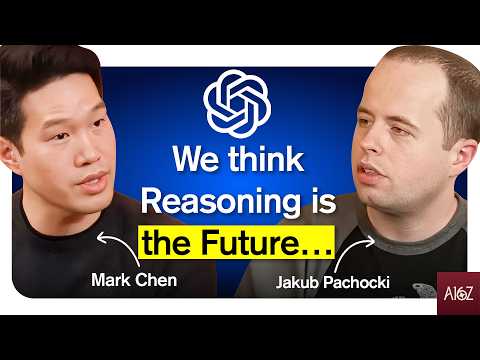
From Vibe Coding to Vibe Researching: OpenAI’s Mark Chen and Jakub Pachocki
a16z· 2025-09-25 13:00
Research & Development Focus - OpenAI is targeting the production of an automated researcher to automate the discovery of new ideas, with a focus on economically relevant advancements [1][3] - The company is extending the reasoning horizon of models, aiming for them to autonomously operate for longer periods, measured by performance in math and programming competitions [3] - OpenAI is working on improving the ability of models to handle more difficult and messy real-world coding environments, focusing on style, proactivity, and latency [12][13] Model Capabilities & Advancements - GPT-5 aims to bring reasoning into the mainstream, improving upon previous models like O3 by delivering reasoning and more agentic behavior by default [1] - The company observed significant progress in models' ability to solve hard science problems, with instances of discovering non-trivial new mathematics [1] - Reinforcement Learning (RL) continues to be a versatile method for continuous improvements, especially when combined with natural language modeling [4][5] Talent & Culture - OpenAI emphasizes fundamental research and innovation, discouraging copying and fostering a culture where researchers are inspired to discover new things [35][36] - The company looks for individuals who have solved hard problems in any field, possessing strong technical fundamentals and the intent to work on ambitious challenges [40] - OpenAI protects fundamental research by delineating researchers focused on algorithmic advances from those focused on product, ensuring space for long-term research questions [46][57] Resource Allocation & Strategy - OpenAI prioritizes core algorithmic advances over product research in compute allocation, but remains flexible to adapt to changing needs [59] - The company believes compute remains a critical resource for advancing AI, not expecting to be data-constrained anytime soon [62][63] - OpenAI acts from a place of strong belief in its long-term research program, not tying it too closely to short-term product reception [70]

Cirrus Logic (CRUS) Q1 EPS Jumps 35%
The Motley Fool· 2025-08-06 10:08
Core Insights - Cirrus Logic reported strong fiscal Q1 results, with non-GAAP earnings per share of $1.51 and GAAP revenue of $407.3 million, both exceeding Wall Street expectations [1][5][9] Financial Performance - Non-GAAP EPS of $1.51 surpassed the estimate of $1.01, reflecting a year-over-year increase of 34.8% from $1.12 in Q1 FY25 [2] - GAAP revenue reached $407.3 million, an 8.9% increase from $374.0 million in Q1 FY25 [2] - Gross margin improved to 52.6%, up 2.0 percentage points from 50.6% in the previous year [2][8] - Free cash flow surged to $113.4 million, a significant increase of 1,961.8% from $5.5 million in Q1 FY25 [2] Business Segments - Revenue from audio products was $240.0 million, up from $219.0 million in Q1 FY25, while high-performance mixed-signal chip sales reached $167.2 million [6] - The company is diversifying its revenue streams, with expectations for laptop market revenue to double in FY26 compared to FY25 [7] - New product offerings include high-performance digital-to-analog converters and advanced audio codecs aimed at professional audio and automotive systems [7] Customer Concentration and Strategy - Cirrus Logic's revenue is heavily reliant on Apple, which accounted for approximately 89% of annual net sales in FY25 [4] - The company focuses on sustained R&D investment to maintain its competitive edge in audio innovation and expand into new markets [4] Future Outlook - Management forecasts Q2 FY26 revenue between $510 million and $570 million, indicating strong sequential growth [9] - Gross margin is expected to remain stable at 51% to 53% for Q2 FY26, with projected non-GAAP operating expenses of $131 million to $137 million [9] - The company aims to reduce its reliance on Apple, with general market revenue potentially reaching 10% of total sales in the future [10]